

604
13 Electromagnetism I
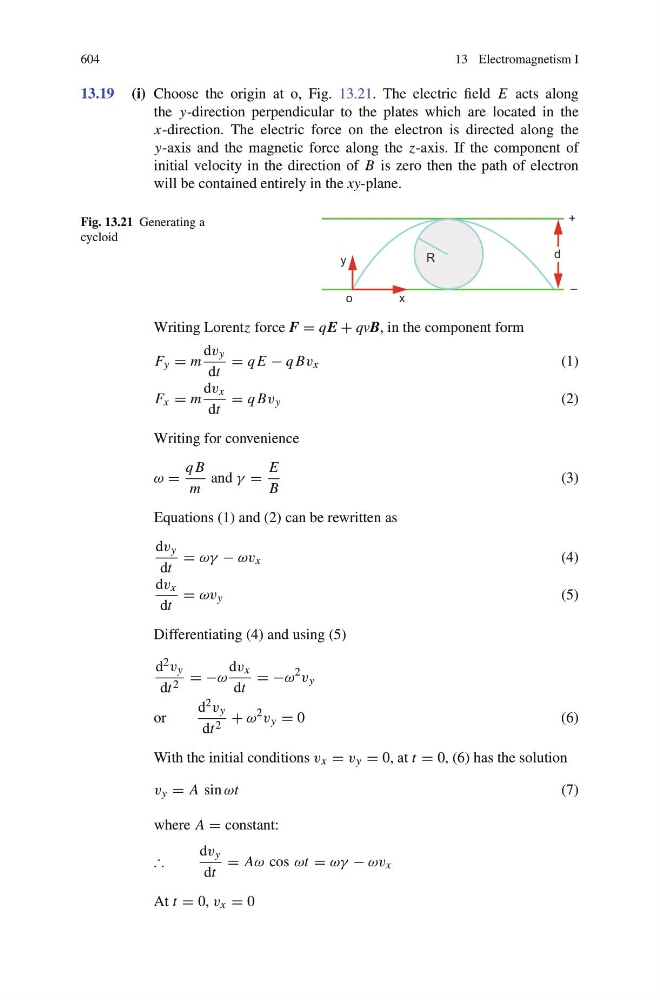
13.19 (i) Choose the origin at o, Fig. 13.21. The electric field E acts along
the y-direction perpendicular to the plates which are located in the
x-direction. The electric force on the electron is directed along the
y-axis and the magnetic force along the z-axis. If the component of
initial velocity in the direction of B is zero then the path of electron
will be contained entirely in the xy-plane.
Fig. 13.21 Generating a
cycloid
Writing Lorentz force F = qE + qvB, in the component form
F y = m
dv y
dt
= q E − q Bv x
(1)
F x = m
dv x
dt
= q Bv y
(2)
Writing for convenience
ω =
q B
m
and γ =
E
B
(3)
Equations (1) and (2) can be rewritten as
dv y
dt
= ωγ − ωv x
(4)
dv x
dt
= ωv y
(5)
Differentiating (4) and using (5)
d 2 v y
dt 2 = −ω
dv x
dt
= −ω
2
v y
or
d 2 v y
dt 2 + ω
2
v y = 0
( 6 )
With the initial conditions v x = v y = 0, at t = 0, (6) has the solution
v y = A sin ωt
(7)
where A = constant:
∴
dv y
dt
= Aω cos ωt = ωγ − ωv x
At t = 0, v x = 0