

13.3 Solutions
603
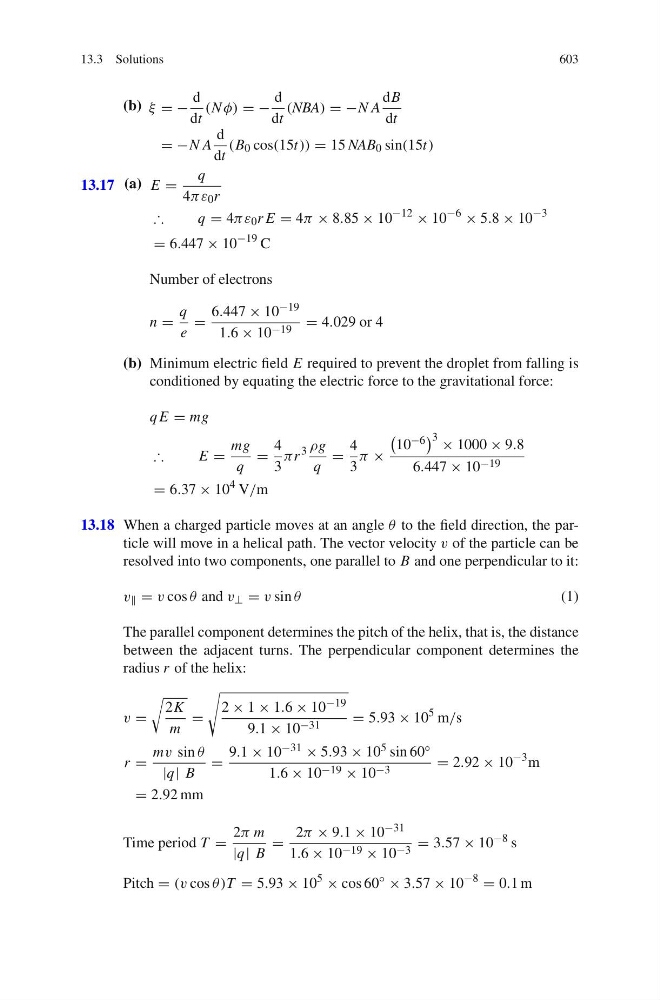
(b) ξ = −
d
dt
(N φ) = −
d
dt
(NBA) = −N A
dB
dt
= −N A
d
dt
(B 0 cos(15t)) = 15 NAB 0 sin(15t)
13.17 (a) E =
q
4πε 0 r
∴
q = 4πε 0 r E = 4π × 8.85 × 10
−12
× 10
−6
× 5.8 × 10
−3
= 6.447 × 10
−19 C
Number of electrons
n =
q
e
=
6.447 × 10 −19
1.6 × 10 −19 = 4.029 or 4
(b) Minimum electric field E required to prevent the droplet from falling is
conditioned by equating the electric force to the gravitational force:
q E = mg
∴
E =
mg
q
=
4
3
πr
3 ρg
q
=
4
3
π ×
10 −6 3 × 1000 × 9.8
6.447 × 10 −19
= 6.37 × 10
4 V/m
13.18 When a charged particle moves at an angle θ to the field direction, the particle will move in a helical path. The vector velocity v of the particle can be
resolved into two components, one parallel to B and one perpendicular to it:
v = v cos θ and v ⊥ = v sin θ
(1)
The parallel component determines the pitch of the helix, that is, the distance
between the adjacent turns. The perpendicular component determines the
radius r of the helix:
v =
2K
m
=
2 × 1 × 1.6 × 10 −19
9.1 × 10 −31
= 5.93 × 10
5 m/s
r =
mv sin θ
|q| B
=
9.1 × 10 −31 × 5.93 × 10 5 sin 60 ◦
1.6 × 10 −19 × 10 −3
= 2.92 × 10
−3 m
= 2.92 mm
Time period T =
2π m
|q| B
=
2π × 9.1 × 10 −31
1.6 × 10 −19 × 10 −3 = 3.57 × 10 −8 s
Pitch = (v cos θ)T = 5.93 × 10
5
× cos 60
◦
× 3.57 × 10
−8
= 0.1 m