

12.3 Solutions
567
(12.17)
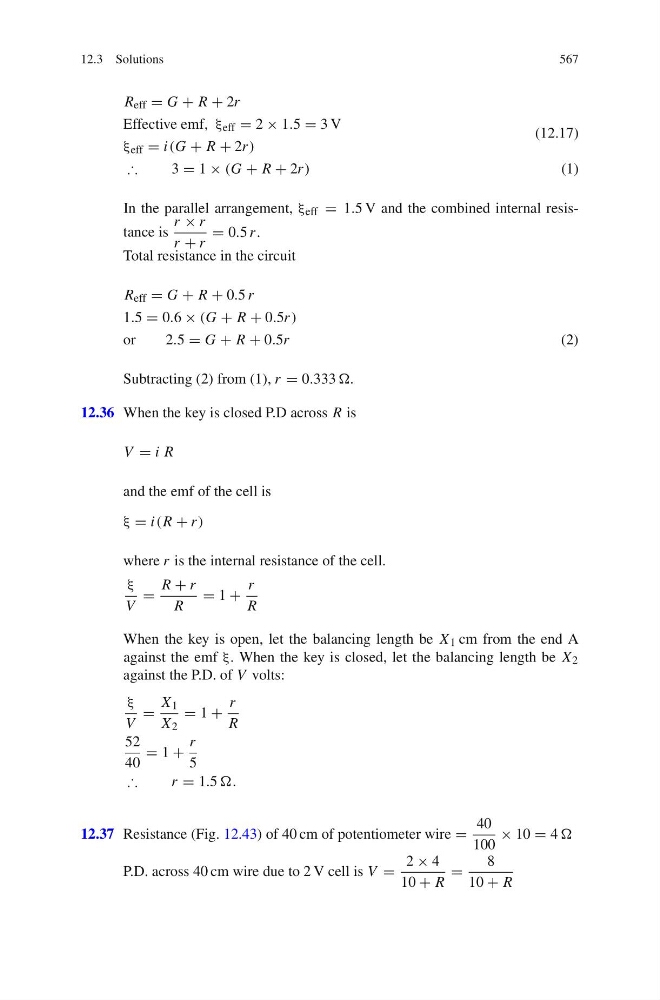
R eff = G + R + 2r
Effective emf, ξ eff = 2 × 1.5 = 3 V
ξ eff = i(G + R + 2r )
∴
3 = 1 × (G + R + 2r )
(1)
In the parallel arrangement, ξ eff = 1.5 V and the combined internal resistance is
r × r
r + r
= 0.5 r .
Total resistance in the circuit
R eff = G + R + 0.5 r
1.5 = 0.6 × (G + R + 0.5r )
or
2.5 = G + R + 0.5r
(2)
Subtracting (2) from (1), r = 0.333 .
12.36 When the key is closed P.D across R is
V = i R
and the emf of the cell is
ξ = i(R + r )
where r is the internal resistance of the cell.
ξ
V
=
R + r
R
= 1 +
r
R
When the key is open, let the balancing length be X 1 cm from the end A
against the emf ξ. When the key is closed, let the balancing length be X 2
against the P.D. of V volts:
ξ
V
=
X 1
X 2
= 1 +
r
R
52
40
= 1 +
r
5
∴
r = 1.5 .
12.37 Resistance (Fig. 12.43) of 40 cm of potentiometer wire =
40
100
× 10 = 4
P.D. across 40 cm wire due to 2 V cell is V =
2 × 4
10 + R
=
8
10 + R