

566
12 Electric Circuits
Applying the loop theorem to the loop BCDB, which also does not have
an emf
(i 1 − i g )Q − i g G − (i 2 − i g )s = 0
( 6 )
Combining (4), (5) and (6)
i g
i
=
Q R − P S
G(Q + S) + (P + R) (G + Q + S)
Note that i g = 0 if Q R − P S = 0, which is identical with the condition (3).
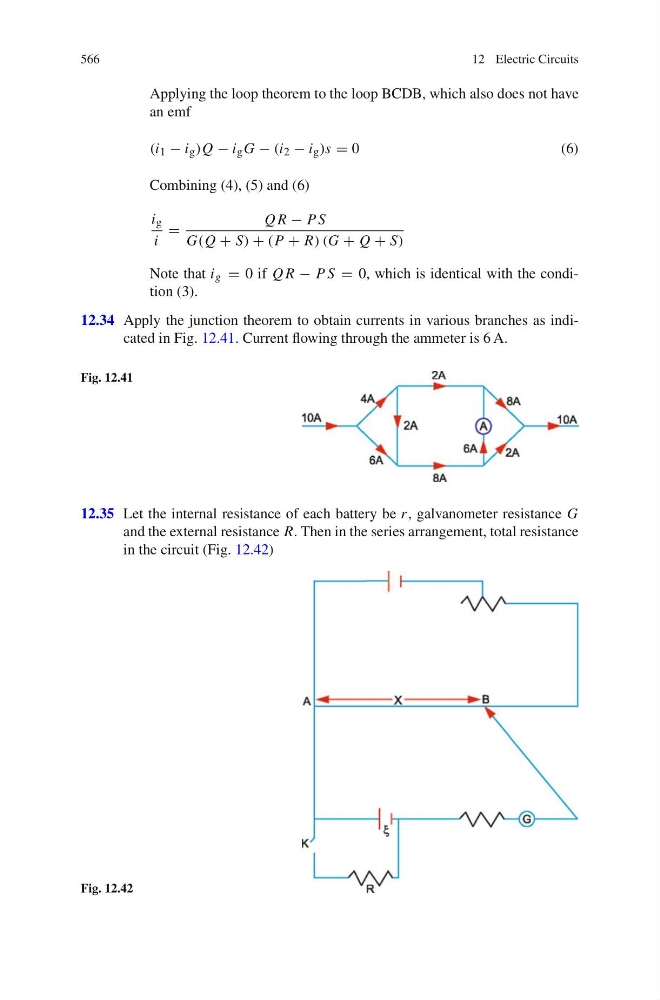
12.34 Apply the junction theorem to obtain currents in various branches as indicated in Fig. 12.41. Current flowing through the ammeter is 6 A.
Fig. 12.41
12.35 Let the internal resistance of each battery be r , galvanometer resistance G
and the external resistance R. Then in the series arrangement, total resistance
in the circuit (Fig. 12.42)
Fig. 12.42