

12.3 Solutions
553
12.3 Let the resistances be R 1 and R 2
R 1 + R 2 = p
(series)
(1)
R 1 R 2
R 1 + R 2
= q
(parallel)
(2)
Combining (1) and (2)
R 1 − R 2 = ±
n(n − 4)
Since R 1 and R 2 are real, n ≥ 4.
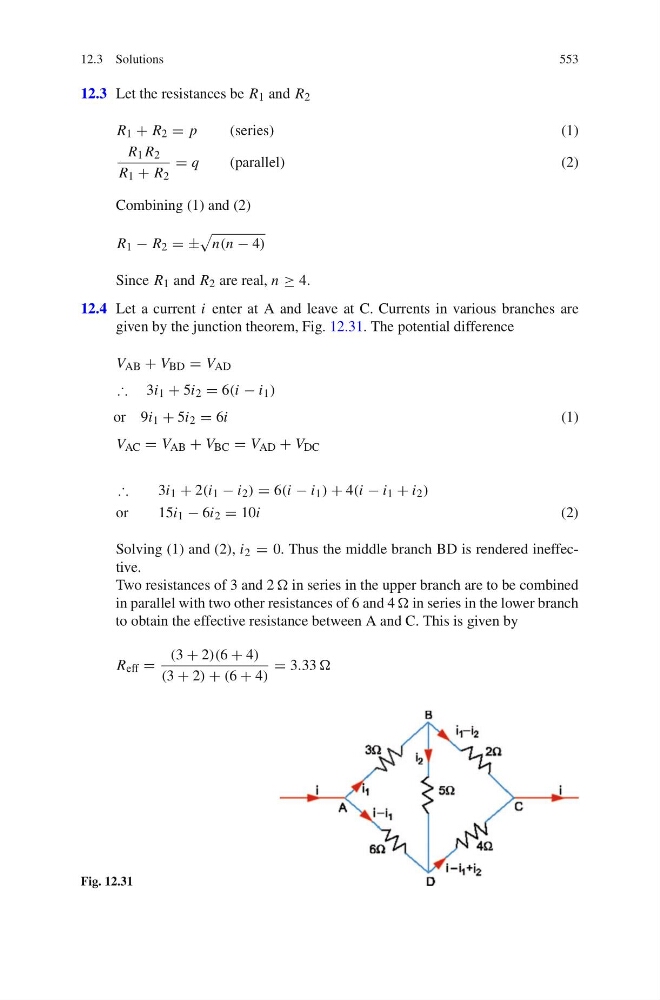
12.4 Let a current i enter at A and leave at C. Currents in various branches are
given by the junction theorem, Fig. 12.31. The potential difference
V AB + V BD = V AD
∴ 3i 1 + 5i 2 = 6(i − i 1 )
or 9i 1 + 5i 2 = 6i
(1)
V AC = V AB + V BC = V AD + V DC
∴
3i 1 + 2(i 1 − i 2 ) = 6(i − i 1 ) + 4(i − i 1 + i 2 )
or
15i 1 − 6i 2 = 10i
(2)
Solving (1) and (2), i 2 = 0. Thus the middle branch BD is rendered ineffective.
Two resistances of 3 and 2 in series in the upper branch are to be combined
in parallel with two other resistances of 6 and 4 in series in the lower branch
to obtain the effective resistance between A and C. This is given by
R eff =
(3 + 2)(6 + 4)
(3 + 2) + (6 + 4)
= 3.33
Fig. 12.31