

538
12 Electric Circuits
Fig. 12.2
Kirchhoff’s Laws
1. Junction theorem: At any junction of an electric network (branched circuit), the
algebraic sum of the currents flowing towards that junction is zero, i.e. the total
current flowing towards the junction is equal to the total current flowing away
from it:
i = 0
(12.16)
2. The loop theorem: The sum of the changes in the potential, encountered in
traversing a loop (closed circuit) in a particular direction (clockwise or counterclockwise), is zero.
(i) If a resistor is traversed in the direction of current, the change in the potential
is −i R, while in the opposite direction it is +i R.
(ii) If a seat of emf is traversed in the direction of the emf, the change in potential
is +ξ, while in the opposite direction it is −ξ.
12.2 Problems
12.2.1 Resistance, EMF, Current, Power
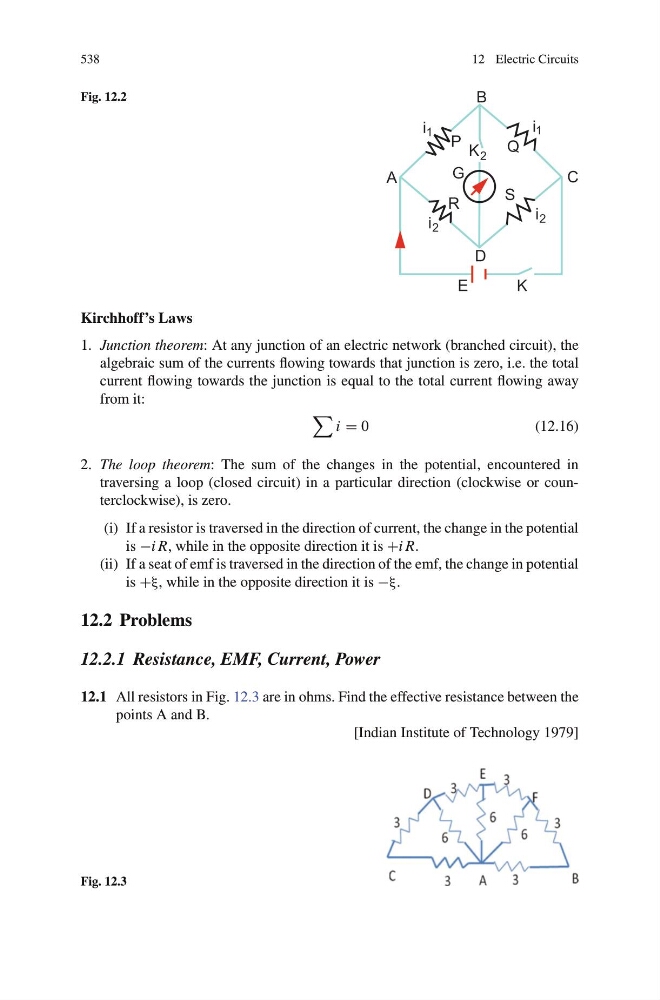
12.1 All resistors in Fig. 12.3 are in ohms. Find the effective resistance between the
points A and B.
[Indian Institute of Technology 1979]
Fig. 12.3