

12.1 Basic Concepts and Formulae
537
Mixed Grouping of Cells
Let there be m rows of cells, with each row containing n cells in series. The emf for
each row of cells would be nξ and the equivalent internal resistance nr. The effective
emf for m rows would again be nξ, but since the rows are in parallel, the effective
internal resistance would be nr/m. The total resistance then becomes R + (nr/m)
(Fig. 12.1):
i =
nξ
R +
nr
m
=
mnξ
m R + nr
=
N ξ
m R + nr
(12.13)
where N = m × n = total number of cells.
Instruments
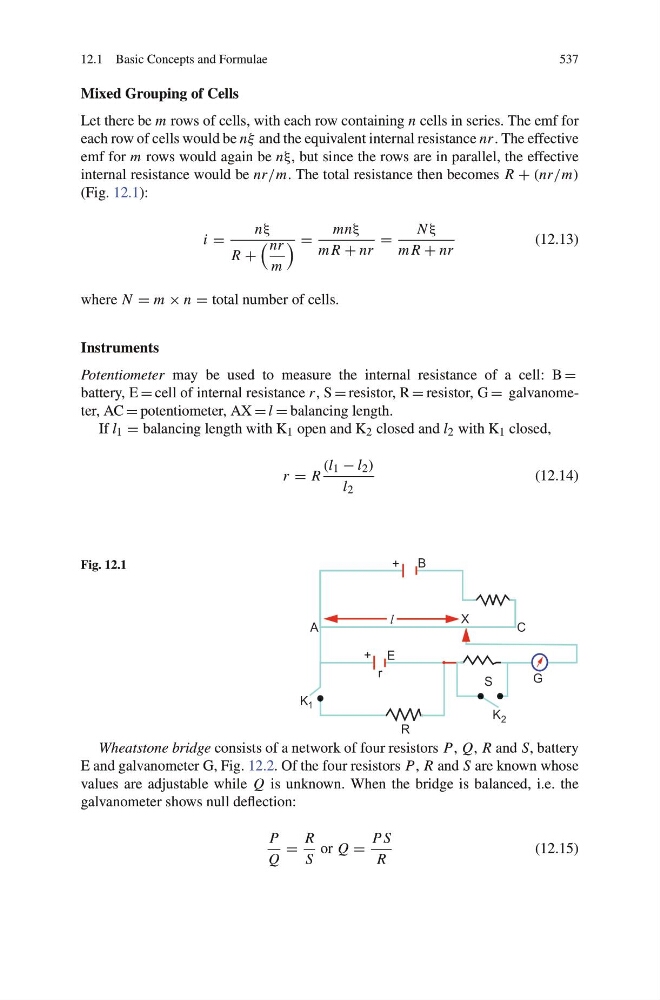
Potentiometer may be used to measure the internal resistance of a cell: B =
battery, E = cell of internal resistance r , S = resistor, R = resistor, G = galvanometer, AC = potentiometer, AX = l = balancing length.
If l 1 = balancing length with K 1 open and K 2 closed and l 2 with K 1 closed,
r = R
(l 1 − l 2 )
l 2
(12.14)
Fig. 12.1
Wheatstone bridge consists of a network of four resistors P, Q, R and S, battery
E and galvanometer G, Fig. 12.2. Of the four resistors P, R and S are known whose
values are adjustable while Q is unknown. When the bridge is balanced, i.e. the
galvanometer shows null deflection:
P
Q
=
R
S
or Q =
P S
R
(12.15)