

516
11 Electrostatics
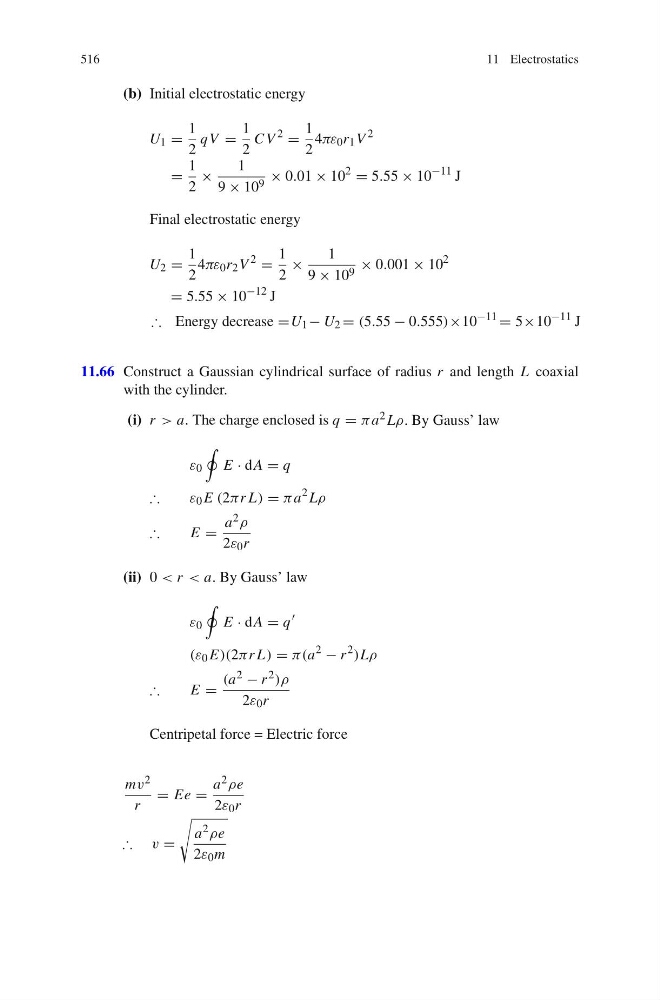
(b) Initial electrostatic energy
U 1 =
1
2
qV =
1
2
C V
2
=
1
2
4πε 0 r 1 V
2
=
1
2
×
1
9 × 10 9 × 0.01 × 10
2
= 5.55 × 10
−11 J
Final electrostatic energy
U 2 =
1
2
4πε 0 r 2 V
2
=
1
2
×
1
9 × 10 9 × 0.001 × 10
2
= 5.55 × 10
−12 J
∴ Energy decrease =U 1 − U 2 = (5.55 − 0.555)×10
−11
= 5×10
−11 J
11.66 Construct a Gaussian cylindrical surface of radius r and length L coaxial
with the cylinder.
(i) r > a. The charge enclosed is q = πa 2 Lρ. By Gauss’ law
ε 0
E · dA = q
∴
ε 0 E (2πr L) = πa
2 Lρ
∴
E =
a 2 ρ
2ε 0 r
(ii) 0 < r < a. By Gauss’ law
ε 0
E · dA = q
(ε 0 E)(2πr L) = π(a
2
− r
2
)Lρ
∴
E =
(a 2 − r 2 )ρ
2ε 0 r
Centripetal force = Electric force
mv 2
r
= Ee =
a 2 ρe
2ε 0 r
∴ v =
a 2 ρe
2ε 0 m
11 Electrostatics
(b) Initial electrostatic energy
U 1 =
1
2
qV =
1
2
C V
2
=
1
2
4πε 0 r 1 V
2
=
1
2
×
1
9 × 10 9 × 0.01 × 10
2
= 5.55 × 10
−11 J
Final electrostatic energy
U 2 =
1
2
4πε 0 r 2 V
2
=
1
2
×
1
9 × 10 9 × 0.001 × 10
2
= 5.55 × 10
−12 J
∴ Energy decrease =U 1 − U 2 = (5.55 − 0.555)×10
−11
= 5×10
−11 J
11.66 Construct a Gaussian cylindrical surface of radius r and length L coaxial
with the cylinder.
(i) r > a. The charge enclosed is q = πa 2 Lρ. By Gauss’ law
ε 0
E · dA = q
∴
ε 0 E (2πr L) = πa
2 Lρ
∴
E =
a 2 ρ
2ε 0 r
(ii) 0 < r < a. By Gauss’ law
ε 0
E · dA = q
(ε 0 E)(2πr L) = π(a
2
− r
2
)Lρ
∴
E =
(a 2 − r 2 )ρ
2ε 0 r
Centripetal force = Electric force
mv 2
r
= Ee =
a 2 ρe
2ε 0 r
∴ v =
a 2 ρe
2ε 0 m