

11.3 Solutions
515
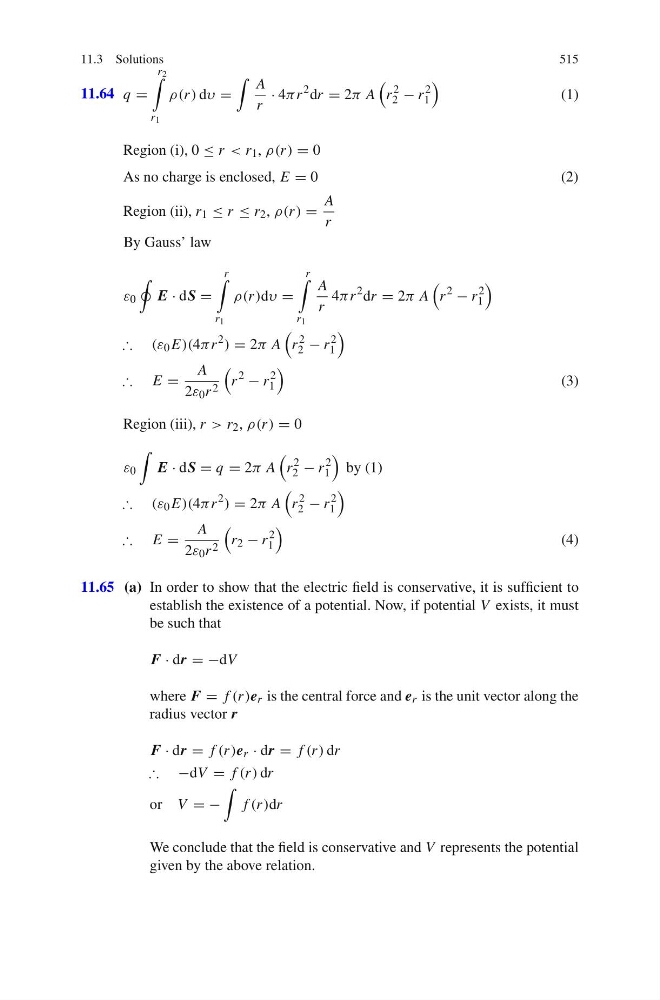
11.64 q =
r 2
r 1
ρ(r ) dυ =
A
r
· 4πr
2 dr = 2π A
r
2
2 − r
2
1
(1)
Region (i), 0 ≤ r < r 1 , ρ(r ) = 0
As no charge is enclosed, E = 0
( 2 )
Region (ii), r 1 ≤ r ≤ r 2 , ρ(r ) =
A
r
By Gauss’ law
ε 0
E · dS =
r
r 1
ρ(r )dυ =
r
r 1
A
r
4πr
2 dr = 2π A
r
2
− r
2
1
∴ (ε 0 E)(4πr
2
) = 2π A
r
2
2 − r
2
1
∴ E =
A
2ε 0 r 2
r
2
− r
2
1
(3)
Region (iii), r > r 2 , ρ(r ) = 0
ε 0
E · dS = q = 2π A
r
2
2 − r
2
1
by (1)
∴ (ε 0 E)(4πr
2
) = 2π A
r
2
2 − r
2
1
∴ E =
A
2ε 0 r 2
r 2 − r
2
1
(4)
11.65 (a) In order to show that the electric field is conservative, it is sufficient to
establish the existence of a potential. Now, if potential V exists, it must
be such that
F · dr = −dV
where F = f (r )e r is the central force and e r is the unit vector along the
radius vector r
F · dr = f (r )e r · dr = f (r ) dr
∴ −dV = f (r ) dr
or V = −
f (r )dr
We conclude that the field is conservative and V represents the potential
given by the above relation.
515
11.64 q =
r 2
r 1
ρ(r ) dυ =
A
r
· 4πr
2 dr = 2π A
r
2
2 − r
2
1
(1)
Region (i), 0 ≤ r < r 1 , ρ(r ) = 0
As no charge is enclosed, E = 0
( 2 )
Region (ii), r 1 ≤ r ≤ r 2 , ρ(r ) =
A
r
By Gauss’ law
ε 0
E · dS =
r
r 1
ρ(r )dυ =
r
r 1
A
r
4πr
2 dr = 2π A
r
2
− r
2
1
∴ (ε 0 E)(4πr
2
) = 2π A
r
2
2 − r
2
1
∴ E =
A
2ε 0 r 2
r
2
− r
2
1
(3)
Region (iii), r > r 2 , ρ(r ) = 0
ε 0
E · dS = q = 2π A
r
2
2 − r
2
1
by (1)
∴ (ε 0 E)(4πr
2
) = 2π A
r
2
2 − r
2
1
∴ E =
A
2ε 0 r 2
r 2 − r
2
1
(4)
11.65 (a) In order to show that the electric field is conservative, it is sufficient to
establish the existence of a potential. Now, if potential V exists, it must
be such that
F · dr = −dV
where F = f (r )e r is the central force and e r is the unit vector along the
radius vector r
F · dr = f (r )e r · dr = f (r ) dr
∴ −dV = f (r ) dr
or V = −
f (r )dr
We conclude that the field is conservative and V represents the potential
given by the above relation.