

11.3 Solutions
509
Thus for r < R, E varies linearly with r . Note that at r = R, both (1)
and (4) give the same value as they should.
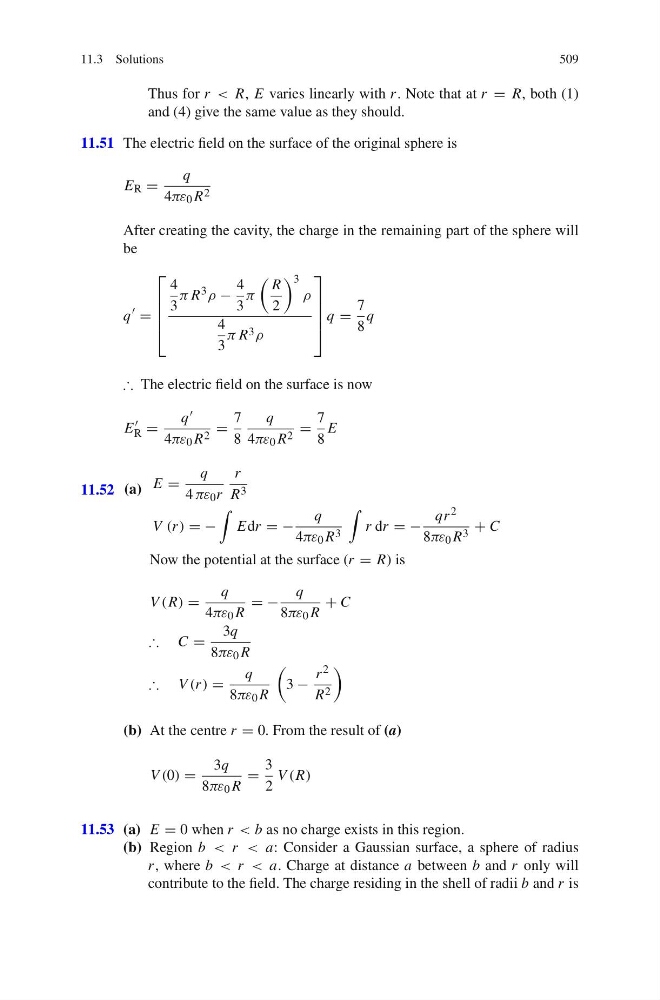
11.51 The electric field on the surface of the original sphere is
E R =
q
4πε 0 R 2
After creating the cavity, the charge in the remaining part of the sphere will
be
q
=
⎡
⎢
⎢
⎢
⎣
4
3
π R 3 ρ −
4
3
π
R
2
3
ρ
4
3
π R 3 ρ
⎤
⎥
⎥
⎥
⎦
q =
7
8
q
∴ The electric field on the surface is now
E
R =
q
4πε 0 R 2 =
7
8
q
4πε 0 R 2 =
7
8
E
11.52 (a) E =
q
4 πε 0 r
r
R 3
V (r ) = −
Edr = −
q
4πε 0 R 3
r dr = −
qr 2
8πε 0 R 3 + C
Now the potential at the surface (r = R) is
V (R) =
q
4πε 0 R
= −
q
8πε 0 R
+ C
∴ C =
3q
8πε 0 R
∴ V (r ) =
q
8πε 0 R
3 −
r 2
R 2
(b) At the centre r = 0. From the result of (a)
V (0) =
3q
8πε 0 R
=
3
2
V (R)
11.53 (a) E = 0 when r < b as no charge exists in this region.
(b) Region b < r < a: Consider a Gaussian surface, a sphere of radius
r , where b < r < a. Charge at distance a between b and r only will
contribute to the field. The charge residing in the shell of radii b and r is
509
Thus for r < R, E varies linearly with r . Note that at r = R, both (1)
and (4) give the same value as they should.
11.51 The electric field on the surface of the original sphere is
E R =
q
4πε 0 R 2
After creating the cavity, the charge in the remaining part of the sphere will
be
q
=
⎡
⎢
⎢
⎢
⎣
4
3
π R 3 ρ −
4
3
π
R
2
3
ρ
4
3
π R 3 ρ
⎤
⎥
⎥
⎥
⎦
q =
7
8
q
∴ The electric field on the surface is now
E
R =
q
4πε 0 R 2 =
7
8
q
4πε 0 R 2 =
7
8
E
11.52 (a) E =
q
4 πε 0 r
r
R 3
V (r ) = −
Edr = −
q
4πε 0 R 3
r dr = −
qr 2
8πε 0 R 3 + C
Now the potential at the surface (r = R) is
V (R) =
q
4πε 0 R
= −
q
8πε 0 R
+ C
∴ C =
3q
8πε 0 R
∴ V (r ) =
q
8πε 0 R
3 −
r 2
R 2
(b) At the centre r = 0. From the result of (a)
V (0) =
3q
8πε 0 R
=
3
2
V (R)
11.53 (a) E = 0 when r < b as no charge exists in this region.
(b) Region b < r < a: Consider a Gaussian surface, a sphere of radius
r , where b < r < a. Charge at distance a between b and r only will
contribute to the field. The charge residing in the shell of radii b and r is