

508
11 Electrostatics
11.50 (a) Integral form of Gauss’ law:
E · ds =
Q
ε 0
Differential form: ∇ · E =
ρ
ε 0
(b) r > R. Construct a Gaussian surface in the form of a sphere of radius
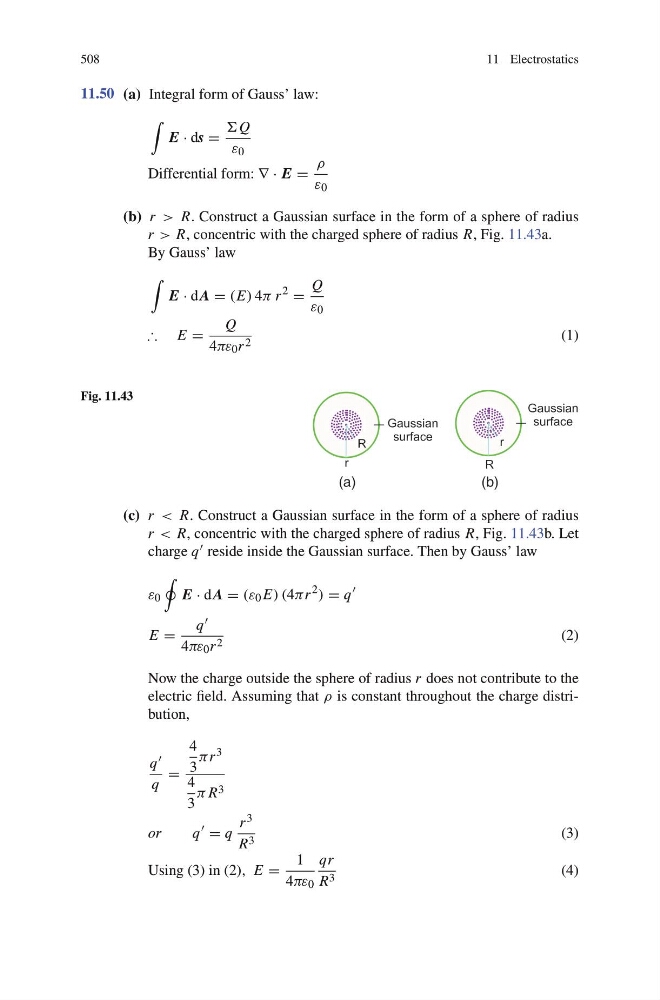
r > R, concentric with the charged sphere of radius R, Fig. 11.43a.
By Gauss’ law
E · d A = (E) 4π r
2
=
Q
ε 0
∴ E =
Q
4πε 0 r 2
(1)
Fig. 11.43
(a)
(b)
(c) r < R. Construct a Gaussian surface in the form of a sphere of radius
r < R, concentric with the charged sphere of radius R, Fig. 11.43b. Let
charge q reside inside the Gaussian surface. Then by Gauss’ law
ε 0
E · d A = (ε 0 E) (4πr
2
) = q
E =
q
4πε 0 r 2
(2)
Now the charge outside the sphere of radius r does not contribute to the
electric field. Assuming that ρ is constant throughout the charge distribution,
q
q
=
4
3
πr 3
4
3
π R 3
or
q
= q
r 3
R 3
(3)
Using (3) in (2), E =
1
4πε 0
qr
R 3
(4)
11 Electrostatics
11.50 (a) Integral form of Gauss’ law:
E · ds =
Q
ε 0
Differential form: ∇ · E =
ρ
ε 0
(b) r > R. Construct a Gaussian surface in the form of a sphere of radius
r > R, concentric with the charged sphere of radius R, Fig. 11.43a.
By Gauss’ law
E · d A = (E) 4π r
2
=
Q
ε 0
∴ E =
Q
4πε 0 r 2
(1)
Fig. 11.43
(a)
(b)
(c) r < R. Construct a Gaussian surface in the form of a sphere of radius
r < R, concentric with the charged sphere of radius R, Fig. 11.43b. Let
charge q reside inside the Gaussian surface. Then by Gauss’ law
ε 0
E · d A = (ε 0 E) (4πr
2
) = q
E =
q
4πε 0 r 2
(2)
Now the charge outside the sphere of radius r does not contribute to the
electric field. Assuming that ρ is constant throughout the charge distribution,
q
q
=
4
3
πr 3
4
3
π R 3
or
q
= q
r 3
R 3
(3)
Using (3) in (2), E =
1
4πε 0
qr
R 3
(4)