

506
11 Electrostatics
For antiparallel arrangement, θ = 180 ◦ and U 2 = +PE = +1.8 ×
10 −25 J.
Therefore the difference in the potential energy U = U 2 − U 1 = 3.6 ×
10 −25 J.
11.3.2 Gauss’ Law
11.49 (a) If φ E is the electric flux, E the electric field, q the charge enclosed and
d A the element of area then q = ε 0
E · d A. The integration is to be
carried over the entire surface. The circle on the integral sign indicates
that the surface of integration is a closed surface.
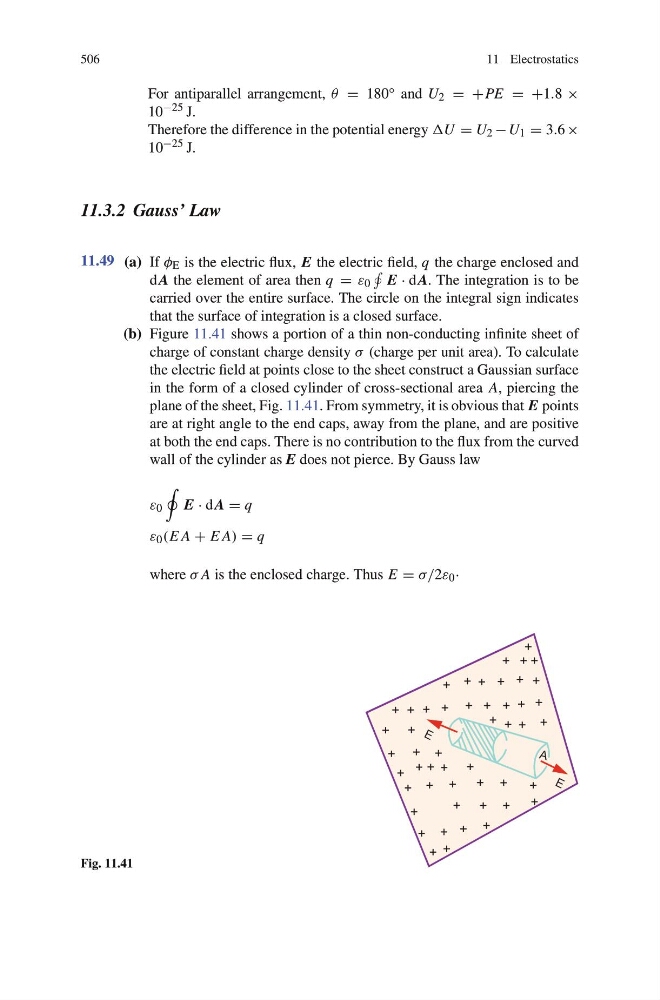
(b) Figure 11.41 shows a portion of a thin non-conducting infinite sheet of
charge of constant charge density σ (charge per unit area). To calculate
the electric field at points close to the sheet construct a Gaussian surface
in the form of a closed cylinder of cross-sectional area A, piercing the
plane of the sheet, Fig. 11.41. From symmetry, it is obvious that E points
are at right angle to the end caps, away from the plane, and are positive
at both the end caps. There is no contribution to the flux from the curved
wall of the cylinder as E does not pierce. By Gauss law
ε 0
E · d A = q
ε 0 (E A + E A) = q
where σ A is the enclosed charge. Thus E = σ/2ε 0 ·
Fig. 11.41
11 Electrostatics
For antiparallel arrangement, θ = 180 ◦ and U 2 = +PE = +1.8 ×
10 −25 J.
Therefore the difference in the potential energy U = U 2 − U 1 = 3.6 ×
10 −25 J.
11.3.2 Gauss’ Law
11.49 (a) If φ E is the electric flux, E the electric field, q the charge enclosed and
d A the element of area then q = ε 0
E · d A. The integration is to be
carried over the entire surface. The circle on the integral sign indicates
that the surface of integration is a closed surface.
(b) Figure 11.41 shows a portion of a thin non-conducting infinite sheet of
charge of constant charge density σ (charge per unit area). To calculate
the electric field at points close to the sheet construct a Gaussian surface
in the form of a closed cylinder of cross-sectional area A, piercing the
plane of the sheet, Fig. 11.41. From symmetry, it is obvious that E points
are at right angle to the end caps, away from the plane, and are positive
at both the end caps. There is no contribution to the flux from the curved
wall of the cylinder as E does not pierce. By Gauss law
ε 0
E · d A = q
ε 0 (E A + E A) = q
where σ A is the enclosed charge. Thus E = σ/2ε 0 ·
Fig. 11.41