

11.3 Solutions
505
Now |F 32 + F 12 | =
√
2 F 12 (∵ F 12 and F 32 act at right angle and are equal
in magnitude)
Further, F 42 acts in the same direction as the combined force of F 32 and
F 12 .
∴
|F 12 + F 32 + F 42 | =
Q 2
4πε 0 a 2
√
2 +
1
2
=
1.914 Q 2
4πε 0 a 2
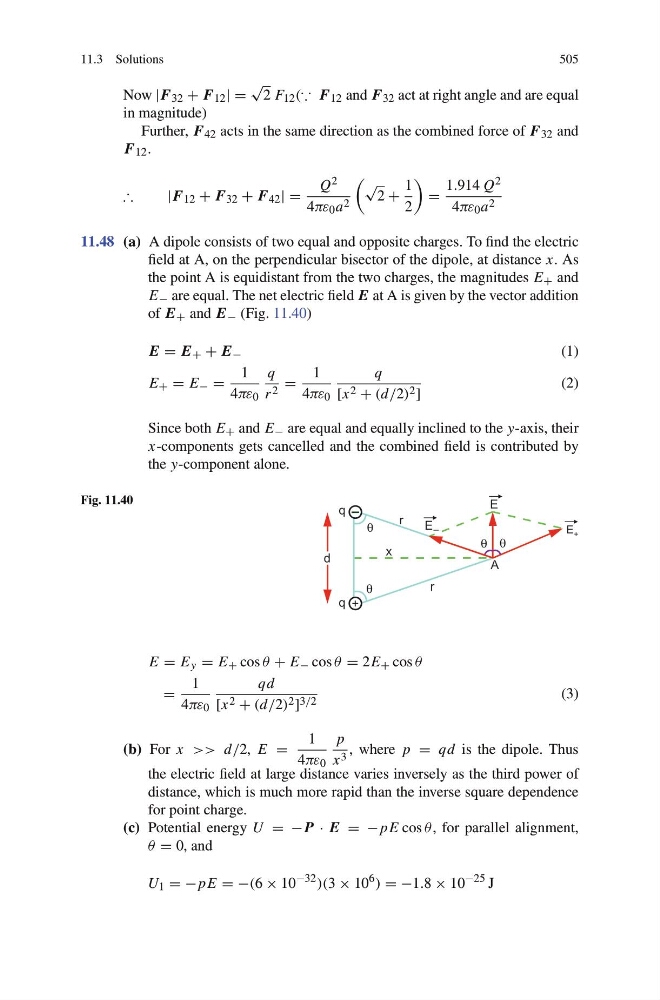
11.48 (a) A dipole consists of two equal and opposite charges. To find the electric
field at A, on the perpendicular bisector of the dipole, at distance x. As
the point A is equidistant from the two charges, the magnitudes E + and
E − are equal. The net electric field E at A is given by the vector addition
of E + and E − (Fig. 11.40)
E = E + + E −
(1)
E + = E − =
1
4πε 0
q
r 2 =
1
4πε 0
q
[x 2 + (d/2) 2 ]
(2)
Since both E + and E − are equal and equally inclined to the y-axis, their
x-components gets cancelled and the combined field is contributed by
the y-component alone.
Fig. 11.40
E = E y = E + cos θ + E − cos θ = 2E + cos θ
=
1
4πε 0
qd
[x 2 + (d/2) 2 ] 3/2
(3)
(b) For x >> d/2, E =
1
4πε 0
p
x 3 , where p = qd is the dipole. Thus
the electric field at large distance varies inversely as the third power of
distance, which is much more rapid than the inverse square dependence
for point charge.
(c) Potential energy U = −P · E = −pE cos θ , for parallel alignment,
θ = 0, and
U 1 = −pE = −(6 × 10
−32
)(3 × 10
6
) = −1.8 × 10
−25 J
505
Now |F 32 + F 12 | =
√
2 F 12 (∵ F 12 and F 32 act at right angle and are equal
in magnitude)
Further, F 42 acts in the same direction as the combined force of F 32 and
F 12 .
∴
|F 12 + F 32 + F 42 | =
Q 2
4πε 0 a 2
√
2 +
1
2
=
1.914 Q 2
4πε 0 a 2
11.48 (a) A dipole consists of two equal and opposite charges. To find the electric
field at A, on the perpendicular bisector of the dipole, at distance x. As
the point A is equidistant from the two charges, the magnitudes E + and
E − are equal. The net electric field E at A is given by the vector addition
of E + and E − (Fig. 11.40)
E = E + + E −
(1)
E + = E − =
1
4πε 0
q
r 2 =
1
4πε 0
q
[x 2 + (d/2) 2 ]
(2)
Since both E + and E − are equal and equally inclined to the y-axis, their
x-components gets cancelled and the combined field is contributed by
the y-component alone.
Fig. 11.40
E = E y = E + cos θ + E − cos θ = 2E + cos θ
=
1
4πε 0
qd
[x 2 + (d/2) 2 ] 3/2
(3)
(b) For x >> d/2, E =
1
4πε 0
p
x 3 , where p = qd is the dipole. Thus
the electric field at large distance varies inversely as the third power of
distance, which is much more rapid than the inverse square dependence
for point charge.
(c) Potential energy U = −P · E = −pE cos θ , for parallel alignment,
θ = 0, and
U 1 = −pE = −(6 × 10
−32
)(3 × 10
6
) = −1.8 × 10
−25 J