

494
11 Electrostatics
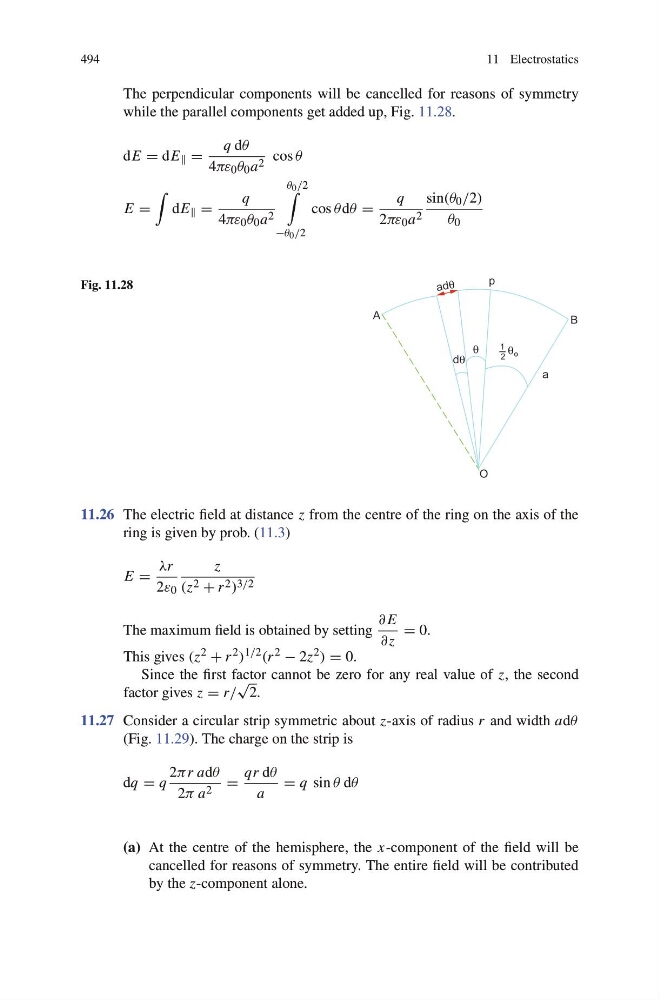
The perpendicular components will be cancelled for reasons of symmetry
while the parallel components get added up, Fig. 11.28.
dE = dE =
q dθ
4πε 0 θ 0 a 2 cos θ
E =
dE =
q
4πε 0 θ 0 a 2
θ 0 /2
−θ 0 /2
cos θ dθ =
q
2πε 0 a 2
sin(θ 0 /2)
θ 0
Fig. 11.28
11.26 The electric field at distance z from the centre of the ring on the axis of the
ring is given by prob. (11.3)
E =
λr
2ε 0
z
(z 2 + r 2 ) 3/2
The maximum field is obtained by setting
∂ E
∂z
= 0.
This gives (z 2 + r 2 ) 1/2 (r 2 − 2z 2 ) = 0.
Since the first factor cannot be zero for any real value of z, the second
factor gives z = r/
√
2.
11.27 Consider a circular strip symmetric about z-axis of radius r and width adθ
(Fig. 11.29). The charge on the strip is
dq = q
2πr adθ
2π a 2 =
qr dθ
a
= q sin θ dθ
(a) At the centre of the hemisphere, the x-component of the field will be
cancelled for reasons of symmetry. The entire field will be contributed
by the z-component alone.
11 Electrostatics
The perpendicular components will be cancelled for reasons of symmetry
while the parallel components get added up, Fig. 11.28.
dE = dE =
q dθ
4πε 0 θ 0 a 2 cos θ
E =
dE =
q
4πε 0 θ 0 a 2
θ 0 /2
−θ 0 /2
cos θ dθ =
q
2πε 0 a 2
sin(θ 0 /2)
θ 0
Fig. 11.28
11.26 The electric field at distance z from the centre of the ring on the axis of the
ring is given by prob. (11.3)
E =
λr
2ε 0
z
(z 2 + r 2 ) 3/2
The maximum field is obtained by setting
∂ E
∂z
= 0.
This gives (z 2 + r 2 ) 1/2 (r 2 − 2z 2 ) = 0.
Since the first factor cannot be zero for any real value of z, the second
factor gives z = r/
√
2.
11.27 Consider a circular strip symmetric about z-axis of radius r and width adθ
(Fig. 11.29). The charge on the strip is
dq = q
2πr adθ
2π a 2 =
qr dθ
a
= q sin θ dθ
(a) At the centre of the hemisphere, the x-component of the field will be
cancelled for reasons of symmetry. The entire field will be contributed
by the z-component alone.