

11.3 Solutions
493
Now E 1 = E 2 in magnitude and act at right angles (from the geometry
of the diagram). The overall field will then be E =
√
2 E 1 =
2
√
2q
4πε 0 a 2 along
positive y-axis.
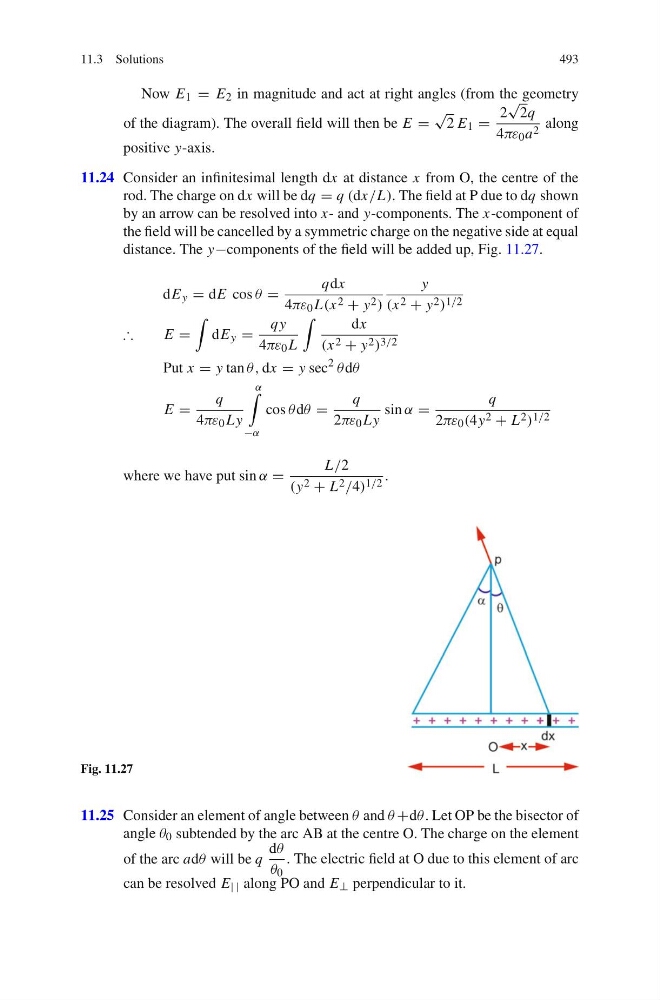
11.24 Consider an infinitesimal length dx at distance x from O, the centre of the
rod. The charge on dx will be dq = q (dx/L). The field at P due to dq shown
by an arrow can be resolved into x- and y-components. The x-component of
the field will be cancelled by a symmetric charge on the negative side at equal
distance. The y−components of the field will be added up, Fig. 11.27.
dE y = dE cos θ =
qdx
4πε 0 L(x 2 + y 2 )
y
(x 2 + y 2 ) 1/2
∴
E =
dE y =
qy
4πε 0 L
dx
(x 2 + y 2 ) 3/2
Put x = y tan θ, dx = y sec
2
θ dθ
E =
q
4πε 0 Ly
α
−α
cos θ dθ =
q
2πε 0 Ly
sin α =
q
2πε 0 (4y 2 + L 2 ) 1/2
where we have put sin α =
L/2
(y 2 + L 2 /4) 1/2 .
Fig. 11.27
11.25 Consider an element of angle between θ and θ +dθ . Let OP be the bisector of
angle θ 0 subtended by the arc AB at the centre O. The charge on the element
of the arc adθ will be q
dθ
θ 0
. The electric field at O due to this element of arc
can be resolved E | | along PO and E ⊥ perpendicular to it.
493
Now E 1 = E 2 in magnitude and act at right angles (from the geometry
of the diagram). The overall field will then be E =
√
2 E 1 =
2
√
2q
4πε 0 a 2 along
positive y-axis.
11.24 Consider an infinitesimal length dx at distance x from O, the centre of the
rod. The charge on dx will be dq = q (dx/L). The field at P due to dq shown
by an arrow can be resolved into x- and y-components. The x-component of
the field will be cancelled by a symmetric charge on the negative side at equal
distance. The y−components of the field will be added up, Fig. 11.27.
dE y = dE cos θ =
qdx
4πε 0 L(x 2 + y 2 )
y
(x 2 + y 2 ) 1/2
∴
E =
dE y =
qy
4πε 0 L
dx
(x 2 + y 2 ) 3/2
Put x = y tan θ, dx = y sec
2
θ dθ
E =
q
4πε 0 Ly
α
−α
cos θ dθ =
q
2πε 0 Ly
sin α =
q
2πε 0 (4y 2 + L 2 ) 1/2
where we have put sin α =
L/2
(y 2 + L 2 /4) 1/2 .
Fig. 11.27
11.25 Consider an element of angle between θ and θ +dθ . Let OP be the bisector of
angle θ 0 subtended by the arc AB at the centre O. The charge on the element
of the arc adθ will be q
dθ
θ 0
. The electric field at O due to this element of arc
can be resolved E | | along PO and E ⊥ perpendicular to it.