

11.2 Problems
469
11.25 A thin non-conducting rod is bent to form an arc of a circle of radius r and
subtends an angle θ 0 at the centre of the circle. If a total charge q is spread
uniformly along the rod, find the electric field at the centre of the circle.
11.26 A ring of radius r located in the xy-plane is given a total charge Q = 2πRλ.
Show that E is maximum when the distance z = r/
√
2.
11.27 A total charge q is spread uniformly over the inner surface of a nonconducting hemispherical cup of inner radius a. Calculate (a) the electric
field and (b) the electric potential at the centre of the hemisphere.
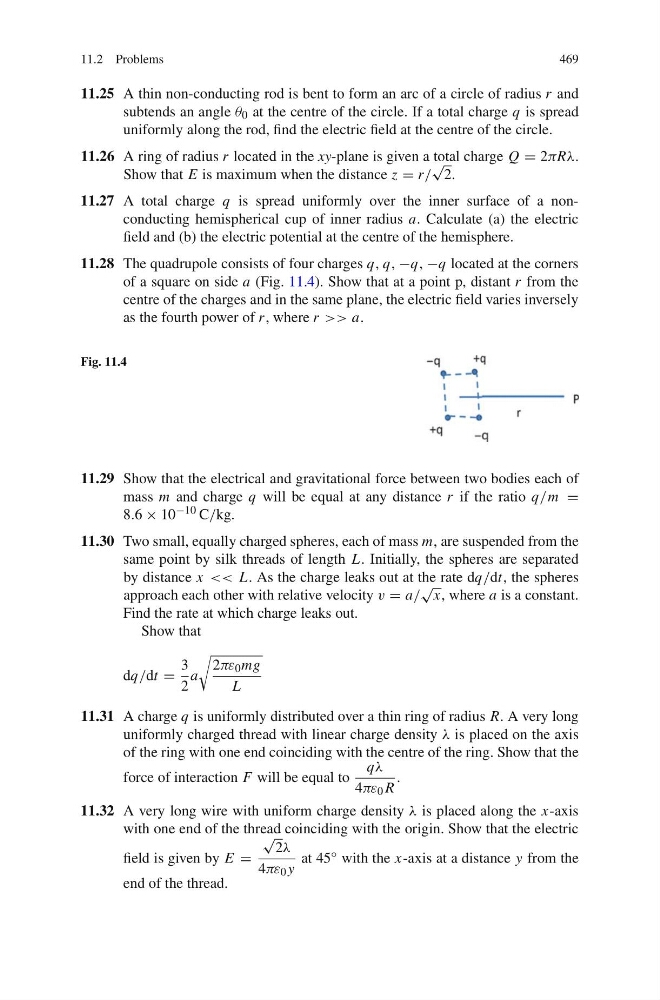
11.28 The quadrupole consists of four charges q, q, −q, −q located at the corners
of a square on side a (Fig. 11.4). Show that at a point p, distant r from the
centre of the charges and in the same plane, the electric field varies inversely
as the fourth power of r , where r >> a.
Fig. 11.4
11.29 Show that the electrical and gravitational force between two bodies each of
mass m and charge q will be equal at any distance r if the ratio q/m =
8.6 × 10 −10 C/kg.
11.30 Two small, equally charged spheres, each of mass m, are suspended from the
same point by silk threads of length L. Initially, the spheres are separated
by distance x << L. As the charge leaks out at the rate dq/dt, the spheres
approach each other with relative velocity v = a/
√
x, where a is a constant.
Find the rate at which charge leaks out.
Show that
dq/dt =
3
2
a
2πε 0 mg
L
11.31 A charge q is uniformly distributed over a thin ring of radius R. A very long
uniformly charged thread with linear charge density λ is placed on the axis
of the ring with one end coinciding with the centre of the ring. Show that the
force of interaction F will be equal to
qλ
4πε 0 R
.
11.32 A very long wire with uniform charge density λ is placed along the x-axis
with one end of the thread coinciding with the origin. Show that the electric
field is given by E =
√
2λ
4πε 0 y
at 45 ◦ with the x-axis at a distance y from the
end of the thread.
469
11.25 A thin non-conducting rod is bent to form an arc of a circle of radius r and
subtends an angle θ 0 at the centre of the circle. If a total charge q is spread
uniformly along the rod, find the electric field at the centre of the circle.
11.26 A ring of radius r located in the xy-plane is given a total charge Q = 2πRλ.
Show that E is maximum when the distance z = r/
√
2.
11.27 A total charge q is spread uniformly over the inner surface of a nonconducting hemispherical cup of inner radius a. Calculate (a) the electric
field and (b) the electric potential at the centre of the hemisphere.
11.28 The quadrupole consists of four charges q, q, −q, −q located at the corners
of a square on side a (Fig. 11.4). Show that at a point p, distant r from the
centre of the charges and in the same plane, the electric field varies inversely
as the fourth power of r , where r >> a.
Fig. 11.4
11.29 Show that the electrical and gravitational force between two bodies each of
mass m and charge q will be equal at any distance r if the ratio q/m =
8.6 × 10 −10 C/kg.
11.30 Two small, equally charged spheres, each of mass m, are suspended from the
same point by silk threads of length L. Initially, the spheres are separated
by distance x << L. As the charge leaks out at the rate dq/dt, the spheres
approach each other with relative velocity v = a/
√
x, where a is a constant.
Find the rate at which charge leaks out.
Show that
dq/dt =
3
2
a
2πε 0 mg
L
11.31 A charge q is uniformly distributed over a thin ring of radius R. A very long
uniformly charged thread with linear charge density λ is placed on the axis
of the ring with one end coinciding with the centre of the ring. Show that the
force of interaction F will be equal to
qλ
4πε 0 R
.
11.32 A very long wire with uniform charge density λ is placed along the x-axis
with one end of the thread coinciding with the origin. Show that the electric
field is given by E =
√
2λ
4πε 0 y
at 45 ◦ with the x-axis at a distance y from the
end of the thread.