

468
11 Electrostatics
11.16 A spark is produced between two insulated surfaces, maintained at a constant
difference of 5 × 10 6 V. If the energy output is 10 −5 J, calculate the charge
transferred. How many electrons have flowed?
[Indian Institute of Technology 1974]
11.17 A rod 25 cm long has a uniform linear charge density (charge per unit length)
λ = 200 μC/m. Calculate the electric field (in N/C) at 10 cm from one end
along the axis of the rod.
11.18 A disc of radius R is uniformly charged to Q and placed in the xy-plane with
its centre at the origin. Find the electric field along the z-axis.
11.19 Electronic charge e may be determined by Millikan’s oil drop method. Oil
drops of radius r acquire a terminal speed v 1 with downward electric field E
and a speed v 2 with the upward electric field. Derive an expression for e in
terms of E, v 1 , v 2 , r and η, the viscosity of oil in air.
11.20 A circular wire of radius r has a uniform linear charge density λ = λ 0 cos 2 θ .
Show that the total charge on the wire is πλ 0 r .
11.21 The distance between the electron and the proton in the hydrogen atom is
about 0.53 Å. By what factor is the electrical force stronger than the gravitational force? Does the distance matter?
11.22 The combined charge on two small spheres is +15 μC. If each sphere is
repelled by the other by a force of 5.4 N when the spheres are 30 cm apart,
find the charges on the spheres.
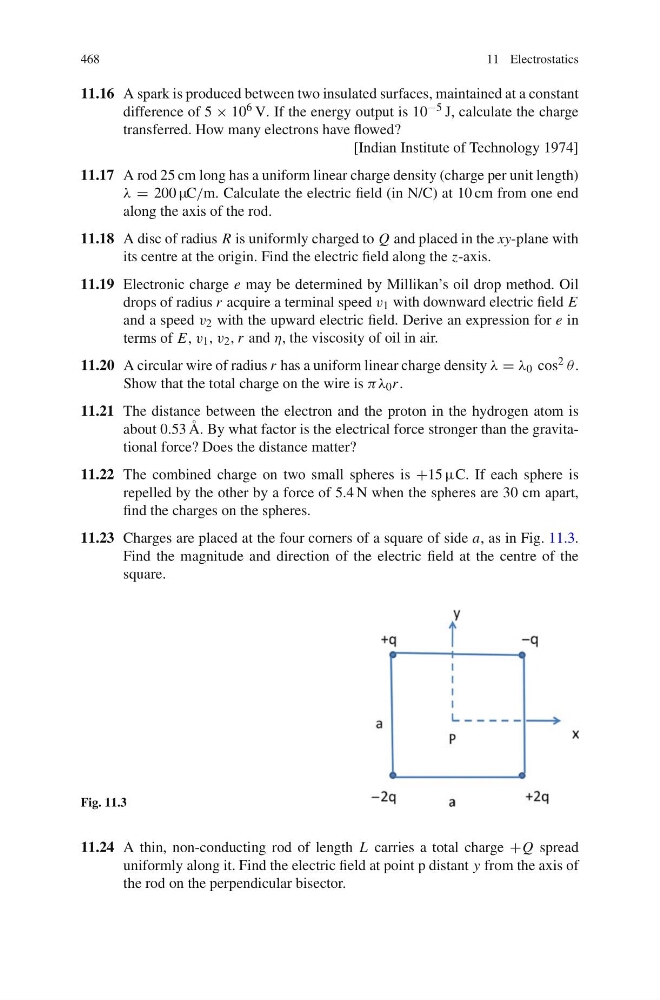
11.23 Charges are placed at the four corners of a square of side a, as in Fig. 11.3.
Find the magnitude and direction of the electric field at the centre of the
square.
Fig. 11.3
11.24 A thin, non-conducting rod of length L carries a total charge +Q spread
uniformly along it. Find the electric field at point p distant y from the axis of
the rod on the perpendicular bisector.
11 Electrostatics
11.16 A spark is produced between two insulated surfaces, maintained at a constant
difference of 5 × 10 6 V. If the energy output is 10 −5 J, calculate the charge
transferred. How many electrons have flowed?
[Indian Institute of Technology 1974]
11.17 A rod 25 cm long has a uniform linear charge density (charge per unit length)
λ = 200 μC/m. Calculate the electric field (in N/C) at 10 cm from one end
along the axis of the rod.
11.18 A disc of radius R is uniformly charged to Q and placed in the xy-plane with
its centre at the origin. Find the electric field along the z-axis.
11.19 Electronic charge e may be determined by Millikan’s oil drop method. Oil
drops of radius r acquire a terminal speed v 1 with downward electric field E
and a speed v 2 with the upward electric field. Derive an expression for e in
terms of E, v 1 , v 2 , r and η, the viscosity of oil in air.
11.20 A circular wire of radius r has a uniform linear charge density λ = λ 0 cos 2 θ .
Show that the total charge on the wire is πλ 0 r .
11.21 The distance between the electron and the proton in the hydrogen atom is
about 0.53 Å. By what factor is the electrical force stronger than the gravitational force? Does the distance matter?
11.22 The combined charge on two small spheres is +15 μC. If each sphere is
repelled by the other by a force of 5.4 N when the spheres are 30 cm apart,
find the charges on the spheres.
11.23 Charges are placed at the four corners of a square of side a, as in Fig. 11.3.
Find the magnitude and direction of the electric field at the centre of the
square.
Fig. 11.3
11.24 A thin, non-conducting rod of length L carries a total charge +Q spread
uniformly along it. Find the electric field at point p distant y from the axis of
the rod on the perpendicular bisector.