

11.2 Problems
465
11.2 Problems
11.2.1 Electric Field and Potential
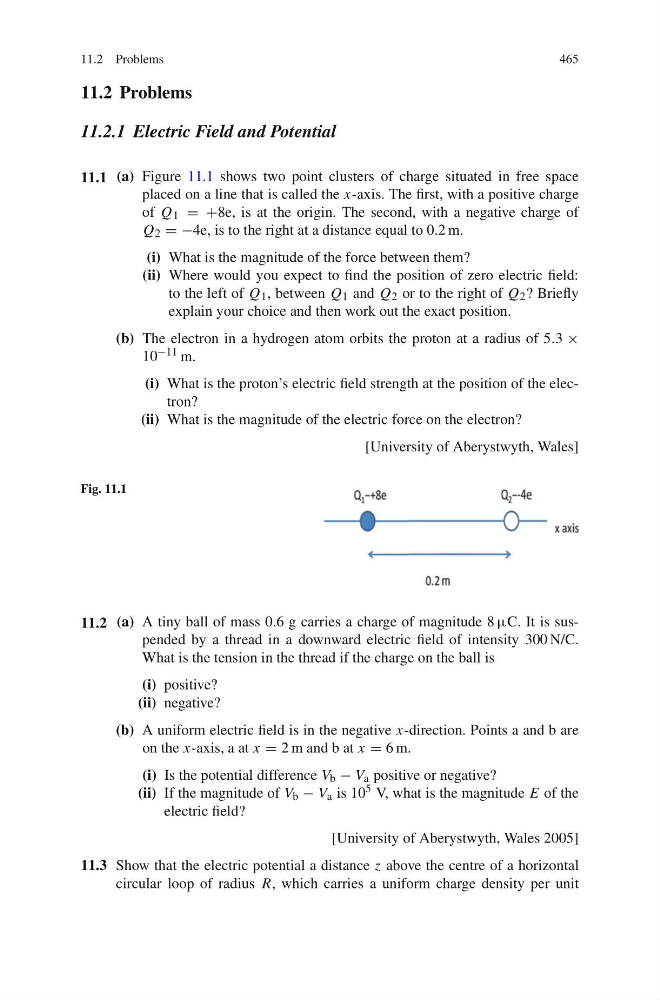
11.1 (a) Figure 11.1 shows two point clusters of charge situated in free space
placed on a line that is called the x-axis. The first, with a positive charge
of Q 1 = +8e, is at the origin. The second, with a negative charge of
Q 2 = −4e, is to the right at a distance equal to 0.2 m.
(i) What is the magnitude of the force between them?
(ii) Where would you expect to find the position of zero electric field:
to the left of Q 1 , between Q 1 and Q 2 or to the right of Q 2 ? Briefly
explain your choice and then work out the exact position.
(b) The electron in a hydrogen atom orbits the proton at a radius of 5.3 ×
10 −11 m.
(i) What is the proton’s electric field strength at the position of the electron?
(ii) What is the magnitude of the electric force on the electron?
[University of Aberystwyth, Wales]
Fig. 11.1
11.2 (a) A tiny ball of mass 0.6 g carries a charge of magnitude 8 μC. It is suspended by a thread in a downward electric field of intensity 300 N/C.
What is the tension in the thread if the charge on the ball is
(i) positive?
(ii) negative?
(b) A uniform electric field is in the negative x-direction. Points a and b are
on the x-axis, a at x = 2 m and b at x = 6 m.
(i) Is the potential difference V b − V a positive or negative?
(ii) If the magnitude of V b − V a is 10 5 V, what is the magnitude E of the
electric field?
[University of Aberystwyth, Wales 2005]
11.3 Show that the electric potential a distance z above the centre of a horizontal
circular loop of radius R, which carries a uniform charge density per unit
465
11.2 Problems
11.2.1 Electric Field and Potential
11.1 (a) Figure 11.1 shows two point clusters of charge situated in free space
placed on a line that is called the x-axis. The first, with a positive charge
of Q 1 = +8e, is at the origin. The second, with a negative charge of
Q 2 = −4e, is to the right at a distance equal to 0.2 m.
(i) What is the magnitude of the force between them?
(ii) Where would you expect to find the position of zero electric field:
to the left of Q 1 , between Q 1 and Q 2 or to the right of Q 2 ? Briefly
explain your choice and then work out the exact position.
(b) The electron in a hydrogen atom orbits the proton at a radius of 5.3 ×
10 −11 m.
(i) What is the proton’s electric field strength at the position of the electron?
(ii) What is the magnitude of the electric force on the electron?
[University of Aberystwyth, Wales]
Fig. 11.1
11.2 (a) A tiny ball of mass 0.6 g carries a charge of magnitude 8 μC. It is suspended by a thread in a downward electric field of intensity 300 N/C.
What is the tension in the thread if the charge on the ball is
(i) positive?
(ii) negative?
(b) A uniform electric field is in the negative x-direction. Points a and b are
on the x-axis, a at x = 2 m and b at x = 6 m.
(i) Is the potential difference V b − V a positive or negative?
(ii) If the magnitude of V b − V a is 10 5 V, what is the magnitude E of the
electric field?
[University of Aberystwyth, Wales 2005]
11.3 Show that the electric potential a distance z above the centre of a horizontal
circular loop of radius R, which carries a uniform charge density per unit