

464
11 Electrostatics
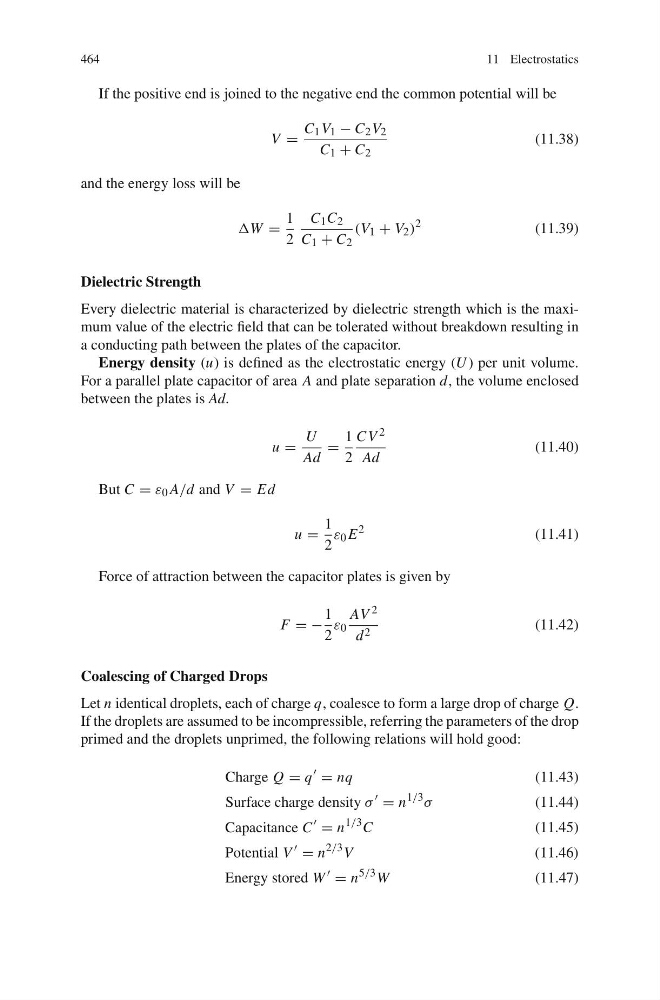
If the positive end is joined to the negative end the common potential will be
V =
C 1 V 1 − C 2 V 2
C 1 + C 2
(11.38)
and the energy loss will be
W =
1
2
C 1 C 2
C 1 + C 2
(V 1 + V 2 )
2
(11.39)
Dielectric Strength
Every dielectric material is characterized by dielectric strength which is the maximum value of the electric field that can be tolerated without breakdown resulting in
a conducting path between the plates of the capacitor.
Energy density (u) is defined as the electrostatic energy (U ) per unit volume.
For a parallel plate capacitor of area A and plate separation d, the volume enclosed
between the plates is Ad.
u =
U
Ad
=
1
2
C V 2
Ad
(11.40)
But C = ε 0 A/d and V = Ed
u =
1
2
ε 0 E
2
(11.41)
Force of attraction between the capacitor plates is given by
F = −
1
2
ε 0
AV 2
d 2
(11.42)
Coalescing of Charged Drops
Let n identical droplets, each of charge q, coalesce to form a large drop of charge Q.
If the droplets are assumed to be incompressible, referring the parameters of the drop
primed and the droplets unprimed, the following relations will hold good:
Charge Q = q
= nq
(11.43)
Surface charge density σ
= n
1/3
σ
(11.44)
Capacitance C
= n
1/3 C
(11.45)
Potential V
= n
2/3 V
(11.46)
Energy stored W
= n
5/3 W
(11.47)
11 Electrostatics
If the positive end is joined to the negative end the common potential will be
V =
C 1 V 1 − C 2 V 2
C 1 + C 2
(11.38)
and the energy loss will be
W =
1
2
C 1 C 2
C 1 + C 2
(V 1 + V 2 )
2
(11.39)
Dielectric Strength
Every dielectric material is characterized by dielectric strength which is the maximum value of the electric field that can be tolerated without breakdown resulting in
a conducting path between the plates of the capacitor.
Energy density (u) is defined as the electrostatic energy (U ) per unit volume.
For a parallel plate capacitor of area A and plate separation d, the volume enclosed
between the plates is Ad.
u =
U
Ad
=
1
2
C V 2
Ad
(11.40)
But C = ε 0 A/d and V = Ed
u =
1
2
ε 0 E
2
(11.41)
Force of attraction between the capacitor plates is given by
F = −
1
2
ε 0
AV 2
d 2
(11.42)
Coalescing of Charged Drops
Let n identical droplets, each of charge q, coalesce to form a large drop of charge Q.
If the droplets are assumed to be incompressible, referring the parameters of the drop
primed and the droplets unprimed, the following relations will hold good:
Charge Q = q
= nq
(11.43)
Surface charge density σ
= n
1/3
σ
(11.44)
Capacitance C
= n
1/3 C
(11.45)
Potential V
= n
2/3 V
(11.46)
Energy stored W
= n
5/3 W
(11.47)