

448
10 Heat and Matter
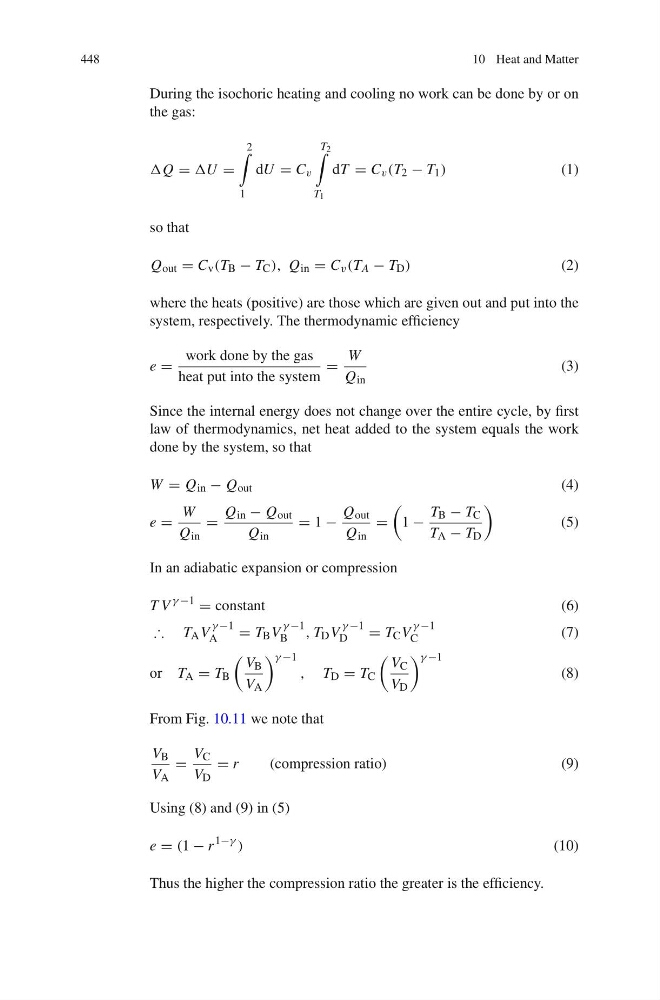
During the isochoric heating and cooling no work can be done by or on
the gas:
Q = U =
2
1
dU = C v
T 2
T 1
dT = C v (T 2 − T 1 )
(1)
so that
Q out = C v (T B − T C ), Q in = C v (T A − T D )
(2)
where the heats (positive) are those which are given out and put into the
system, respectively. The thermodynamic efficiency
e =
work done by the gas
heat put into the system
=
W
Q in
(3)
Since the internal energy does not change over the entire cycle, by first
law of thermodynamics, net heat added to the system equals the work
done by the system, so that
W = Q in − Q out
(4)
e =
W
Q in
=
Q in − Q out
Q in
= 1 −
Q out
Q in
=
1 −
T B − T C
T A − T D
(5)
In an adiabatic expansion or compression
T V
γ −1
= constant
(6)
∴ T A V
γ −1
A
= T B V
γ −1
B
, T D V
γ −1
D
= T C V
γ −1
C
(7)
or T A = T B
V B
V A
γ −1
, T D = T C
V C
V D
γ −1
(8)
From Fig. 10.11 we note that
V B
V A
=
V C
V D
= r
(compression ratio)
(9)
Using (8) and (9) in (5)
e = (1 − r
1−γ
)
(10)
Thus the higher the compression ratio the greater is the efficiency.
10 Heat and Matter
During the isochoric heating and cooling no work can be done by or on
the gas:
Q = U =
2
1
dU = C v
T 2
T 1
dT = C v (T 2 − T 1 )
(1)
so that
Q out = C v (T B − T C ), Q in = C v (T A − T D )
(2)
where the heats (positive) are those which are given out and put into the
system, respectively. The thermodynamic efficiency
e =
work done by the gas
heat put into the system
=
W
Q in
(3)
Since the internal energy does not change over the entire cycle, by first
law of thermodynamics, net heat added to the system equals the work
done by the system, so that
W = Q in − Q out
(4)
e =
W
Q in
=
Q in − Q out
Q in
= 1 −
Q out
Q in
=
1 −
T B − T C
T A − T D
(5)
In an adiabatic expansion or compression
T V
γ −1
= constant
(6)
∴ T A V
γ −1
A
= T B V
γ −1
B
, T D V
γ −1
D
= T C V
γ −1
C
(7)
or T A = T B
V B
V A
γ −1
, T D = T C
V C
V D
γ −1
(8)
From Fig. 10.11 we note that
V B
V A
=
V C
V D
= r
(compression ratio)
(9)
Using (8) and (9) in (5)
e = (1 − r
1−γ
)
(10)
Thus the higher the compression ratio the greater is the efficiency.