

10.3 Solutions
447
Combining (9) with (2)
p
P 0
=
n
n 0
(10)
Using (10) in (8)
n = n 0 exp
−
Mgh
RT
(11)
(c)
P
P 0
=
1
2
= exp
−
Mgh
RT
∴ h =
RT
Mg
ln 2 =
8.31 × 273 × 0.693
0.029 × 9.8
= 54224 m 54 km
10.50 (a) For a Carnot cycle
(i) e =
Q H − Q C
Q H
(ii) e =
T H − T C
T H
The symbols H and C are for hot and cold reservoirs.
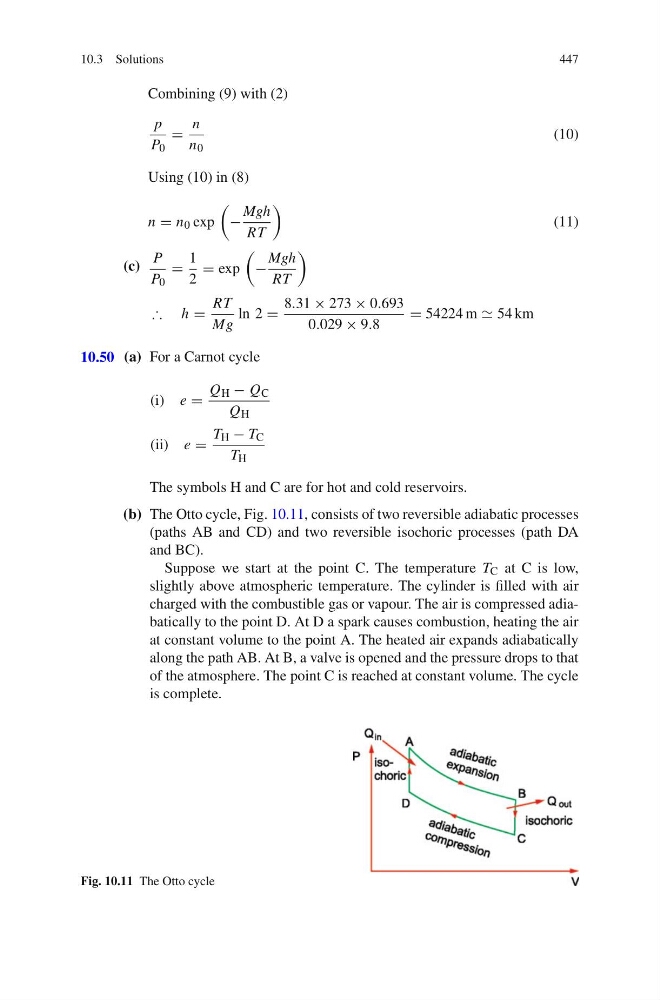
(b) The Otto cycle, Fig. 10.11, consists of two reversible adiabatic processes
(paths AB and CD) and two reversible isochoric processes (path DA
and BC).
Suppose we start at the point C. The temperature T C at C is low,
slightly above atmospheric temperature. The cylinder is filled with air
charged with the combustible gas or vapour. The air is compressed adiabatically to the point D. At D a spark causes combustion, heating the air
at constant volume to the point A. The heated air expands adiabatically
along the path AB. At B, a valve is opened and the pressure drops to that
of the atmosphere. The point C is reached at constant volume. The cycle
is complete.
Fig. 10.11 The Otto cycle
447
Combining (9) with (2)
p
P 0
=
n
n 0
(10)
Using (10) in (8)
n = n 0 exp
−
Mgh
RT
(11)
(c)
P
P 0
=
1
2
= exp
−
Mgh
RT
∴ h =
RT
Mg
ln 2 =
8.31 × 273 × 0.693
0.029 × 9.8
= 54224 m 54 km
10.50 (a) For a Carnot cycle
(i) e =
Q H − Q C
Q H
(ii) e =
T H − T C
T H
The symbols H and C are for hot and cold reservoirs.
(b) The Otto cycle, Fig. 10.11, consists of two reversible adiabatic processes
(paths AB and CD) and two reversible isochoric processes (path DA
and BC).
Suppose we start at the point C. The temperature T C at C is low,
slightly above atmospheric temperature. The cylinder is filled with air
charged with the combustible gas or vapour. The air is compressed adiabatically to the point D. At D a spark causes combustion, heating the air
at constant volume to the point A. The heated air expands adiabatically
along the path AB. At B, a valve is opened and the pressure drops to that
of the atmosphere. The point C is reached at constant volume. The cycle
is complete.
Fig. 10.11 The Otto cycle