

8.3 Solutions
369
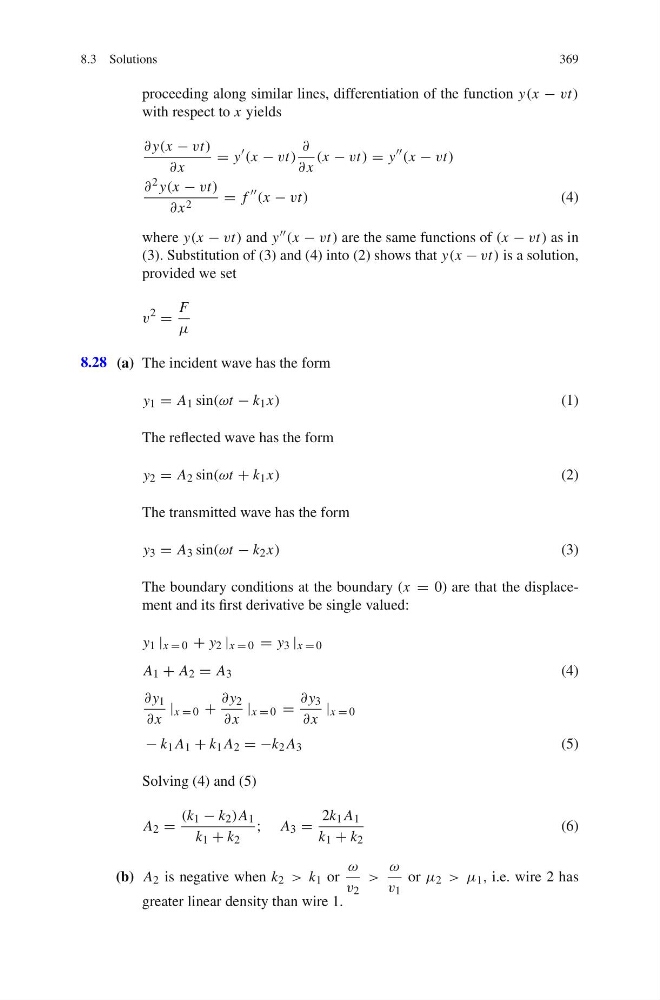
proceeding along similar lines, differentiation of the function y(x − vt)
with respect to x yields
∂ y(x − vt)
∂ x
= y
(x − vt)
∂
∂ x
(x − vt) = y
(x − vt)
∂ 2 y(x − vt)
∂ x 2
= f
(x − vt)
(4)
where y(x − vt) and y (x − vt) are the same functions of (x − vt) as in
(3). Substitution of (3) and (4) into (2) shows that y(x − vt) is a solution,
provided we set
v
2
=
F
μ
8.28 (a) The incident wave has the form
y 1 = A 1 sin(ωt − k 1 x)
(1)
The reflected wave has the form
y 2 = A 2 sin(ωt + k 1 x)
(2)
The transmitted wave has the form
y 3 = A 3 sin(ωt − k 2 x)
(3)
The boundary conditions at the boundary (x = 0) are that the displacement and its first derivative be single valued:
y 1 | x = 0 + y 2 | x = 0 = y 3 | x = 0
A 1 + A 2 = A 3
(4)
∂ y 1
∂ x
| x = 0 +
∂ y 2
∂ x
| x = 0 =
∂ y 3
∂ x
| x = 0
− k 1 A 1 + k 1 A 2 = −k 2 A 3
(5)
Solving (4) and (5)
A 2 =
(k 1 − k 2 )A 1
k 1 + k 2
; A 3 =
2k 1 A 1
k 1 + k 2
(6)
(b) A 2 is negative when k 2 > k 1 or
ω
v 2
>
ω
v 1
or μ 2 > μ 1 , i.e. wire 2 has
greater linear density than wire 1.
369
proceeding along similar lines, differentiation of the function y(x − vt)
with respect to x yields
∂ y(x − vt)
∂ x
= y
(x − vt)
∂
∂ x
(x − vt) = y
(x − vt)
∂ 2 y(x − vt)
∂ x 2
= f
(x − vt)
(4)
where y(x − vt) and y (x − vt) are the same functions of (x − vt) as in
(3). Substitution of (3) and (4) into (2) shows that y(x − vt) is a solution,
provided we set
v
2
=
F
μ
8.28 (a) The incident wave has the form
y 1 = A 1 sin(ωt − k 1 x)
(1)
The reflected wave has the form
y 2 = A 2 sin(ωt + k 1 x)
(2)
The transmitted wave has the form
y 3 = A 3 sin(ωt − k 2 x)
(3)
The boundary conditions at the boundary (x = 0) are that the displacement and its first derivative be single valued:
y 1 | x = 0 + y 2 | x = 0 = y 3 | x = 0
A 1 + A 2 = A 3
(4)
∂ y 1
∂ x
| x = 0 +
∂ y 2
∂ x
| x = 0 =
∂ y 3
∂ x
| x = 0
− k 1 A 1 + k 1 A 2 = −k 2 A 3
(5)
Solving (4) and (5)
A 2 =
(k 1 − k 2 )A 1
k 1 + k 2
; A 3 =
2k 1 A 1
k 1 + k 2
(6)
(b) A 2 is negative when k 2 > k 1 or
ω
v 2
>
ω
v 1
or μ 2 > μ 1 , i.e. wire 2 has
greater linear density than wire 1.