

368
8 Waves
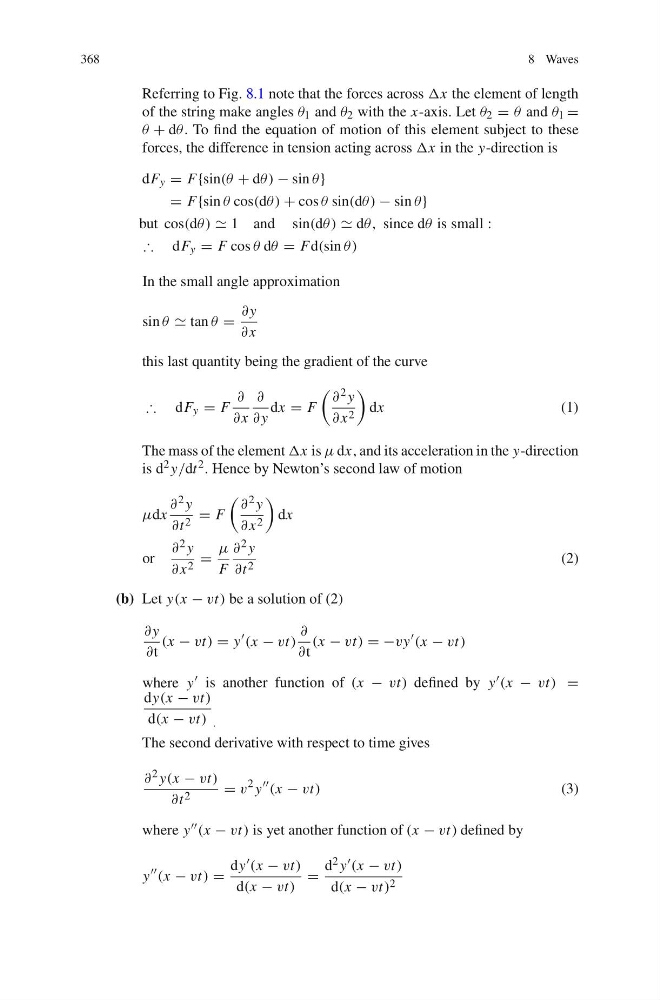
Referring to Fig. 8.1 note that the forces across x the element of length
of the string make angles θ 1 and θ 2 with the x-axis. Let θ 2 = θ and θ 1 =
θ + dθ . To find the equation of motion of this element subject to these
forces, the difference in tension acting across x in the y-direction is
dF y = F{sin(θ + dθ) − sin θ }
= F{sin θ cos(dθ) + cos θ sin(dθ) − sin θ }
but cos(dθ) 1 and sin(dθ) dθ, since dθ is small :
∴ dF y = F cos θ dθ = Fd(sin θ)
In the small angle approximation
sin θ tan θ =
∂ y
∂ x
this last quantity being the gradient of the curve
∴ dF y = F
∂
∂ x
∂
∂ y
dx = F
∂ 2 y
∂ x 2
dx
(1)
The mass of the element x is μ dx, and its acceleration in the y-direction
is d 2 y/dt 2 . Hence by Newton’s second law of motion
μdx
∂ 2 y
∂t 2 = F
∂ 2 y
∂ x 2
dx
or
∂ 2 y
∂ x 2 =
μ
F
∂ 2 y
∂t 2
(2)
(b) Let y(x − vt) be a solution of (2)
∂ y
∂t
(x − vt) = y
(x − vt)
∂
∂t
(x − vt) = −vy
(x − vt)
where y is another function of (x − vt) defined by y (x − vt) =
dy(x − vt)
d(x − vt) .
The second derivative with respect to time gives
∂ 2 y(x − vt)
∂t 2
= v
2 y
(x − vt)
(3)
where y (x − vt) is yet another function of (x − vt) defined by
y
(x − vt) =
dy (x − vt)
d(x − vt)
=
d 2 y (x − vt)
d(x − vt) 2
8 Waves
Referring to Fig. 8.1 note that the forces across x the element of length
of the string make angles θ 1 and θ 2 with the x-axis. Let θ 2 = θ and θ 1 =
θ + dθ . To find the equation of motion of this element subject to these
forces, the difference in tension acting across x in the y-direction is
dF y = F{sin(θ + dθ) − sin θ }
= F{sin θ cos(dθ) + cos θ sin(dθ) − sin θ }
but cos(dθ) 1 and sin(dθ) dθ, since dθ is small :
∴ dF y = F cos θ dθ = Fd(sin θ)
In the small angle approximation
sin θ tan θ =
∂ y
∂ x
this last quantity being the gradient of the curve
∴ dF y = F
∂
∂ x
∂
∂ y
dx = F
∂ 2 y
∂ x 2
dx
(1)
The mass of the element x is μ dx, and its acceleration in the y-direction
is d 2 y/dt 2 . Hence by Newton’s second law of motion
μdx
∂ 2 y
∂t 2 = F
∂ 2 y
∂ x 2
dx
or
∂ 2 y
∂ x 2 =
μ
F
∂ 2 y
∂t 2
(2)
(b) Let y(x − vt) be a solution of (2)
∂ y
∂t
(x − vt) = y
(x − vt)
∂
∂t
(x − vt) = −vy
(x − vt)
where y is another function of (x − vt) defined by y (x − vt) =
dy(x − vt)
d(x − vt) .
The second derivative with respect to time gives
∂ 2 y(x − vt)
∂t 2
= v
2 y
(x − vt)
(3)
where y (x − vt) is yet another function of (x − vt) defined by
y
(x − vt) =
dy (x − vt)
d(x − vt)
=
d 2 y (x − vt)
d(x − vt) 2