

366
8 Waves
Solving we find
v =
x
t
= 0.5 m/s along the + x − direction.
Now, y(−x, t) =
0.10
4 + (2x + t) 2 = y(x, t)
Therefore, the pulse is not symmetric.
8.22 (a) f =
N
2l
F
μ
(N = 1)
μ =
F
4 f 2 L 2 =
300
(4)(660) 2 (0.6) 2 = 4.78 × 10
−4 kg/m
(b) The frequencies of the first two harmonics are f 2 = 2 f = 1320 Hz and
f 3 = 3 f = 1980 Hz.
(c) For open pipe length is
L =
λ
2
=
v
2 f
=
340
2 × 660
= 0.2576 m
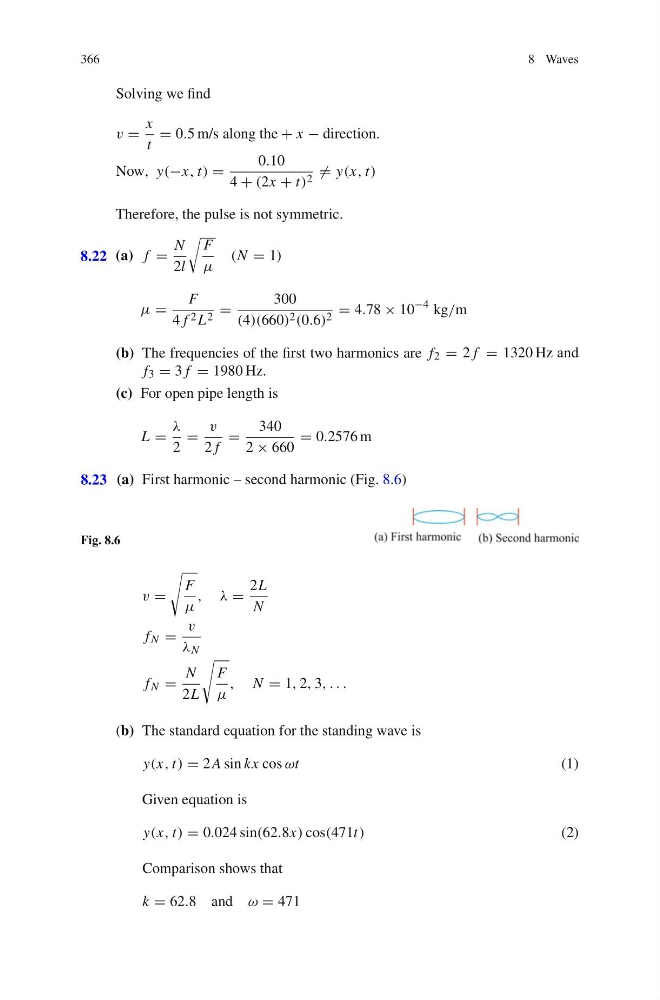
8.23 (a) First harmonic – second harmonic (Fig. 8.6)
Fig. 8.6
v =
F
μ
, λ =
2L
N
f N =
v
λ N
f N =
N
2L
F
μ
, N = 1, 2, 3, . . .
(b) The standard equation for the standing wave is
y(x, t) = 2A sin kx cos ωt
(1)
Given equation is
y(x, t) = 0.024 sin(62.8x) cos(471t)
(2)
Comparison shows that
k = 62.8 and ω = 471
8 Waves
Solving we find
v =
x
t
= 0.5 m/s along the + x − direction.
Now, y(−x, t) =
0.10
4 + (2x + t) 2 = y(x, t)
Therefore, the pulse is not symmetric.
8.22 (a) f =
N
2l
F
μ
(N = 1)
μ =
F
4 f 2 L 2 =
300
(4)(660) 2 (0.6) 2 = 4.78 × 10
−4 kg/m
(b) The frequencies of the first two harmonics are f 2 = 2 f = 1320 Hz and
f 3 = 3 f = 1980 Hz.
(c) For open pipe length is
L =
λ
2
=
v
2 f
=
340
2 × 660
= 0.2576 m
8.23 (a) First harmonic – second harmonic (Fig. 8.6)
Fig. 8.6
v =
F
μ
, λ =
2L
N
f N =
v
λ N
f N =
N
2L
F
μ
, N = 1, 2, 3, . . .
(b) The standard equation for the standing wave is
y(x, t) = 2A sin kx cos ωt
(1)
Given equation is
y(x, t) = 0.024 sin(62.8x) cos(471t)
(2)
Comparison shows that
k = 62.8 and ω = 471