

8.3 Solutions
365
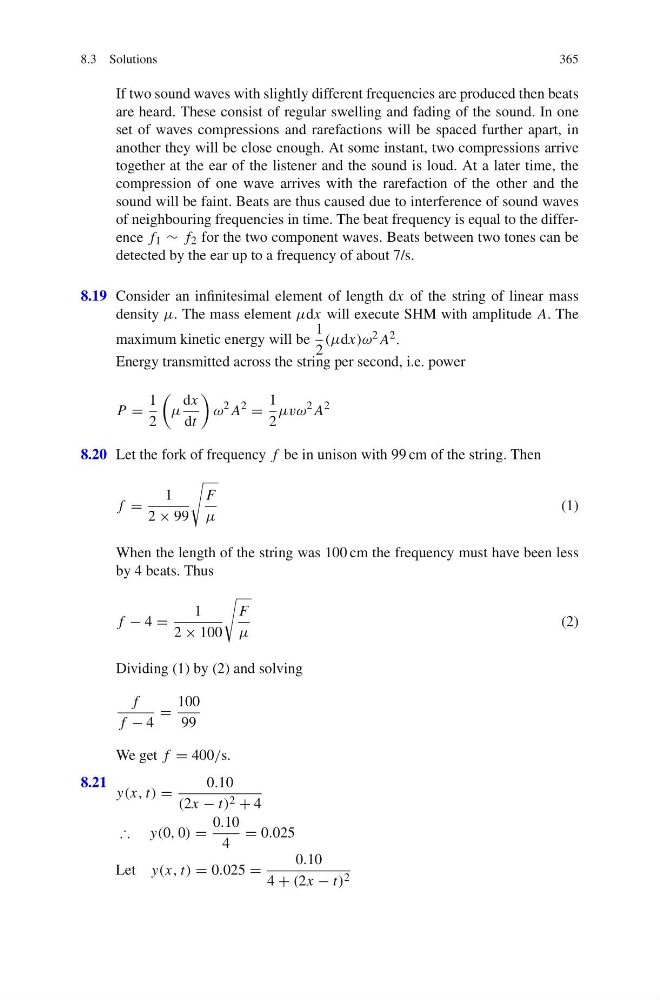
If two sound waves with slightly different frequencies are produced then beats
are heard. These consist of regular swelling and fading of the sound. In one
set of waves compressions and rarefactions will be spaced further apart, in
another they will be close enough. At some instant, two compressions arrive
together at the ear of the listener and the sound is loud. At a later time, the
compression of one wave arrives with the rarefaction of the other and the
sound will be faint. Beats are thus caused due to interference of sound waves
of neighbouring frequencies in time. The beat frequency is equal to the difference f 1 ∼ f 2 for the two component waves. Beats between two tones can be
detected by the ear up to a frequency of about 7/s.
8.19 Consider an infinitesimal element of length dx of the string of linear mass
density μ. The mass element μdx will execute SHM with amplitude A. The
maximum kinetic energy will be
1
2
(μdx)ω 2 A 2 .
Energy transmitted across the string per second, i.e. power
P =
1
2
μ
dx
dt
ω
2 A
2
=
1
2
μvω
2 A
2
8.20 Let the fork of frequency f be in unison with 99 cm of the string. Then
f =
1
2 × 99
F
μ
(1)
When the length of the string was 100 cm the frequency must have been less
by 4 beats. Thus
f − 4 =
1
2 × 100
F
μ
(2)
Dividing (1) by (2) and solving
f
f − 4
=
100
99
We get f = 400/s.
8.21
y(x, t) =
0.10
(2x − t) 2 + 4
∴ y(0, 0) =
0.10
4
= 0.025
Let y(x, t) = 0.025 =
0.10
4 + (2x − t) 2
365
If two sound waves with slightly different frequencies are produced then beats
are heard. These consist of regular swelling and fading of the sound. In one
set of waves compressions and rarefactions will be spaced further apart, in
another they will be close enough. At some instant, two compressions arrive
together at the ear of the listener and the sound is loud. At a later time, the
compression of one wave arrives with the rarefaction of the other and the
sound will be faint. Beats are thus caused due to interference of sound waves
of neighbouring frequencies in time. The beat frequency is equal to the difference f 1 ∼ f 2 for the two component waves. Beats between two tones can be
detected by the ear up to a frequency of about 7/s.
8.19 Consider an infinitesimal element of length dx of the string of linear mass
density μ. The mass element μdx will execute SHM with amplitude A. The
maximum kinetic energy will be
1
2
(μdx)ω 2 A 2 .
Energy transmitted across the string per second, i.e. power
P =
1
2
μ
dx
dt
ω
2 A
2
=
1
2
μvω
2 A
2
8.20 Let the fork of frequency f be in unison with 99 cm of the string. Then
f =
1
2 × 99
F
μ
(1)
When the length of the string was 100 cm the frequency must have been less
by 4 beats. Thus
f − 4 =
1
2 × 100
F
μ
(2)
Dividing (1) by (2) and solving
f
f − 4
=
100
99
We get f = 400/s.
8.21
y(x, t) =
0.10
(2x − t) 2 + 4
∴ y(0, 0) =
0.10
4
= 0.025
Let y(x, t) = 0.025 =
0.10
4 + (2x − t) 2