

310
7 Lagrangian and Hamiltonian Mechanics
This is the equation for one-dimensional harmonic oscillator. The general
solution is
x = A sin(ωt + ε) + B cos(ωt + ε)
(6)
which can be verified by substituting (6) in (5). Here A, B and ε are constants
to be determined from initial conditions.
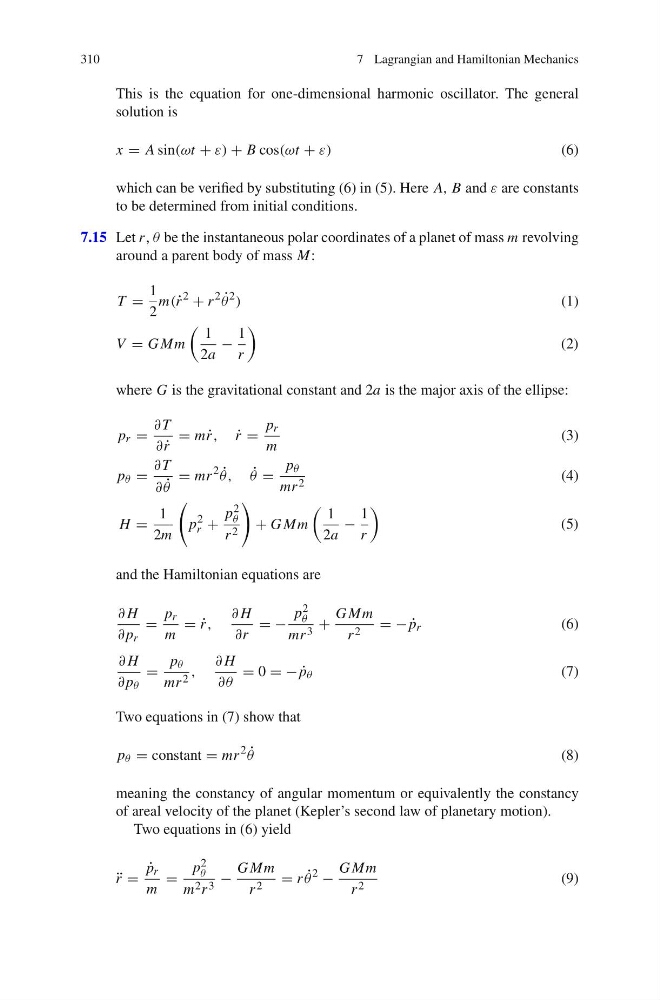
7.15 Let r , θ be the instantaneous polar coordinates of a planet of mass m revolving
around a parent body of mass M:
T =
1
2
m(˙ r
2
+ r
2 ˙
θ
2
)
(1)
V = G Mm
1
2a
−
1
r
(2)
where G is the gravitational constant and 2a is the major axis of the ellipse:
p r =
∂ T
∂ ˙
r
= m ˙
r , ˙
r =
p r
m
(3)
p θ =
∂ T
∂ ˙
θ
= mr
2 ˙
θ, ˙
θ =
p θ
mr 2
(4)
H =
1
2m
p
2
r +
p 2
θ
r 2
+ G Mm
1
2a
−
1
r
(5)
and the Hamiltonian equations are
∂ H
∂ p r
=
p r
m
= ˙
r ,
∂ H
∂r
= −
p 2
θ
mr 3 +
G Mm
r 2 = − ˙
p r
(6)
∂ H
∂ p θ
=
p θ
mr 2 ,
∂ H
∂θ
= 0 = − ˙
p θ
(7)
Two equations in (7) show that
p θ = constant = mr
2 ˙
θ
(8)
meaning the constancy of angular momentum or equivalently the constancy
of areal velocity of the planet (Kepler’s second law of planetary motion).
Two equations in (6) yield
¨
r =
˙
p r
m
=
p 2
θ
m 2 r 3 −
G Mm
r 2 = r ˙
θ
2
−
G Mm
r 2
(9)
7 Lagrangian and Hamiltonian Mechanics
This is the equation for one-dimensional harmonic oscillator. The general
solution is
x = A sin(ωt + ε) + B cos(ωt + ε)
(6)
which can be verified by substituting (6) in (5). Here A, B and ε are constants
to be determined from initial conditions.
7.15 Let r , θ be the instantaneous polar coordinates of a planet of mass m revolving
around a parent body of mass M:
T =
1
2
m(˙ r
2
+ r
2 ˙
θ
2
)
(1)
V = G Mm
1
2a
−
1
r
(2)
where G is the gravitational constant and 2a is the major axis of the ellipse:
p r =
∂ T
∂ ˙
r
= m ˙
r , ˙
r =
p r
m
(3)
p θ =
∂ T
∂ ˙
θ
= mr
2 ˙
θ, ˙
θ =
p θ
mr 2
(4)
H =
1
2m
p
2
r +
p 2
θ
r 2
+ G Mm
1
2a
−
1
r
(5)
and the Hamiltonian equations are
∂ H
∂ p r
=
p r
m
= ˙
r ,
∂ H
∂r
= −
p 2
θ
mr 3 +
G Mm
r 2 = − ˙
p r
(6)
∂ H
∂ p θ
=
p θ
mr 2 ,
∂ H
∂θ
= 0 = − ˙
p θ
(7)
Two equations in (7) show that
p θ = constant = mr
2 ˙
θ
(8)
meaning the constancy of angular momentum or equivalently the constancy
of areal velocity of the planet (Kepler’s second law of planetary motion).
Two equations in (6) yield
¨
r =
˙
p r
m
=
p 2
θ
m 2 r 3 −
G Mm
r 2 = r ˙
θ
2
−
G Mm
r 2
(9)