

7.3 Solutions
309
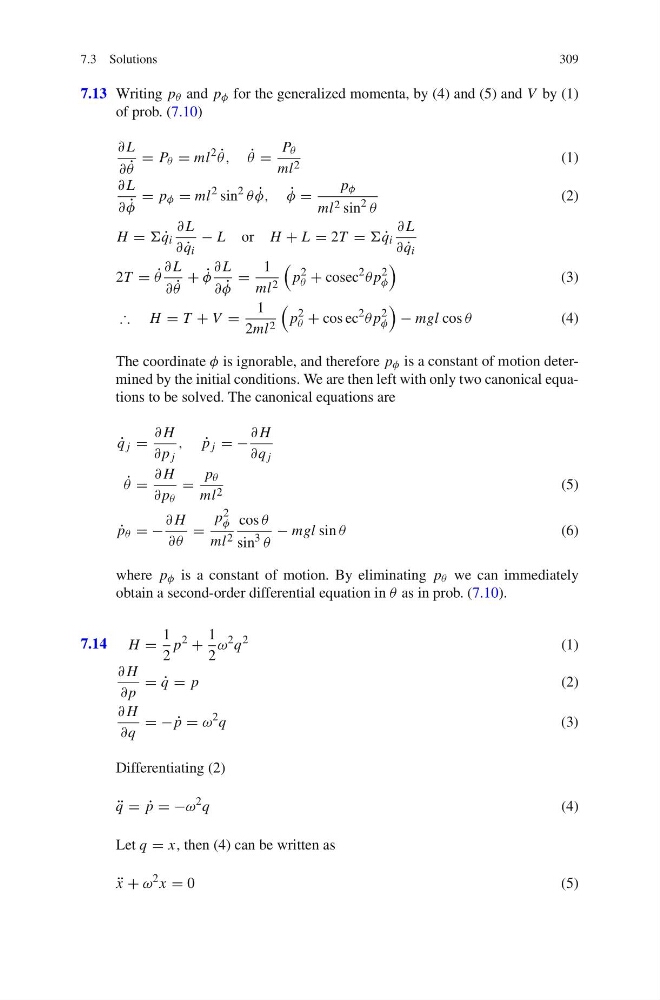
7.13 Writing p θ and p φ for the generalized momenta, by (4) and (5) and V by (1)
of prob. (7.10)
∂ L
∂ ˙
θ
= P θ = ml
2 ˙
θ, ˙
θ =
P θ
ml 2
(1)
∂ L
∂ ˙
φ
= p φ = ml
2 sin
2
θ ˙
φ, ˙
φ =
p φ
ml 2 sin
2
θ
(2)
H = ˙
q i
∂ L
∂ ˙
q i
− L or H + L = 2T = ˙
q i
∂ L
∂ ˙
q i
2T = ˙
θ
∂ L
∂ ˙
θ
+ ˙
φ
∂ L
∂ ˙
φ
=
1
ml 2
p
2
θ + cosec
2
θ p
2
φ
(3)
∴ H = T + V =
1
2ml 2
p
2
θ + cos ec
2
θ p
2
φ
− mgl cos θ
(4)
The coordinate φ is ignorable, and therefore p φ is a constant of motion determined by the initial conditions. We are then left with only two canonical equations to be solved. The canonical equations are
˙
q j =
∂ H
∂ p j
, ˙
p j = −
∂ H
∂q j
˙
θ =
∂ H
∂ p θ
=
p θ
ml 2
(5)
˙
p θ = −
∂ H
∂θ
=
p 2
φ
ml 2
cos θ
sin
3
θ
− mgl sin θ
(6)
where p φ is a constant of motion. By eliminating p θ we can immediately
obtain a second-order differential equation in θ as in prob. (7.10).
7.14 H =
1
2
p
2
+
1
2
ω
2 q
2
(1)
∂ H
∂ p
= ˙
q = p
(2)
∂ H
∂q
= − ˙
p = ω
2 q
(3)
Differentiating (2)
¨
q = ˙
p = −ω
2 q
(4)
Let q = x, then (4) can be written as
¨
x + ω
2 x = 0
( 5 )
309
7.13 Writing p θ and p φ for the generalized momenta, by (4) and (5) and V by (1)
of prob. (7.10)
∂ L
∂ ˙
θ
= P θ = ml
2 ˙
θ, ˙
θ =
P θ
ml 2
(1)
∂ L
∂ ˙
φ
= p φ = ml
2 sin
2
θ ˙
φ, ˙
φ =
p φ
ml 2 sin
2
θ
(2)
H = ˙
q i
∂ L
∂ ˙
q i
− L or H + L = 2T = ˙
q i
∂ L
∂ ˙
q i
2T = ˙
θ
∂ L
∂ ˙
θ
+ ˙
φ
∂ L
∂ ˙
φ
=
1
ml 2
p
2
θ + cosec
2
θ p
2
φ
(3)
∴ H = T + V =
1
2ml 2
p
2
θ + cos ec
2
θ p
2
φ
− mgl cos θ
(4)
The coordinate φ is ignorable, and therefore p φ is a constant of motion determined by the initial conditions. We are then left with only two canonical equations to be solved. The canonical equations are
˙
q j =
∂ H
∂ p j
, ˙
p j = −
∂ H
∂q j
˙
θ =
∂ H
∂ p θ
=
p θ
ml 2
(5)
˙
p θ = −
∂ H
∂θ
=
p 2
φ
ml 2
cos θ
sin
3
θ
− mgl sin θ
(6)
where p φ is a constant of motion. By eliminating p θ we can immediately
obtain a second-order differential equation in θ as in prob. (7.10).
7.14 H =
1
2
p
2
+
1
2
ω
2 q
2
(1)
∂ H
∂ p
= ˙
q = p
(2)
∂ H
∂q
= − ˙
p = ω
2 q
(3)
Differentiating (2)
¨
q = ˙
p = −ω
2 q
(4)
Let q = x, then (4) can be written as
¨
x + ω
2 x = 0
( 5 )