

7.3 Solutions
307
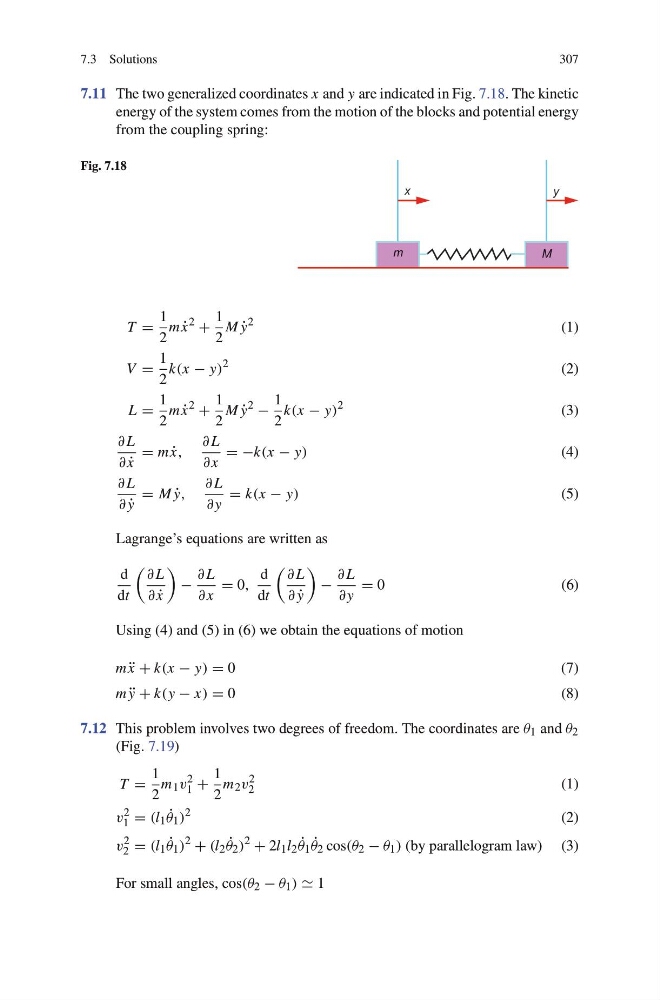
7.11 The two generalized coordinates x and y are indicated in Fig. 7.18. The kinetic
energy of the system comes from the motion of the blocks and potential energy
from the coupling spring:
Fig. 7.18
T =
1
2
m ˙
x
2
+
1
2
M ˙
y
2
(1)
V =
1
2
k(x − y)
2
(2)
L =
1
2
m ˙
x
2
+
1
2
M ˙
y
2
−
1
2
k(x − y)
2
(3)
∂ L
∂ ˙
x
= m ˙
x,
∂ L
∂ x
= −k(x − y)
(4)
∂ L
∂ ˙
y
= M ˙
y,
∂ L
∂ y
= k(x − y)
(5)
Lagrange’s equations are written as
d
dt
∂ L
∂ ˙
x
−
∂ L
∂ x
= 0,
d
dt
∂ L
∂ ˙
y
−
∂ L
∂ y
= 0
( 6 )
Using (4) and (5) in (6) we obtain the equations of motion
m ¨
x + k(x − y) = 0
( 7 )
m ¨
y + k(y − x) = 0
( 8 )
7.12 This problem involves two degrees of freedom. The coordinates are θ 1 and θ 2
(Fig. 7.19)
T =
1
2
m 1 v
2
1 +
1
2
m 2 v
2
2
(1)
v
2
1 = (l 1 ˙
θ 1 )
2
(2)
v
2
2 = (l 1 ˙
θ 1 )
2
+ (l 2 ˙
θ 2 )
2
+ 2l 1 l 2 ˙
θ 1 ˙
θ 2 cos(θ 2 − θ 1 ) (by parallelogram law) (3)
For small angles, cos(θ 2 − θ 1 ) 1
307
7.11 The two generalized coordinates x and y are indicated in Fig. 7.18. The kinetic
energy of the system comes from the motion of the blocks and potential energy
from the coupling spring:
Fig. 7.18
T =
1
2
m ˙
x
2
+
1
2
M ˙
y
2
(1)
V =
1
2
k(x − y)
2
(2)
L =
1
2
m ˙
x
2
+
1
2
M ˙
y
2
−
1
2
k(x − y)
2
(3)
∂ L
∂ ˙
x
= m ˙
x,
∂ L
∂ x
= −k(x − y)
(4)
∂ L
∂ ˙
y
= M ˙
y,
∂ L
∂ y
= k(x − y)
(5)
Lagrange’s equations are written as
d
dt
∂ L
∂ ˙
x
−
∂ L
∂ x
= 0,
d
dt
∂ L
∂ ˙
y
−
∂ L
∂ y
= 0
( 6 )
Using (4) and (5) in (6) we obtain the equations of motion
m ¨
x + k(x − y) = 0
( 7 )
m ¨
y + k(y − x) = 0
( 8 )
7.12 This problem involves two degrees of freedom. The coordinates are θ 1 and θ 2
(Fig. 7.19)
T =
1
2
m 1 v
2
1 +
1
2
m 2 v
2
2
(1)
v
2
1 = (l 1 ˙
θ 1 )
2
(2)
v
2
2 = (l 1 ˙
θ 1 )
2
+ (l 2 ˙
θ 2 )
2
+ 2l 1 l 2 ˙
θ 1 ˙
θ 2 cos(θ 2 − θ 1 ) (by parallelogram law) (3)
For small angles, cos(θ 2 − θ 1 ) 1