

6.3 Solutions
279
where μ is the reduced mass given by
μ =
m H m Cl
m H + m Cl
=
10. × 36.46
1.0 + 36.46
= 0.9733 amu = 0.9733 × 1.66 × 10
−27 kg = 1.6157 × 10
−27 kg
f =
1
2π
480
1.6157 × 10 −27 = 8.68 × 10
13 Hz
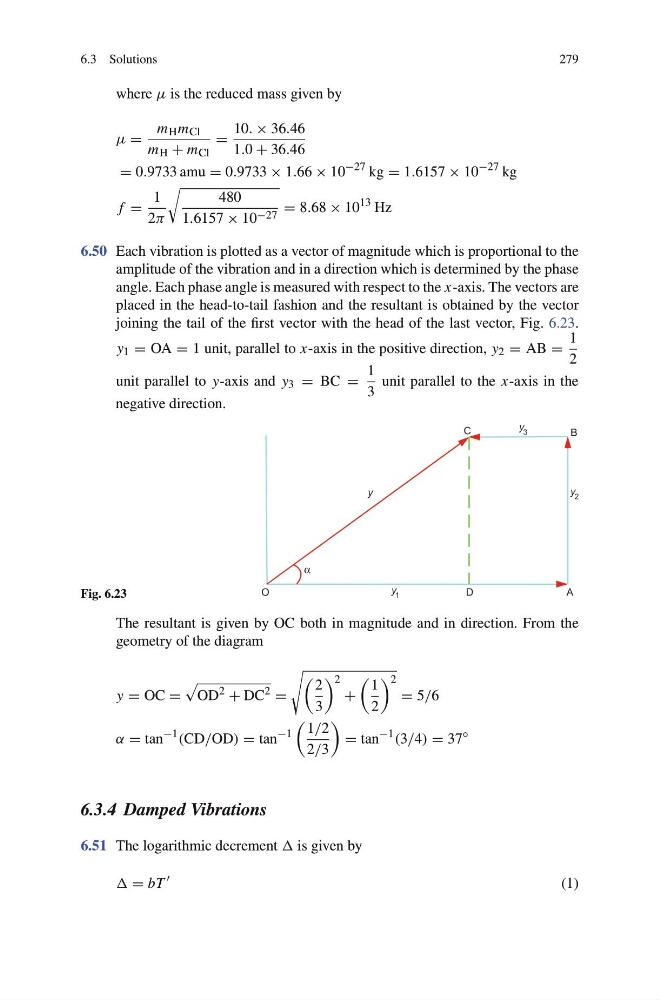
6.50 Each vibration is plotted as a vector of magnitude which is proportional to the
amplitude of the vibration and in a direction which is determined by the phase
angle. Each phase angle is measured with respect to the x-axis. The vectors are
placed in the head-to-tail fashion and the resultant is obtained by the vector
joining the tail of the first vector with the head of the last vector, Fig. 6.23.
y 1 = OA = 1 unit, parallel to x-axis in the positive direction, y 2 = AB =
1
2
unit parallel to y-axis and y 3 = BC =
1
3
unit parallel to the x-axis in the
negative direction.
Fig. 6.23
The resultant is given by OC both in magnitude and in direction. From the
geometry of the diagram
y = OC =
OD
2
+ DC
2
=
2
3
2
+
1
2
2
= 5/6
α = tan
−1
(CD/OD) = tan
−1
1/2
2/3
= tan
−1
(3/4) = 37
◦
6.3.4 Damped Vibrations
6.51 The logarithmic decrement is given by
= bT
(1)
279
where μ is the reduced mass given by
μ =
m H m Cl
m H + m Cl
=
10. × 36.46
1.0 + 36.46
= 0.9733 amu = 0.9733 × 1.66 × 10
−27 kg = 1.6157 × 10
−27 kg
f =
1
2π
480
1.6157 × 10 −27 = 8.68 × 10
13 Hz
6.50 Each vibration is plotted as a vector of magnitude which is proportional to the
amplitude of the vibration and in a direction which is determined by the phase
angle. Each phase angle is measured with respect to the x-axis. The vectors are
placed in the head-to-tail fashion and the resultant is obtained by the vector
joining the tail of the first vector with the head of the last vector, Fig. 6.23.
y 1 = OA = 1 unit, parallel to x-axis in the positive direction, y 2 = AB =
1
2
unit parallel to y-axis and y 3 = BC =
1
3
unit parallel to the x-axis in the
negative direction.
Fig. 6.23
The resultant is given by OC both in magnitude and in direction. From the
geometry of the diagram
y = OC =
OD
2
+ DC
2
=
2
3
2
+
1
2
2
= 5/6
α = tan
−1
(CD/OD) = tan
−1
1/2
2/3
= tan
−1
(3/4) = 37
◦
6.3.4 Damped Vibrations
6.51 The logarithmic decrement is given by
= bT
(1)