

278
6 Oscillations
V =
mg
4b
X
2
1 +
mg
4b
+
k
2
X
2
2
(11)
T =
m
4
( ˙
X
2
1 + ˙
X
2
2 )
(12)
Thus the cross terms have now disappeared. The potential energy V is now
expressed as a sum of squares of normal coordinates multiplied by constant
coefficients and kinetic energy. T is expressed in the form of a sum of squares
of the time derivatives of the normal coordination.
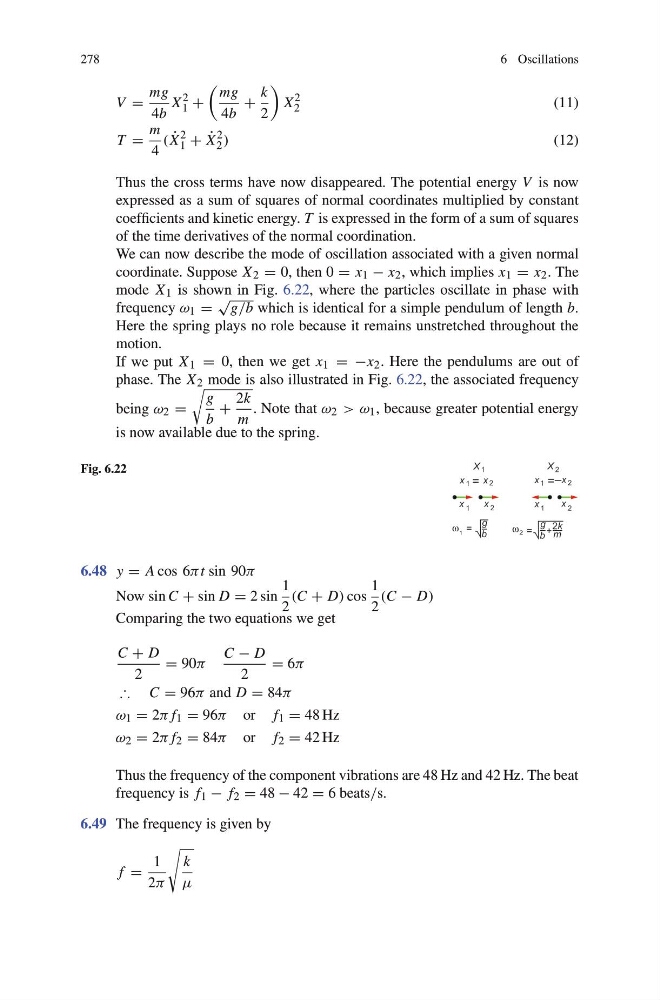
We can now describe the mode of oscillation associated with a given normal
coordinate. Suppose X 2 = 0, then 0 = x 1 − x 2 , which implies x 1 = x 2 . The
mode X 1 is shown in Fig. 6.22, where the particles oscillate in phase with
frequency ω 1 =
√
g/b which is identical for a simple pendulum of length b.
Here the spring plays no role because it remains unstretched throughout the
motion.
If we put X 1 = 0, then we get x 1 = −x 2 . Here the pendulums are out of
phase. The X 2 mode is also illustrated in Fig. 6.22, the associated frequency
being ω 2 =
g
b
+
2k
m
. Note that ω 2 > ω 1 , because greater potential energy
is now available due to the spring.
Fig. 6.22
6.48 y = A cos 6π t sin 90π
Now sin C + sin D = 2 sin
1
2
(C + D) cos
1
2
(C − D)
Comparing the two equations we get
C + D
2
= 90π
C − D
2
= 6π
∴ C = 96π and D = 84π
ω 1 = 2π f 1 = 96π or f 1 = 48 Hz
ω 2 = 2π f 2 = 84π or f 2 = 42 Hz
Thus the frequency of the component vibrations are 48 Hz and 42 Hz. The beat
frequency is f 1 − f 2 = 48 − 42 = 6 beats/s.
6.49 The frequency is given by
f =
1
2π
k
μ
6 Oscillations
V =
mg
4b
X
2
1 +
mg
4b
+
k
2
X
2
2
(11)
T =
m
4
( ˙
X
2
1 + ˙
X
2
2 )
(12)
Thus the cross terms have now disappeared. The potential energy V is now
expressed as a sum of squares of normal coordinates multiplied by constant
coefficients and kinetic energy. T is expressed in the form of a sum of squares
of the time derivatives of the normal coordination.
We can now describe the mode of oscillation associated with a given normal
coordinate. Suppose X 2 = 0, then 0 = x 1 − x 2 , which implies x 1 = x 2 . The
mode X 1 is shown in Fig. 6.22, where the particles oscillate in phase with
frequency ω 1 =
√
g/b which is identical for a simple pendulum of length b.
Here the spring plays no role because it remains unstretched throughout the
motion.
If we put X 1 = 0, then we get x 1 = −x 2 . Here the pendulums are out of
phase. The X 2 mode is also illustrated in Fig. 6.22, the associated frequency
being ω 2 =
g
b
+
2k
m
. Note that ω 2 > ω 1 , because greater potential energy
is now available due to the spring.
Fig. 6.22
6.48 y = A cos 6π t sin 90π
Now sin C + sin D = 2 sin
1
2
(C + D) cos
1
2
(C − D)
Comparing the two equations we get
C + D
2
= 90π
C − D
2
= 6π
∴ C = 96π and D = 84π
ω 1 = 2π f 1 = 96π or f 1 = 48 Hz
ω 2 = 2π f 2 = 84π or f 2 = 42 Hz
Thus the frequency of the component vibrations are 48 Hz and 42 Hz. The beat
frequency is f 1 − f 2 = 48 − 42 = 6 beats/s.
6.49 The frequency is given by
f =
1
2π
k
μ