

276
6 Oscillations
from P, that is, k(x 1 − x 2 )b or k(θ 1 − θ 2 )b 2 . The second equation of motion
can be similarly written. Thus, the two equations of motion are
mb ¨
θ 1 + mgθ 1 + kb(θ 1 − θ 2 ) = 0
( 1 )
mb ¨
θ 2 + mgθ 2 + kb(θ 2 − θ 1 ) = 0
( 2 )
The harmonic solutions are
θ 1 = A sin ωt, θ 2 = B sin ωt
(3)
¨
θ 1 = −Aω
2 sin ωt, ¨
θ 2 = −Bω
2 sin ωt
(4)
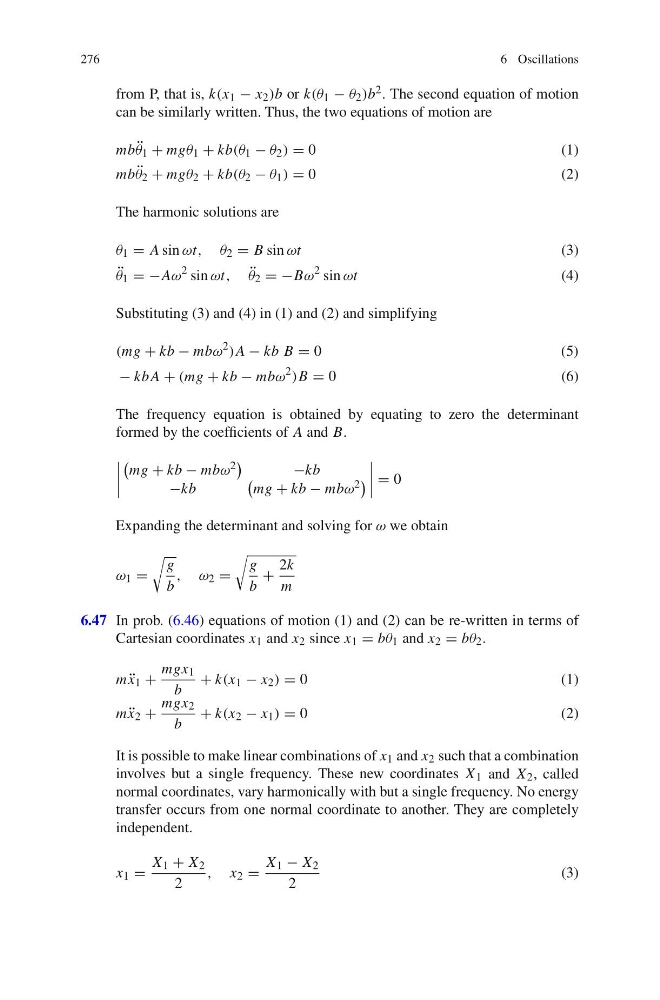
Substituting (3) and (4) in (1) and (2) and simplifying
(mg + kb − mbω
2
)A − kb B = 0
( 5 )
− kb A + (mg + kb − mbω
2
)B = 0
( 6 )
The frequency equation is obtained by equating to zero the determinant
formed by the coefficients of A and B.
mg + kb − mbω 2
−kb
−kb
mg + kb − mbω 2
= 0
Expanding the determinant and solving for ω we obtain
ω 1 =
g
b
, ω 2 =
g
b
+
2k
m
6.47 In prob. (6.46) equations of motion (1) and (2) can be re-written in terms of
Cartesian coordinates x 1 and x 2 since x 1 = bθ 1 and x 2 = bθ 2 .
m ¨
x 1 +
mgx 1
b
+ k(x 1 − x 2 ) = 0
( 1 )
m ¨
x 2 +
mgx 2
b
+ k(x 2 − x 1 ) = 0
( 2 )
It is possible to make linear combinations of x 1 and x 2 such that a combination
involves but a single frequency. These new coordinates X 1 and X 2 , called
normal coordinates, vary harmonically with but a single frequency. No energy
transfer occurs from one normal coordinate to another. They are completely
independent.
x 1 =
X 1 + X 2
2
, x 2 =
X 1 − X 2
2
(3)
6 Oscillations
from P, that is, k(x 1 − x 2 )b or k(θ 1 − θ 2 )b 2 . The second equation of motion
can be similarly written. Thus, the two equations of motion are
mb ¨
θ 1 + mgθ 1 + kb(θ 1 − θ 2 ) = 0
( 1 )
mb ¨
θ 2 + mgθ 2 + kb(θ 2 − θ 1 ) = 0
( 2 )
The harmonic solutions are
θ 1 = A sin ωt, θ 2 = B sin ωt
(3)
¨
θ 1 = −Aω
2 sin ωt, ¨
θ 2 = −Bω
2 sin ωt
(4)
Substituting (3) and (4) in (1) and (2) and simplifying
(mg + kb − mbω
2
)A − kb B = 0
( 5 )
− kb A + (mg + kb − mbω
2
)B = 0
( 6 )
The frequency equation is obtained by equating to zero the determinant
formed by the coefficients of A and B.
mg + kb − mbω 2
−kb
−kb
mg + kb − mbω 2
= 0
Expanding the determinant and solving for ω we obtain
ω 1 =
g
b
, ω 2 =
g
b
+
2k
m
6.47 In prob. (6.46) equations of motion (1) and (2) can be re-written in terms of
Cartesian coordinates x 1 and x 2 since x 1 = bθ 1 and x 2 = bθ 2 .
m ¨
x 1 +
mgx 1
b
+ k(x 1 − x 2 ) = 0
( 1 )
m ¨
x 2 +
mgx 2
b
+ k(x 2 − x 1 ) = 0
( 2 )
It is possible to make linear combinations of x 1 and x 2 such that a combination
involves but a single frequency. These new coordinates X 1 and X 2 , called
normal coordinates, vary harmonically with but a single frequency. No energy
transfer occurs from one normal coordinate to another. They are completely
independent.
x 1 =
X 1 + X 2
2
, x 2 =
X 1 − X 2
2
(3)