

6.3 Solutions
275
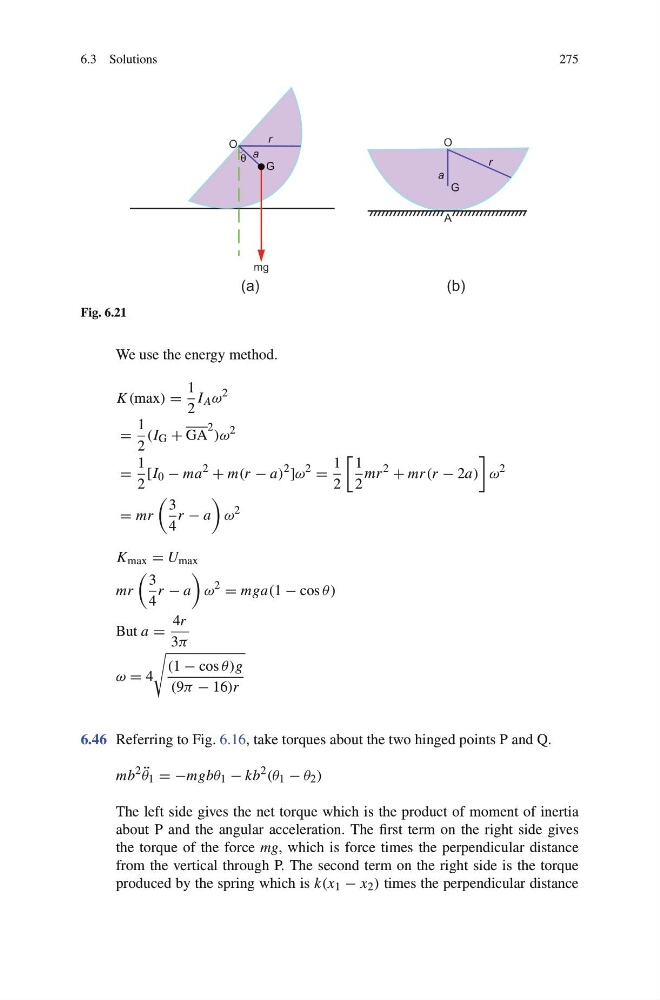
Fig. 6.21
We use the energy method.
K (max) =
1
2
I A ω
2
=
1
2
(I G + GA
2 )ω
2
=
1
2
[I 0 − ma
2
+ m(r − a)
2
]ω
2
=
1
2
1
2
mr
2
+ mr(r − 2a)
ω
2
= mr
3
4
r − a
ω
2
K max = U max
mr
3
4
r − a
ω
2
= mga(1 − cos θ)
But a =
4r
3π
ω = 4
(1 − cos θ)g
(9π − 16)r
6.46 Referring to Fig. 6.16, take torques about the two hinged points P and Q.
mb
2 ¨
θ 1 = −mgbθ 1 − kb
2
(θ 1 − θ 2 )
The left side gives the net torque which is the product of moment of inertia
about P and the angular acceleration. The first term on the right side gives
the torque of the force mg, which is force times the perpendicular distance
from the vertical through P. The second term on the right side is the torque
produced by the spring which is k(x 1 − x 2 ) times the perpendicular distance
275
Fig. 6.21
We use the energy method.
K (max) =
1
2
I A ω
2
=
1
2
(I G + GA
2 )ω
2
=
1
2
[I 0 − ma
2
+ m(r − a)
2
]ω
2
=
1
2
1
2
mr
2
+ mr(r − 2a)
ω
2
= mr
3
4
r − a
ω
2
K max = U max
mr
3
4
r − a
ω
2
= mga(1 − cos θ)
But a =
4r
3π
ω = 4
(1 − cos θ)g
(9π − 16)r
6.46 Referring to Fig. 6.16, take torques about the two hinged points P and Q.
mb
2 ¨
θ 1 = −mgbθ 1 − kb
2
(θ 1 − θ 2 )
The left side gives the net torque which is the product of moment of inertia
about P and the angular acceleration. The first term on the right side gives
the torque of the force mg, which is force times the perpendicular distance
from the vertical through P. The second term on the right side is the torque
produced by the spring which is k(x 1 − x 2 ) times the perpendicular distance