

5.3 Solutions
207
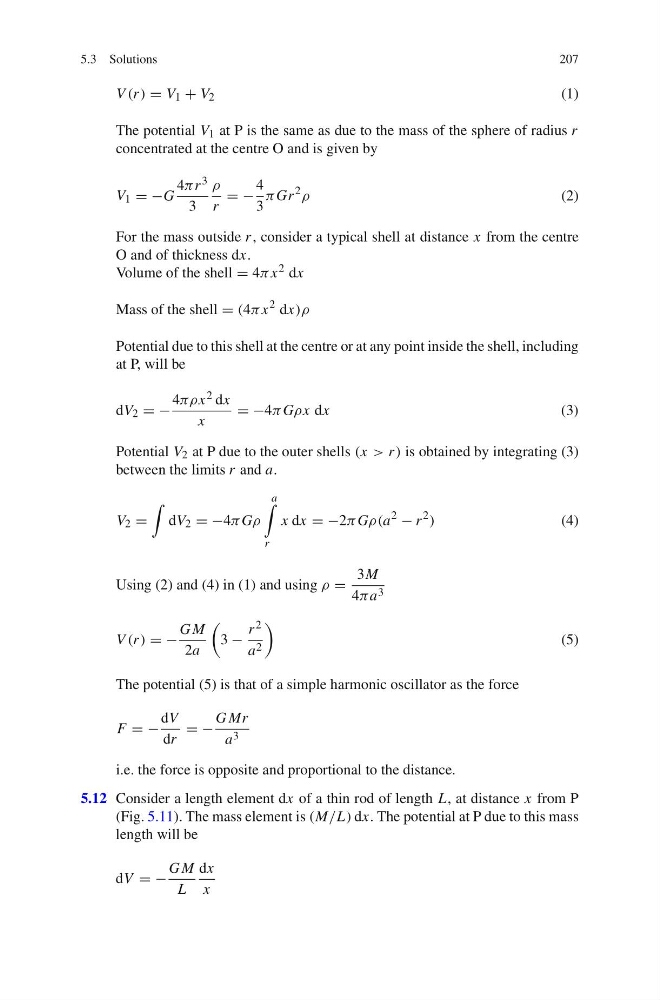
V (r ) = V 1 + V 2
(1)
The potential V 1 at P is the same as due to the mass of the sphere of radius r
concentrated at the centre O and is given by
V 1 = −G
4πr 3
3
ρ
r
= −
4
3
π Gr
2
ρ
(2)
For the mass outside r , consider a typical shell at distance x from the centre
O and of thickness dx.
Volume of the shell = 4π x 2 dx
Mass of the shell = (4π x
2 dx)ρ
Potential due to this shell at the centre or at any point inside the shell, including
at P, will be
dV 2 = −
4πρx 2 dx
x
= −4π Gρx dx
(3)
Potential V 2 at P due to the outer shells (x > r ) is obtained by integrating (3)
between the limits r and a.
V 2 =
dV 2 = −4π Gρ
a
r
x dx = −2π Gρ(a
2
− r
2
)
(4)
Using (2) and (4) in (1) and using ρ =
3M
4πa 3
V (r ) = −
G M
2a
3 −
r 2
a 2
(5)
The potential (5) is that of a simple harmonic oscillator as the force
F = −
dV
dr
= −
G Mr
a 3
i.e. the force is opposite and proportional to the distance.
5.12 Consider a length element dx of a thin rod of length L, at distance x from P
(Fig. 5.11). The mass element is (M/L) dx. The potential at P due to this mass
length will be
dV = −
G M
L
dx
x
207
V (r ) = V 1 + V 2
(1)
The potential V 1 at P is the same as due to the mass of the sphere of radius r
concentrated at the centre O and is given by
V 1 = −G
4πr 3
3
ρ
r
= −
4
3
π Gr
2
ρ
(2)
For the mass outside r , consider a typical shell at distance x from the centre
O and of thickness dx.
Volume of the shell = 4π x 2 dx
Mass of the shell = (4π x
2 dx)ρ
Potential due to this shell at the centre or at any point inside the shell, including
at P, will be
dV 2 = −
4πρx 2 dx
x
= −4π Gρx dx
(3)
Potential V 2 at P due to the outer shells (x > r ) is obtained by integrating (3)
between the limits r and a.
V 2 =
dV 2 = −4π Gρ
a
r
x dx = −2π Gρ(a
2
− r
2
)
(4)
Using (2) and (4) in (1) and using ρ =
3M
4πa 3
V (r ) = −
G M
2a
3 −
r 2
a 2
(5)
The potential (5) is that of a simple harmonic oscillator as the force
F = −
dV
dr
= −
G Mr
a 3
i.e. the force is opposite and proportional to the distance.
5.12 Consider a length element dx of a thin rod of length L, at distance x from P
(Fig. 5.11). The mass element is (M/L) dx. The potential at P due to this mass
length will be
dV = −
G M
L
dx
x