

206
5 Gravitation
d =
√
5 − 1
2
R = 0.118R = 0.118 × 6400 = 755 km
5.8 Weight mg =
G Mm
R 2
M =
4
3
π R
3
ρ
∴ ρ =
3g
4π G R
=
3 × 980
4π × 6.67 × 10 −8 × 6.38 × 10 8 = 5.5 g/cm
3
5.9 Let M s and M E be the masses of the sun and earth, respectively. Let the body of
mass m be at distance x from the centre of the earth and d the distance between
the centres of the sun and the earth. The forces are balanced if
G m M E
x 2 =
G m M s
(d − x) 2
Given that M s = 3.24 × 10
5 M E
x =
d
570.2
=
9.3 × 10 7
570.2
= 1.631 × 10
5 km
5.10 By problem (5.5) g = g − Rω 2 cos 2 λ
Set λ = 0, ω = 7.27 × 10 −5 rad/s, R = 6.4 × 10 8 cm
g = g − g
= Rω
2
= 6.4 × 10
8
× (7.27 × 10
−5
)
2
= 3.38 cm/s
2
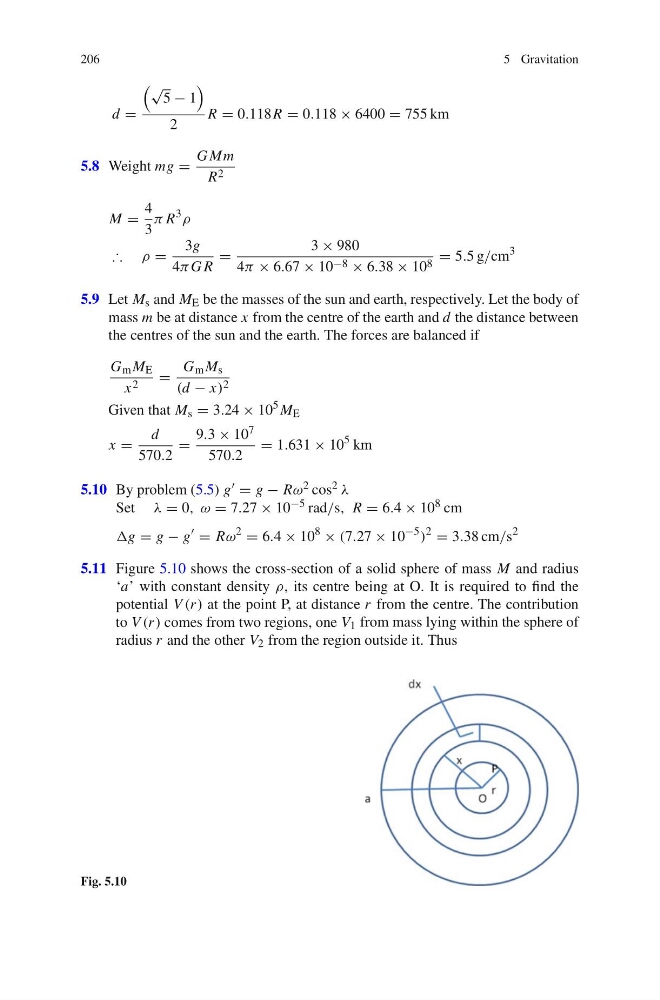
5.11 Figure 5.10 shows the cross-section of a solid sphere of mass M and radius
‘a’ with constant density ρ, its centre being at O. It is required to find the
potential V (r ) at the point P, at distance r from the centre. The contribution
to V (r ) comes from two regions, one V 1 from mass lying within the sphere of
radius r and the other V 2 from the region outside it. Thus
Fig. 5.10
5 Gravitation
d =
√
5 − 1
2
R = 0.118R = 0.118 × 6400 = 755 km
5.8 Weight mg =
G Mm
R 2
M =
4
3
π R
3
ρ
∴ ρ =
3g
4π G R
=
3 × 980
4π × 6.67 × 10 −8 × 6.38 × 10 8 = 5.5 g/cm
3
5.9 Let M s and M E be the masses of the sun and earth, respectively. Let the body of
mass m be at distance x from the centre of the earth and d the distance between
the centres of the sun and the earth. The forces are balanced if
G m M E
x 2 =
G m M s
(d − x) 2
Given that M s = 3.24 × 10
5 M E
x =
d
570.2
=
9.3 × 10 7
570.2
= 1.631 × 10
5 km
5.10 By problem (5.5) g = g − Rω 2 cos 2 λ
Set λ = 0, ω = 7.27 × 10 −5 rad/s, R = 6.4 × 10 8 cm
g = g − g
= Rω
2
= 6.4 × 10
8
× (7.27 × 10
−5
)
2
= 3.38 cm/s
2
5.11 Figure 5.10 shows the cross-section of a solid sphere of mass M and radius
‘a’ with constant density ρ, its centre being at O. It is required to find the
potential V (r ) at the point P, at distance r from the centre. The contribution
to V (r ) comes from two regions, one V 1 from mass lying within the sphere of
radius r and the other V 2 from the region outside it. Thus
Fig. 5.10