

5.2 Problems
193
1
p 2 =
1
r 2 +
1
r 4
dr
d θ
2
(5.26)
f = −
h 2
p 3
d p
dr
(5.27)
where p is the impact parameter and h is the angular momentum per unit mass.
5.2 Problems
5.2.1 Field and Potential
5.1 Calculate the gravitational force between two lead spheres of radius 10 cm in
contact with one another, G = 6.67 × 10 −11 MKS units. Density of lead =
11,300 kg/m 3 .
[University of Dublin]
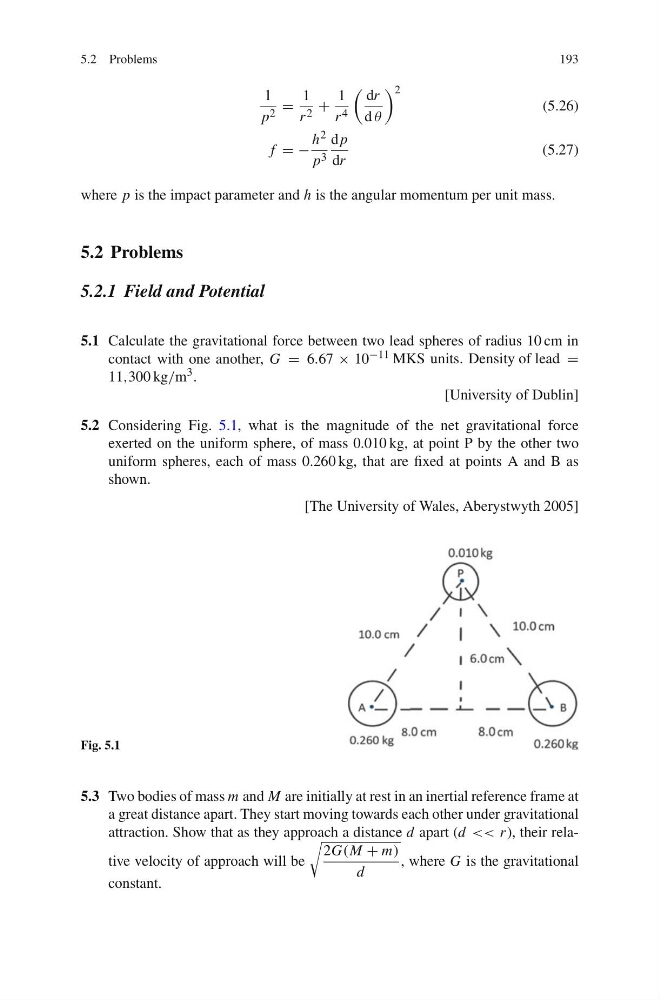
5.2 Considering Fig. 5.1, what is the magnitude of the net gravitational force
exerted on the uniform sphere, of mass 0.010 kg, at point P by the other two
uniform spheres, each of mass 0.260 kg, that are fixed at points A and B as
shown.
[The University of Wales, Aberystwyth 2005]
Fig. 5.1
5.3 Two bodies of mass m and M are initially at rest in an inertial reference frame at
a great distance apart. They start moving towards each other under gravitational
attraction. Show that as they approach a distance d apart (d << r ), their relative velocity of approach will be
2G(M + m)
d
, where G is the gravitational
constant.
193
1
p 2 =
1
r 2 +
1
r 4
dr
d θ
2
(5.26)
f = −
h 2
p 3
d p
dr
(5.27)
where p is the impact parameter and h is the angular momentum per unit mass.
5.2 Problems
5.2.1 Field and Potential
5.1 Calculate the gravitational force between two lead spheres of radius 10 cm in
contact with one another, G = 6.67 × 10 −11 MKS units. Density of lead =
11,300 kg/m 3 .
[University of Dublin]
5.2 Considering Fig. 5.1, what is the magnitude of the net gravitational force
exerted on the uniform sphere, of mass 0.010 kg, at point P by the other two
uniform spheres, each of mass 0.260 kg, that are fixed at points A and B as
shown.
[The University of Wales, Aberystwyth 2005]
Fig. 5.1
5.3 Two bodies of mass m and M are initially at rest in an inertial reference frame at
a great distance apart. They start moving towards each other under gravitational
attraction. Show that as they approach a distance d apart (d << r ), their relative velocity of approach will be
2G(M + m)
d
, where G is the gravitational
constant.