

192
5 Gravitation
Total energy:
E = −G Mm/2r
(5.19)
Elliptic Orbits
Orbital velocity
v
2
= G M
2
r
−
1
a
(5.20)
where r is the distance of the planet/satellite from the centre of parent body and a is
the semi-major axis.
The eccentricity
ε =
1 +
2E J 2
G 2 M 2 m 3
(5.21)
Total energy
E = −
G 2 M 2 m 3
2J 2 (1 − ε
2
)
(5.22)
E = −G Mm/2a
(5.23)
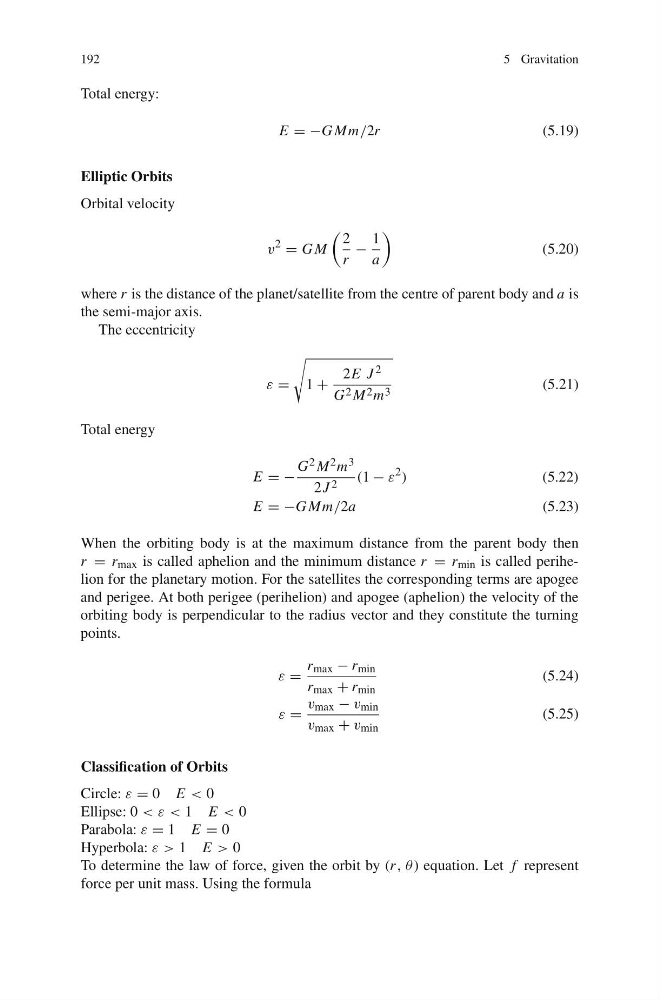
When the orbiting body is at the maximum distance from the parent body then
r = r max is called aphelion and the minimum distance r = r min is called perihelion for the planetary motion. For the satellites the corresponding terms are apogee
and perigee. At both perigee (perihelion) and apogee (aphelion) the velocity of the
orbiting body is perpendicular to the radius vector and they constitute the turning
points.
ε =
r max − r min
r max + r min
(5.24)
ε =
v max − v min
v max + v min
(5.25)
Classification of Orbits
Circle: ε = 0 E < 0
Ellipse: 0 < ε < 1 E < 0
Parabola: ε = 1 E = 0
Hyperbola: ε > 1 E > 0
To determine the law of force, given the orbit by (r , θ ) equation. Let f represent
force per unit mass. Using the formula
5 Gravitation
Total energy:
E = −G Mm/2r
(5.19)
Elliptic Orbits
Orbital velocity
v
2
= G M
2
r
−
1
a
(5.20)
where r is the distance of the planet/satellite from the centre of parent body and a is
the semi-major axis.
The eccentricity
ε =
1 +
2E J 2
G 2 M 2 m 3
(5.21)
Total energy
E = −
G 2 M 2 m 3
2J 2 (1 − ε
2
)
(5.22)
E = −G Mm/2a
(5.23)
When the orbiting body is at the maximum distance from the parent body then
r = r max is called aphelion and the minimum distance r = r min is called perihelion for the planetary motion. For the satellites the corresponding terms are apogee
and perigee. At both perigee (perihelion) and apogee (aphelion) the velocity of the
orbiting body is perpendicular to the radius vector and they constitute the turning
points.
ε =
r max − r min
r max + r min
(5.24)
ε =
v max − v min
v max + v min
(5.25)
Classification of Orbits
Circle: ε = 0 E < 0
Ellipse: 0 < ε < 1 E < 0
Parabola: ε = 1 E = 0
Hyperbola: ε > 1 E > 0
To determine the law of force, given the orbit by (r , θ ) equation. Let f represent
force per unit mass. Using the formula