

4.3 Solutions
183
ω =
5g
7(b − a)
(9)
and time period
T = 2π
7(b − a)
5g
(10)
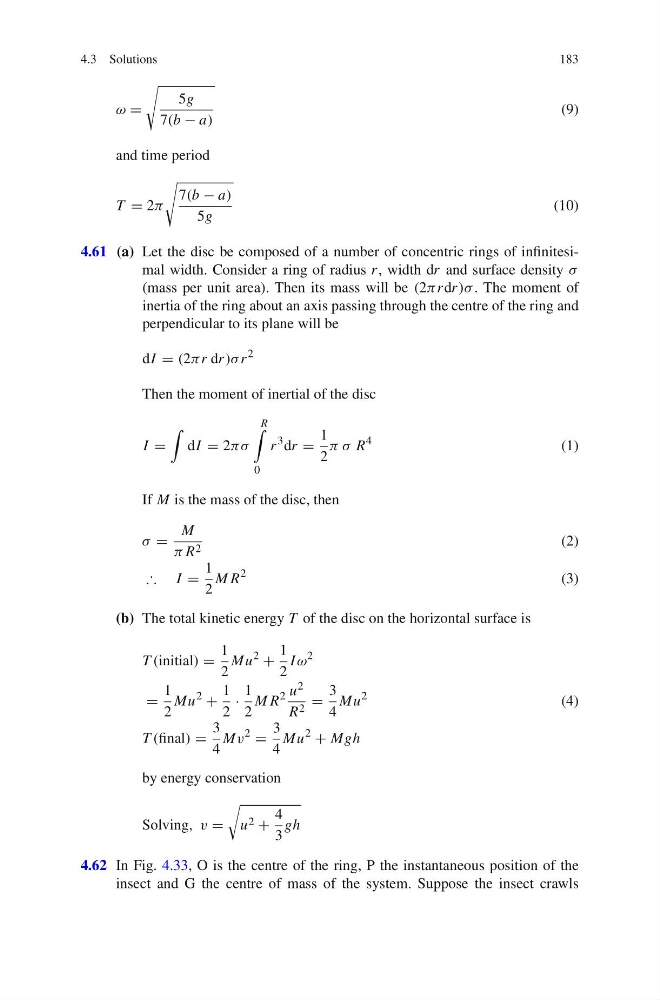
4.61 (a) Let the disc be composed of a number of concentric rings of infinitesimal width. Consider a ring of radius r , width dr and surface density σ
(mass per unit area). Then its mass will be (2πr dr )σ . The moment of
inertia of the ring about an axis passing through the centre of the ring and
perpendicular to its plane will be
dI = (2πr dr )σ r
2
Then the moment of inertial of the disc
I =
dI = 2πσ
R
0
r
3 dr =
1
2
π σ R
4
(1)
If M is the mass of the disc, then
σ =
M
π R 2
(2)
∴ I =
1
2
M R
2
(3)
(b) The total kinetic energy T of the disc on the horizontal surface is
T (initial) =
1
2
Mu
2
+
1
2
I ω
2
=
1
2
Mu
2
+
1
2
·
1
2
M R
2 u 2
R 2 =
3
4
Mu
2
(4)
T (final) =
3
4
Mv
2
=
3
4
Mu
2
+ Mgh
by energy conservation
Solving, v =
u 2 +
4
3
gh
4.62 In Fig. 4.33, O is the centre of the ring, P the instantaneous position of the
insect and G the centre of mass of the system. Suppose the insect crawls
183
ω =
5g
7(b − a)
(9)
and time period
T = 2π
7(b − a)
5g
(10)
4.61 (a) Let the disc be composed of a number of concentric rings of infinitesimal width. Consider a ring of radius r , width dr and surface density σ
(mass per unit area). Then its mass will be (2πr dr )σ . The moment of
inertia of the ring about an axis passing through the centre of the ring and
perpendicular to its plane will be
dI = (2πr dr )σ r
2
Then the moment of inertial of the disc
I =
dI = 2πσ
R
0
r
3 dr =
1
2
π σ R
4
(1)
If M is the mass of the disc, then
σ =
M
π R 2
(2)
∴ I =
1
2
M R
2
(3)
(b) The total kinetic energy T of the disc on the horizontal surface is
T (initial) =
1
2
Mu
2
+
1
2
I ω
2
=
1
2
Mu
2
+
1
2
·
1
2
M R
2 u 2
R 2 =
3
4
Mu
2
(4)
T (final) =
3
4
Mv
2
=
3
4
Mu
2
+ Mgh
by energy conservation
Solving, v =
u 2 +
4
3
gh
4.62 In Fig. 4.33, O is the centre of the ring, P the instantaneous position of the
insect and G the centre of mass of the system. Suppose the insect crawls