

174
4 Rotational Dynamics
Fig. 4.28
mg cos θ =
mv 2
R + r
(1)
Loss in potential energy = gain in kinetic energy
mg(R + r )(1 − cos θ) =
7
10
mv
2
(2)
Solving (1) and (2)
g(R + r ) =
17
10
v
2
=
17
10
ω
2 r
2
∴ ω =
10
17
g
(R + r )
r 2
and θ = cos
−1
10
17
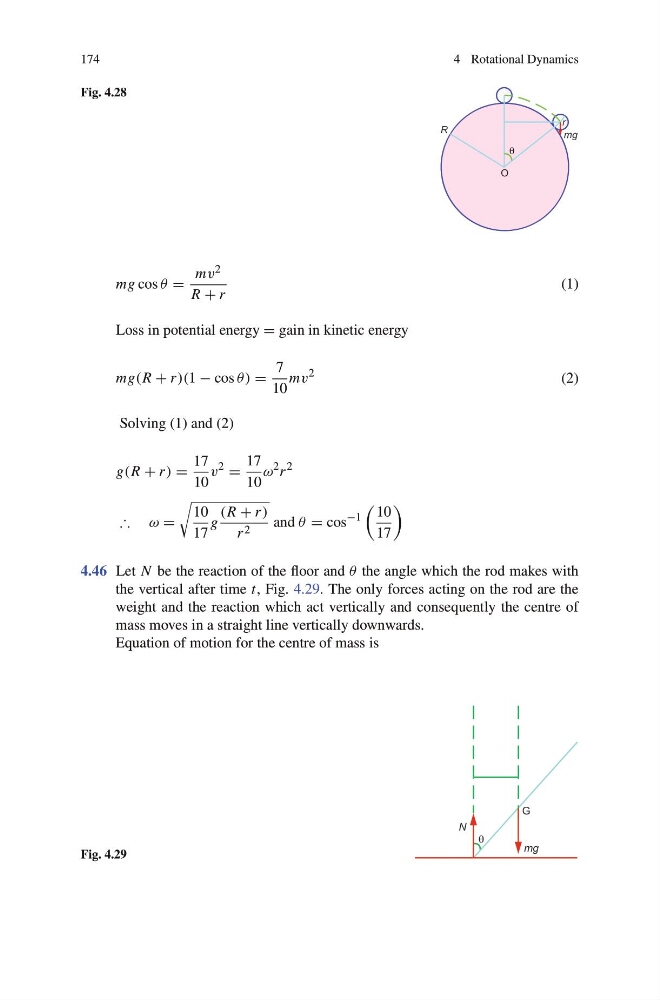
4.46 Let N be the reaction of the floor and θ the angle which the rod makes with
the vertical after time t, Fig. 4.29. The only forces acting on the rod are the
weight and the reaction which act vertically and consequently the centre of
mass moves in a straight line vertically downwards.
Equation of motion for the centre of mass is
Fig. 4.29
4 Rotational Dynamics
Fig. 4.28
mg cos θ =
mv 2
R + r
(1)
Loss in potential energy = gain in kinetic energy
mg(R + r )(1 − cos θ) =
7
10
mv
2
(2)
Solving (1) and (2)
g(R + r ) =
17
10
v
2
=
17
10
ω
2 r
2
∴ ω =
10
17
g
(R + r )
r 2
and θ = cos
−1
10
17
4.46 Let N be the reaction of the floor and θ the angle which the rod makes with
the vertical after time t, Fig. 4.29. The only forces acting on the rod are the
weight and the reaction which act vertically and consequently the centre of
mass moves in a straight line vertically downwards.
Equation of motion for the centre of mass is
Fig. 4.29