

4.3 Solutions
173
= v
2
0 − 2μgs
5
7
v 0
2
= v
2
0 − 2μgs
s =
12
49
v 2
0
μg
The assumption made is that we have either pure sliding or pure rolling.
Actually in the transition both may be present.
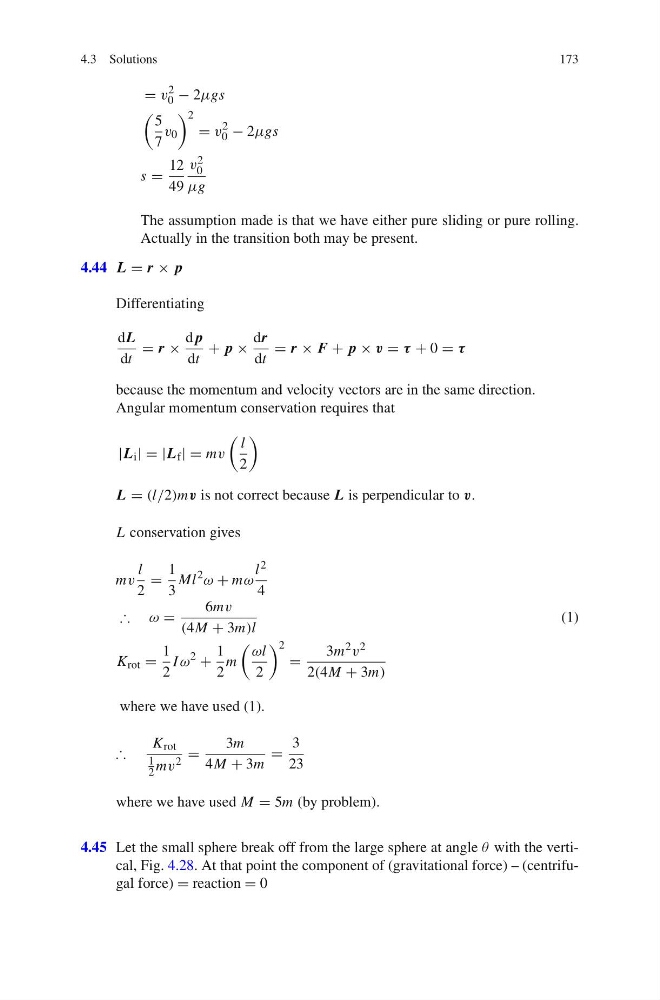
4.44 L = r × p
Differentiating
dL
dt
= r ×
d p
dt
+ p ×
dr
dt
= r × F + p × v = τ + 0 = τ
because the momentum and velocity vectors are in the same direction.
Angular momentum conservation requires that
|L i | = |L f | = mv
l
2
L = (l/2)mv is not correct because L is perpendicular to v.
L conservation gives
mv
l
2
=
1
3
Ml
2
ω + mω
l 2
4
∴ ω =
6mv
(4M + 3m)l
(1)
K rot =
1
2
I ω
2
+
1
2
m
ωl
2
2
=
3m 2 v 2
2(4M + 3m)
where we have used (1).
∴
K rot
1
2 mv 2 =
3m
4M + 3m
=
3
23
where we have used M = 5m (by problem).
4.45 Let the small sphere break off from the large sphere at angle θ with the vertical, Fig. 4.28. At that point the component of (gravitational force) – (centrifugal force) = reaction = 0
173
= v
2
0 − 2μgs
5
7
v 0
2
= v
2
0 − 2μgs
s =
12
49
v 2
0
μg
The assumption made is that we have either pure sliding or pure rolling.
Actually in the transition both may be present.
4.44 L = r × p
Differentiating
dL
dt
= r ×
d p
dt
+ p ×
dr
dt
= r × F + p × v = τ + 0 = τ
because the momentum and velocity vectors are in the same direction.
Angular momentum conservation requires that
|L i | = |L f | = mv
l
2
L = (l/2)mv is not correct because L is perpendicular to v.
L conservation gives
mv
l
2
=
1
3
Ml
2
ω + mω
l 2
4
∴ ω =
6mv
(4M + 3m)l
(1)
K rot =
1
2
I ω
2
+
1
2
m
ωl
2
2
=
3m 2 v 2
2(4M + 3m)
where we have used (1).
∴
K rot
1
2 mv 2 =
3m
4M + 3m
=
3
23
where we have used M = 5m (by problem).
4.45 Let the small sphere break off from the large sphere at angle θ with the vertical, Fig. 4.28. At that point the component of (gravitational force) – (centrifugal force) = reaction = 0