

4.3 Solutions
151
4.3 Solutions
4.3.1 Moment of Inertia
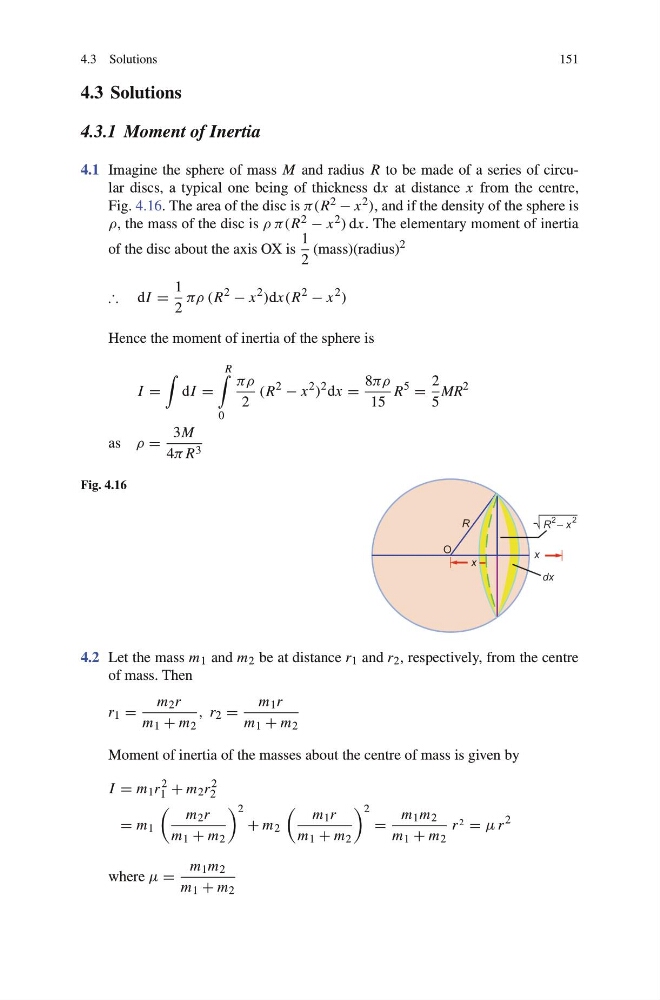
4.1 Imagine the sphere of mass M and radius R to be made of a series of circular discs, a typical one being of thickness dx at distance x from the centre,
Fig. 4.16. The area of the disc is π(R 2 − x 2 ), and if the density of the sphere is
ρ, the mass of the disc is ρ π(R 2 − x 2 ) dx. The elementary moment of inertia
of the disc about the axis OX is
1
2
(mass)(radius)
2
∴ dI =
1
2
πρ (R
2
− x
2
)dx(R
2
− x
2
)
Hence the moment of inertia of the sphere is
I =
dI =
R
0
πρ
2
(R
2
− x
2
)
2 dx =
8πρ
15
R
5
=
2
5
MR
2
as ρ =
3M
4π R 3
Fig. 4.16
4.2 Let the mass m 1 and m 2 be at distance r 1 and r 2 , respectively, from the centre
of mass. Then
r 1 =
m 2 r
m 1 + m 2
, r 2 =
m 1 r
m 1 + m 2
Moment of inertia of the masses about the centre of mass is given by
I = m 1 r
2
1 + m 2 r
2
2
= m 1
m 2 r
m 1 + m 2
2
+ m 2
m 1 r
m 1 + m 2
2
=
m 1 m 2
m 1 + m 2
r 2 = μ r
2
where μ =
m 1 m 2
m 1 + m 2
151
4.3 Solutions
4.3.1 Moment of Inertia
4.1 Imagine the sphere of mass M and radius R to be made of a series of circular discs, a typical one being of thickness dx at distance x from the centre,
Fig. 4.16. The area of the disc is π(R 2 − x 2 ), and if the density of the sphere is
ρ, the mass of the disc is ρ π(R 2 − x 2 ) dx. The elementary moment of inertia
of the disc about the axis OX is
1
2
(mass)(radius)
2
∴ dI =
1
2
πρ (R
2
− x
2
)dx(R
2
− x
2
)
Hence the moment of inertia of the sphere is
I =
dI =
R
0
πρ
2
(R
2
− x
2
)
2 dx =
8πρ
15
R
5
=
2
5
MR
2
as ρ =
3M
4π R 3
Fig. 4.16
4.2 Let the mass m 1 and m 2 be at distance r 1 and r 2 , respectively, from the centre
of mass. Then
r 1 =
m 2 r
m 1 + m 2
, r 2 =
m 1 r
m 1 + m 2
Moment of inertia of the masses about the centre of mass is given by
I = m 1 r
2
1 + m 2 r
2
2
= m 1
m 2 r
m 1 + m 2
2
+ m 2
m 1 r
m 1 + m 2
2
=
m 1 m 2
m 1 + m 2
r 2 = μ r
2
where μ =
m 1 m 2
m 1 + m 2