

4.2 Problems
145
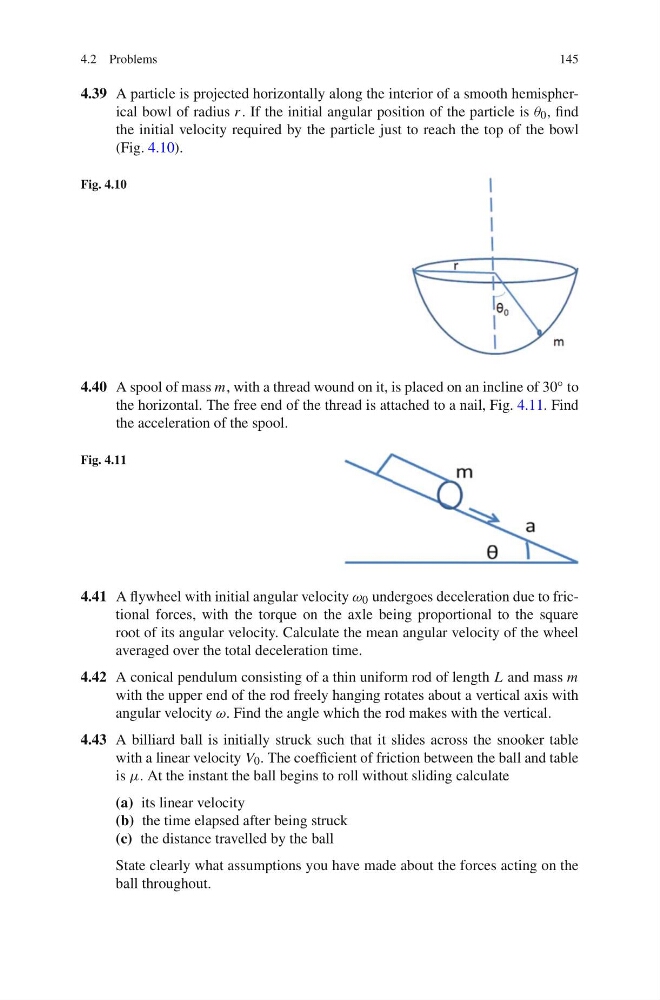
4.39 A particle is projected horizontally along the interior of a smooth hemispherical bowl of radius r . If the initial angular position of the particle is θ 0 , find
the initial velocity required by the particle just to reach the top of the bowl
(Fig. 4.10).
Fig. 4.10
4.40 A spool of mass m, with a thread wound on it, is placed on an incline of 30 ◦ to
the horizontal. The free end of the thread is attached to a nail, Fig. 4.11. Find
the acceleration of the spool.
Fig. 4.11
4.41 A flywheel with initial angular velocity ω 0 undergoes deceleration due to frictional forces, with the torque on the axle being proportional to the square
root of its angular velocity. Calculate the mean angular velocity of the wheel
averaged over the total deceleration time.
4.42 A conical pendulum consisting of a thin uniform rod of length L and mass m
with the upper end of the rod freely hanging rotates about a vertical axis with
angular velocity ω. Find the angle which the rod makes with the vertical.
4.43 A billiard ball is initially struck such that it slides across the snooker table
with a linear velocity V 0 . The coefficient of friction between the ball and table
is μ. At the instant the ball begins to roll without sliding calculate
(a) its linear velocity
(b) the time elapsed after being struck
(c) the distance travelled by the ball
State clearly what assumptions you have made about the forces acting on the
ball throughout.
145
4.39 A particle is projected horizontally along the interior of a smooth hemispherical bowl of radius r . If the initial angular position of the particle is θ 0 , find
the initial velocity required by the particle just to reach the top of the bowl
(Fig. 4.10).
Fig. 4.10
4.40 A spool of mass m, with a thread wound on it, is placed on an incline of 30 ◦ to
the horizontal. The free end of the thread is attached to a nail, Fig. 4.11. Find
the acceleration of the spool.
Fig. 4.11
4.41 A flywheel with initial angular velocity ω 0 undergoes deceleration due to frictional forces, with the torque on the axle being proportional to the square
root of its angular velocity. Calculate the mean angular velocity of the wheel
averaged over the total deceleration time.
4.42 A conical pendulum consisting of a thin uniform rod of length L and mass m
with the upper end of the rod freely hanging rotates about a vertical axis with
angular velocity ω. Find the angle which the rod makes with the vertical.
4.43 A billiard ball is initially struck such that it slides across the snooker table
with a linear velocity V 0 . The coefficient of friction between the ball and table
is μ. At the instant the ball begins to roll without sliding calculate
(a) its linear velocity
(b) the time elapsed after being struck
(c) the distance travelled by the ball
State clearly what assumptions you have made about the forces acting on the
ball throughout.