

144
4 Rotational Dynamics
Fig. 4.8
4.35 A tall pole cracks and falls over. If θ is the angle made by the pole with the
vertical, show that the radial acceleration of the top of the pole is a R =
3
2
g(1−
cos θ) and its tangential acceleration is a T =
3
2
g sin θ .
4.36 The angular momentum of a particle of a point varies with time as J = at 2 ˆ
i +
b ˆ
j, where a and b are constants. When the angle between the torque about
the point and the angular momentum is 45 ◦ , show that the magnitude of the
torque and angular momentum will be 2
√
ab and
√
2b, respectively.
4.37 A uniform disc of radius R is spun about the vertical axis and placed on a
horizontal surface. If the initial angular speed is ω and the coefficient of friction μ show that the time before which the disc comes to rest is given by
t = 3ω R/4μg.
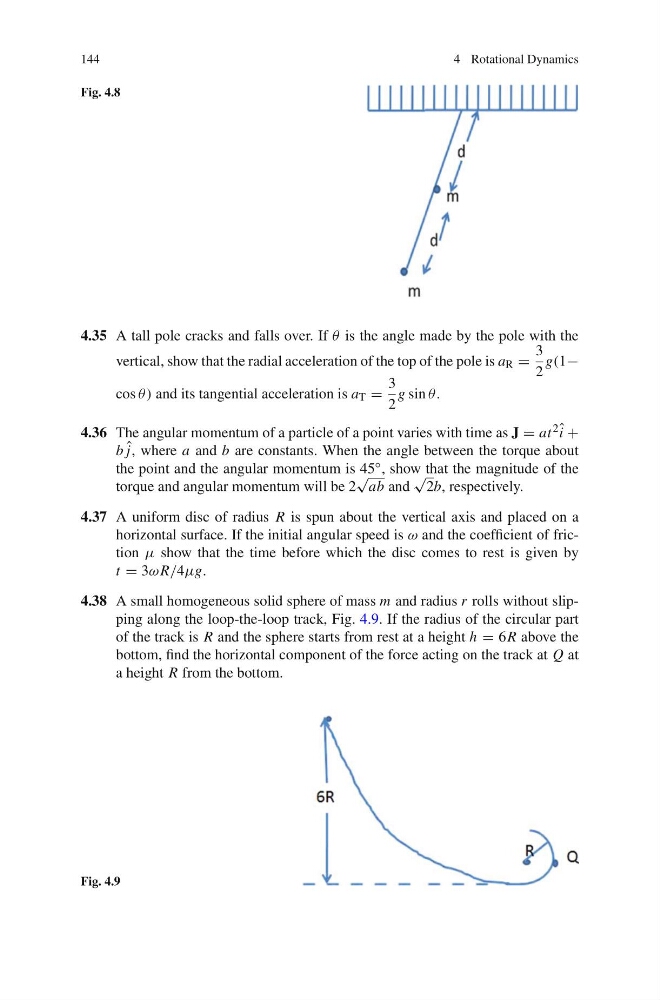
4.38 A small homogeneous solid sphere of mass m and radius r rolls without slipping along the loop-the-loop track, Fig. 4.9. If the radius of the circular part
of the track is R and the sphere starts from rest at a height h = 6R above the
bottom, find the horizontal component of the force acting on the track at Q at
a height R from the bottom.
Fig. 4.9
4 Rotational Dynamics
Fig. 4.8
4.35 A tall pole cracks and falls over. If θ is the angle made by the pole with the
vertical, show that the radial acceleration of the top of the pole is a R =
3
2
g(1−
cos θ) and its tangential acceleration is a T =
3
2
g sin θ .
4.36 The angular momentum of a particle of a point varies with time as J = at 2 ˆ
i +
b ˆ
j, where a and b are constants. When the angle between the torque about
the point and the angular momentum is 45 ◦ , show that the magnitude of the
torque and angular momentum will be 2
√
ab and
√
2b, respectively.
4.37 A uniform disc of radius R is spun about the vertical axis and placed on a
horizontal surface. If the initial angular speed is ω and the coefficient of friction μ show that the time before which the disc comes to rest is given by
t = 3ω R/4μg.
4.38 A small homogeneous solid sphere of mass m and radius r rolls without slipping along the loop-the-loop track, Fig. 4.9. If the radius of the circular part
of the track is R and the sphere starts from rest at a height h = 6R above the
bottom, find the horizontal component of the force acting on the track at Q at
a height R from the bottom.
Fig. 4.9