

4.1 Basic Concepts and Formulae
137
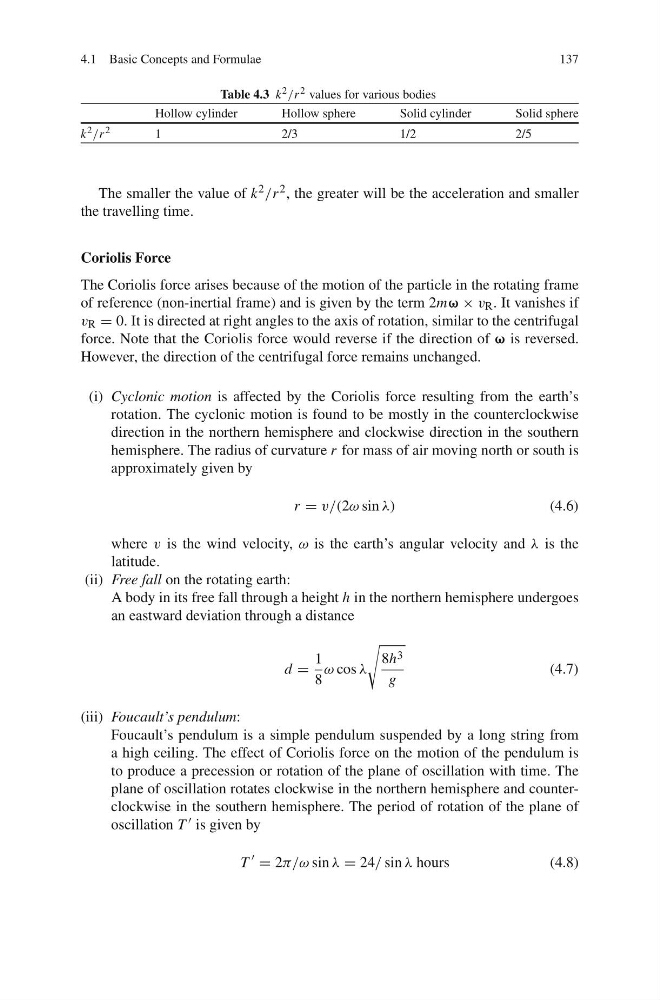
Table 4.3 k 2 /r 2 values for various bodies
Hollow cylinder
Hollow sphere
Solid cylinder
Solid sphere
k 2 /r 2
1
2 / 3
1 / 2
2 / 5
The smaller the value of k 2 /r 2 , the greater will be the acceleration and smaller
the travelling time.
Coriolis Force
The Coriolis force arises because of the motion of the particle in the rotating frame
of reference (non-inertial frame) and is given by the term 2mω × v R . It vanishes if
v R = 0. It is directed at right angles to the axis of rotation, similar to the centrifugal
force. Note that the Coriolis force would reverse if the direction of ω is reversed.
However, the direction of the centrifugal force remains unchanged.
(i) Cyclonic motion is affected by the Coriolis force resulting from the earth’s
rotation. The cyclonic motion is found to be mostly in the counterclockwise
direction in the northern hemisphere and clockwise direction in the southern
hemisphere. The radius of curvature r for mass of air moving north or south is
approximately given by
r = v/(2ω sin λ)
(4.6)
where v is the wind velocity, ω is the earth’s angular velocity and λ is the
latitude.
(ii) Free fall on the rotating earth:
A body in its free fall through a height h in the northern hemisphere undergoes
an eastward deviation through a distance
d =
1
8
ω cos λ
8h 3
g
(4.7)
(iii) Foucault’s pendulum:
Foucault’s pendulum is a simple pendulum suspended by a long string from
a high ceiling. The effect of Coriolis force on the motion of the pendulum is
to produce a precession or rotation of the plane of oscillation with time. The
plane of oscillation rotates clockwise in the northern hemisphere and counterclockwise in the southern hemisphere. The period of rotation of the plane of
oscillation T is given by
T
= 2π/ω sin λ = 24/ sin λ hours
(4.8)
137
Table 4.3 k 2 /r 2 values for various bodies
Hollow cylinder
Hollow sphere
Solid cylinder
Solid sphere
k 2 /r 2
1
2 / 3
1 / 2
2 / 5
The smaller the value of k 2 /r 2 , the greater will be the acceleration and smaller
the travelling time.
Coriolis Force
The Coriolis force arises because of the motion of the particle in the rotating frame
of reference (non-inertial frame) and is given by the term 2mω × v R . It vanishes if
v R = 0. It is directed at right angles to the axis of rotation, similar to the centrifugal
force. Note that the Coriolis force would reverse if the direction of ω is reversed.
However, the direction of the centrifugal force remains unchanged.
(i) Cyclonic motion is affected by the Coriolis force resulting from the earth’s
rotation. The cyclonic motion is found to be mostly in the counterclockwise
direction in the northern hemisphere and clockwise direction in the southern
hemisphere. The radius of curvature r for mass of air moving north or south is
approximately given by
r = v/(2ω sin λ)
(4.6)
where v is the wind velocity, ω is the earth’s angular velocity and λ is the
latitude.
(ii) Free fall on the rotating earth:
A body in its free fall through a height h in the northern hemisphere undergoes
an eastward deviation through a distance
d =
1
8
ω cos λ
8h 3
g
(4.7)
(iii) Foucault’s pendulum:
Foucault’s pendulum is a simple pendulum suspended by a long string from
a high ceiling. The effect of Coriolis force on the motion of the pendulum is
to produce a precession or rotation of the plane of oscillation with time. The
plane of oscillation rotates clockwise in the northern hemisphere and counterclockwise in the southern hemisphere. The period of rotation of the plane of
oscillation T is given by
T
= 2π/ω sin λ = 24/ sin λ hours
(4.8)