

136
4 Rotational Dynamics
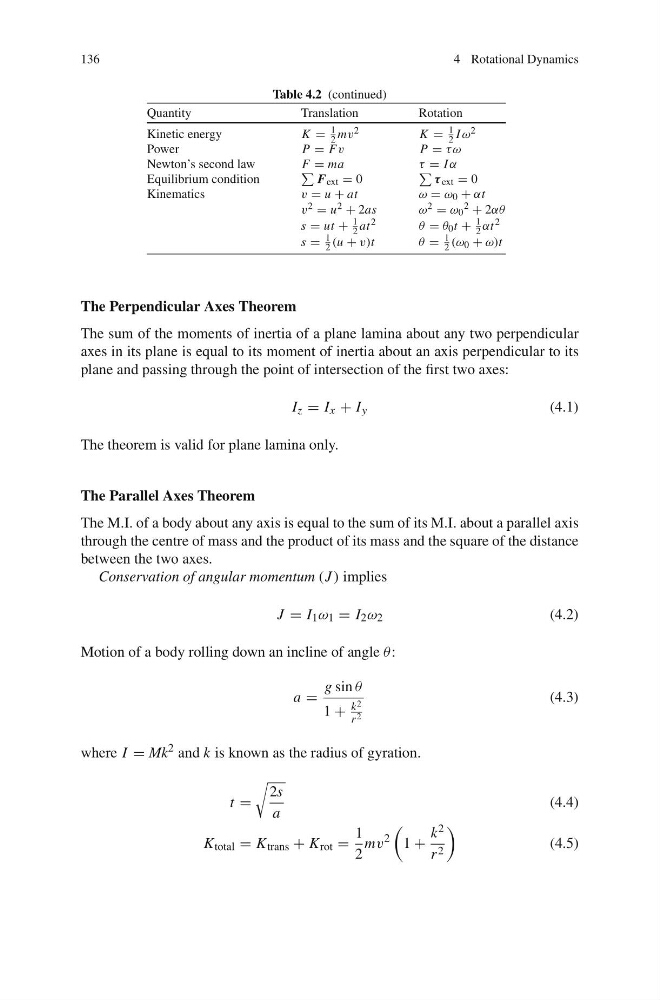
Table 4.2 (continued)
Quantity
Translation
Rotation
Kinetic energy
K =
1
2 mv 2
K =
1
2 I ω 2
Power
P = Fv
P = τ ω
Newton’s second law
F = ma
τ = I α
Equilibrium condition
F ext = 0
τ ext = 0
Kinematics
v = u + at
ω = ω 0 + αt
v 2 = u 2 + 2as
ω 2 = ω 0
2 + 2αθ
s = ut +
1
2 at 2
θ = θ 0 t +
1
2 αt 2
s =
1
2 (u + v)t
θ =
1
2 (ω 0 + ω)t
The Perpendicular Axes Theorem
The sum of the moments of inertia of a plane lamina about any two perpendicular
axes in its plane is equal to its moment of inertia about an axis perpendicular to its
plane and passing through the point of intersection of the first two axes:
I z = I x + I y
(4.1)
The theorem is valid for plane lamina only.
The Parallel Axes Theorem
The M.I. of a body about any axis is equal to the sum of its M.I. about a parallel axis
through the centre of mass and the product of its mass and the square of the distance
between the two axes.
Conservation of angular momentum (J ) implies
J = I 1 ω 1 = I 2 ω 2
(4.2)
Motion of a body rolling down an incline of angle θ :
a =
g sin θ
1 +
k 2
r 2
(4.3)
where I = Mk 2 and k is known as the radius of gyration.
t =
2s
a
(4.4)
K total = K trans + K rot =
1
2
mv
2
1 +
k 2
r 2
(4.5)
4 Rotational Dynamics
Table 4.2 (continued)
Quantity
Translation
Rotation
Kinetic energy
K =
1
2 mv 2
K =
1
2 I ω 2
Power
P = Fv
P = τ ω
Newton’s second law
F = ma
τ = I α
Equilibrium condition
F ext = 0
τ ext = 0
Kinematics
v = u + at
ω = ω 0 + αt
v 2 = u 2 + 2as
ω 2 = ω 0
2 + 2αθ
s = ut +
1
2 at 2
θ = θ 0 t +
1
2 αt 2
s =
1
2 (u + v)t
θ =
1
2 (ω 0 + ω)t
The Perpendicular Axes Theorem
The sum of the moments of inertia of a plane lamina about any two perpendicular
axes in its plane is equal to its moment of inertia about an axis perpendicular to its
plane and passing through the point of intersection of the first two axes:
I z = I x + I y
(4.1)
The theorem is valid for plane lamina only.
The Parallel Axes Theorem
The M.I. of a body about any axis is equal to the sum of its M.I. about a parallel axis
through the centre of mass and the product of its mass and the square of the distance
between the two axes.
Conservation of angular momentum (J ) implies
J = I 1 ω 1 = I 2 ω 2
(4.2)
Motion of a body rolling down an incline of angle θ :
a =
g sin θ
1 +
k 2
r 2
(4.3)
where I = Mk 2 and k is known as the radius of gyration.
t =
2s
a
(4.4)
K total = K trans + K rot =
1
2
mv
2
1 +
k 2
r 2
(4.5)