

2.3 Solutions
91
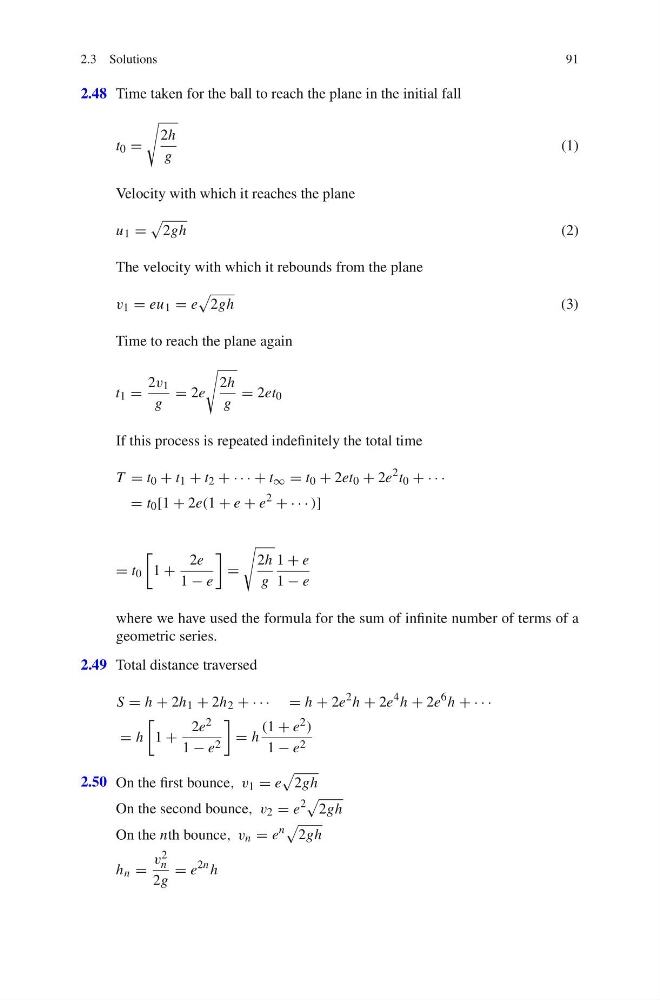
2.48 Time taken for the ball to reach the plane in the initial fall
t 0 =
2h
g
(1)
Velocity with which it reaches the plane
u 1 =
2gh
(2)
The velocity with which it rebounds from the plane
v 1 = eu 1 = e
2gh
(3)
Time to reach the plane again
t 1 =
2v 1
g
= 2e
2h
g
= 2et 0
If this process is repeated indefinitely the total time
T = t 0 + t 1 + t 2 + · · · + t ∞ = t 0 + 2et 0 + 2e
2 t 0 + · · ·
= t 0 [1 + 2e(1 + e + e
2
+ · · · )]
= t 0
1 +
2e
1 − e
=
2h
g
1 + e
1 − e
where we have used the formula for the sum of infinite number of terms of a
geometric series.
2.49 Total distance traversed
S = h + 2h 1 + 2h 2 + · · · = h + 2e
2 h + 2e
4 h + 2e
6 h + · · ·
= h
1 +
2e 2
1 − e 2
= h
(1 + e 2 )
1 − e 2
2.50 On the first bounce, v 1 = e
2gh
On the second bounce, v 2 = e
2
2gh
On the nth bounce, v n = e
n
2gh
h n =
v 2
n
2g
= e
2n h
91
2.48 Time taken for the ball to reach the plane in the initial fall
t 0 =
2h
g
(1)
Velocity with which it reaches the plane
u 1 =
2gh
(2)
The velocity with which it rebounds from the plane
v 1 = eu 1 = e
2gh
(3)
Time to reach the plane again
t 1 =
2v 1
g
= 2e
2h
g
= 2et 0
If this process is repeated indefinitely the total time
T = t 0 + t 1 + t 2 + · · · + t ∞ = t 0 + 2et 0 + 2e
2 t 0 + · · ·
= t 0 [1 + 2e(1 + e + e
2
+ · · · )]
= t 0
1 +
2e
1 − e
=
2h
g
1 + e
1 − e
where we have used the formula for the sum of infinite number of terms of a
geometric series.
2.49 Total distance traversed
S = h + 2h 1 + 2h 2 + · · · = h + 2e
2 h + 2e
4 h + 2e
6 h + · · ·
= h
1 +
2e 2
1 − e 2
= h
(1 + e 2 )
1 − e 2
2.50 On the first bounce, v 1 = e
2gh
On the second bounce, v 2 = e
2
2gh
On the nth bounce, v n = e
n
2gh
h n =
v 2
n
2g
= e
2n h