

90
2 Particle Dynamics
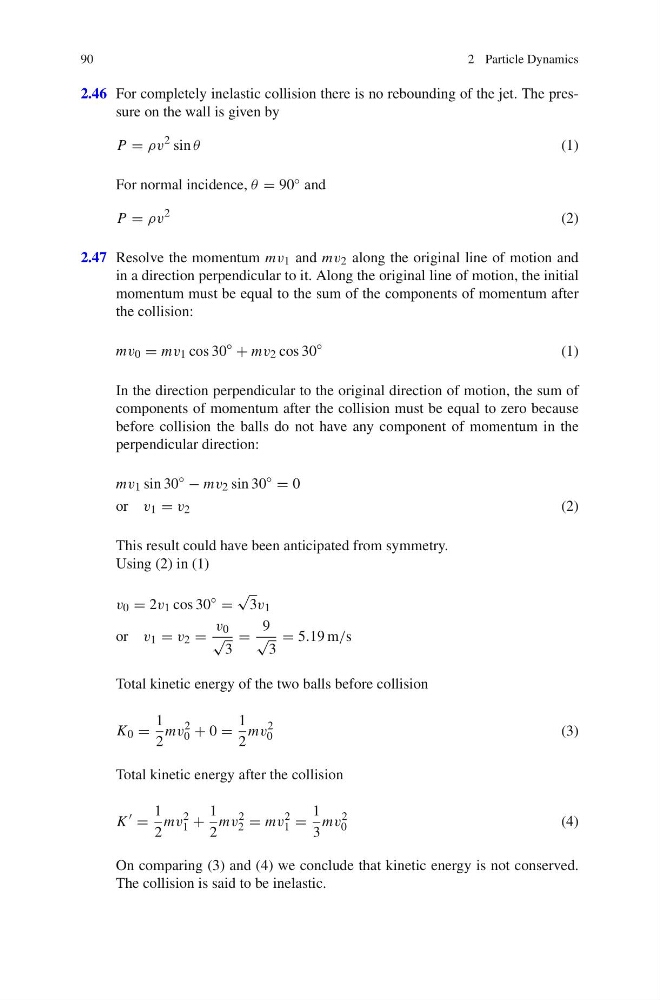
2.46 For completely inelastic collision there is no rebounding of the jet. The pressure on the wall is given by
P = ρv
2 sin θ
(1)
For normal incidence, θ = 90 ◦ and
P = ρv
2
(2)
2.47 Resolve the momentum mv 1 and mv 2 along the original line of motion and
in a direction perpendicular to it. Along the original line of motion, the initial
momentum must be equal to the sum of the components of momentum after
the collision:
mv 0 = mv 1 cos 30
◦
+ mv 2 cos 30
◦
(1)
In the direction perpendicular to the original direction of motion, the sum of
components of momentum after the collision must be equal to zero because
before collision the balls do not have any component of momentum in the
perpendicular direction:
mv 1 sin 30
◦
− mv 2 sin 30
◦
= 0
or v 1 = v 2
(2)
This result could have been anticipated from symmetry.
Using (2) in (1)
v 0 = 2v 1 cos 30
◦
=
√
3v 1
or v 1 = v 2 =
v 0
√
3
=
9
√
3
= 5.19 m/s
Total kinetic energy of the two balls before collision
K 0 =
1
2
mv
2
0 + 0 =
1
2
mv
2
0
(3)
Total kinetic energy after the collision
K
=
1
2
mv
2
1 +
1
2
mv
2
2 = mv
2
1 =
1
3
mv
2
0
(4)
On comparing (3) and (4) we conclude that kinetic energy is not conserved.
The collision is said to be inelastic.
2 Particle Dynamics
2.46 For completely inelastic collision there is no rebounding of the jet. The pressure on the wall is given by
P = ρv
2 sin θ
(1)
For normal incidence, θ = 90 ◦ and
P = ρv
2
(2)
2.47 Resolve the momentum mv 1 and mv 2 along the original line of motion and
in a direction perpendicular to it. Along the original line of motion, the initial
momentum must be equal to the sum of the components of momentum after
the collision:
mv 0 = mv 1 cos 30
◦
+ mv 2 cos 30
◦
(1)
In the direction perpendicular to the original direction of motion, the sum of
components of momentum after the collision must be equal to zero because
before collision the balls do not have any component of momentum in the
perpendicular direction:
mv 1 sin 30
◦
− mv 2 sin 30
◦
= 0
or v 1 = v 2
(2)
This result could have been anticipated from symmetry.
Using (2) in (1)
v 0 = 2v 1 cos 30
◦
=
√
3v 1
or v 1 = v 2 =
v 0
√
3
=
9
√
3
= 5.19 m/s
Total kinetic energy of the two balls before collision
K 0 =
1
2
mv
2
0 + 0 =
1
2
mv
2
0
(3)
Total kinetic energy after the collision
K
=
1
2
mv
2
1 +
1
2
mv
2
2 = mv
2
1 =
1
3
mv
2
0
(4)
On comparing (3) and (4) we conclude that kinetic energy is not conserved.
The collision is said to be inelastic.