

68
CHAPTE R 4 MOTION IN TWO AND THREE DIM ENSIONS
Average Acceleration and Instantaneous Acceleration
When a particle’s velocity changes from to in a time interval t, its average
acceleration
during t is
or
(4-15)
If we shrink ⌬t to zero about some instant, then in the limit
approaches the
instantaneous acceleration (or acceleration) at that instant; that is,
(4-16)
If the velocity changes in either magnitude or direction (or both), the particle
must have an acceleration.
We can write Eq. 4-16 in unit-vector form by substituting Eq. 4-11 for to obtain
We can rewrite this as
(4-17)
where the scalar components of are
(4-18)
To find the scalar components of , we differentiate the scalar components of .
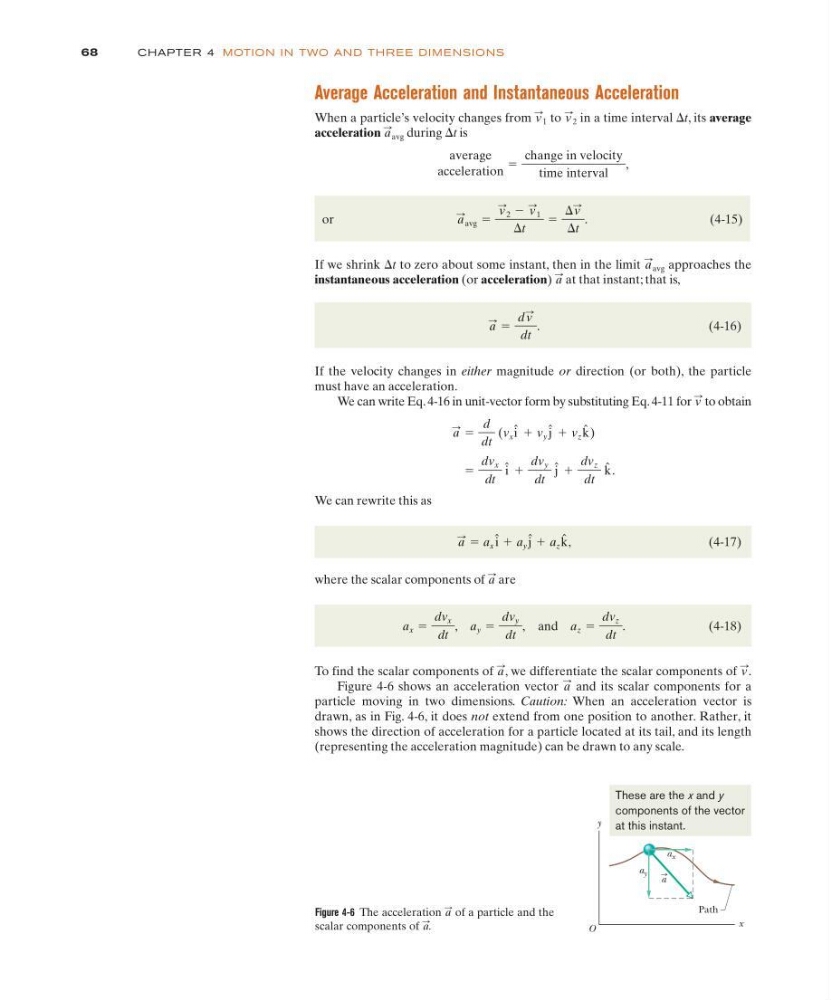
Figure 4-6 shows an acceleration vector and its scalar components for a
particle moving in two dimensions. Caution: When an acceleration vector is
drawn, as in Fig. 4-6, it does not extend from one position to another. Rather, it
shows the direction of acceleration for a particle located at its tail, and its length
(representing the acceleration magnitude) can be drawn to any scale.
a
:
v
:
a
:
a x ϭ
dv x
dt
, a y ϭ
dv y
dt
, and a z ϭ
dv z
dt
.
a
:
a
: ϭ a x i ˆ ϩ a y j ˆ ϩ a z k ˆ ,
ϭ
dv x
dt
i ˆ ϩ
dv y
dt
j ˆ ϩ
dv z
dt
k ˆ .
a
: ϭ
d
dt
(v x i ˆ ϩ v y j ˆ ϩ v z k ˆ )
v
:
a
: ϭ
dv
:
dt
.
a
:
a
:
avg
a
:
avg ϭ
v
:
2 Ϫ v
:
1
⌬t
ϭ
⌬v
:
⌬t
.
average
acceleration
ϭ
change in velocity
time interval
,
⌬
a
:
avg
⌬
v
:
2
v
:
1
O
y
x
a y
a x
Path
a
These are the x and y
components of the vector
at this instant.
Figure 4-6 The acceleration of a particle and the
scalar components of .
a
:
a
:
CHAPTE R 4 MOTION IN TWO AND THREE DIM ENSIONS
Average Acceleration and Instantaneous Acceleration
When a particle’s velocity changes from to in a time interval t, its average
acceleration
during t is
or
(4-15)
If we shrink ⌬t to zero about some instant, then in the limit
approaches the
instantaneous acceleration (or acceleration) at that instant; that is,
(4-16)
If the velocity changes in either magnitude or direction (or both), the particle
must have an acceleration.
We can write Eq. 4-16 in unit-vector form by substituting Eq. 4-11 for to obtain
We can rewrite this as
(4-17)
where the scalar components of are
(4-18)
To find the scalar components of , we differentiate the scalar components of .
Figure 4-6 shows an acceleration vector and its scalar components for a
particle moving in two dimensions. Caution: When an acceleration vector is
drawn, as in Fig. 4-6, it does not extend from one position to another. Rather, it
shows the direction of acceleration for a particle located at its tail, and its length
(representing the acceleration magnitude) can be drawn to any scale.
a
:
v
:
a
:
a x ϭ
dv x
dt
, a y ϭ
dv y
dt
, and a z ϭ
dv z
dt
.
a
:
a
: ϭ a x i ˆ ϩ a y j ˆ ϩ a z k ˆ ,
ϭ
dv x
dt
i ˆ ϩ
dv y
dt
j ˆ ϩ
dv z
dt
k ˆ .
a
: ϭ
d
dt
(v x i ˆ ϩ v y j ˆ ϩ v z k ˆ )
v
:
a
: ϭ
dv
:
dt
.
a
:
a
:
avg
a
:
avg ϭ
v
:
2 Ϫ v
:
1
⌬t
ϭ
⌬v
:
⌬t
.
average
acceleration
ϭ
change in velocity
time interval
,
⌬
a
:
avg
⌬
v
:
2
v
:
1
O
y
x
a y
a x
Path
a
These are the x and y
components of the vector
at this instant.
Figure 4-6 The acceleration of a particle and the
scalar components of .
a
:
a
: