

toward zero. (2) The direction of
(and thus of
) approaches the
direction of the line tangent to the particle’s path at position 1. (3) The average
velocity
approaches the instantaneous velocity at t 1 .
v
:
v
:
avg
v
:
avg
⌬ r
: /⌬t
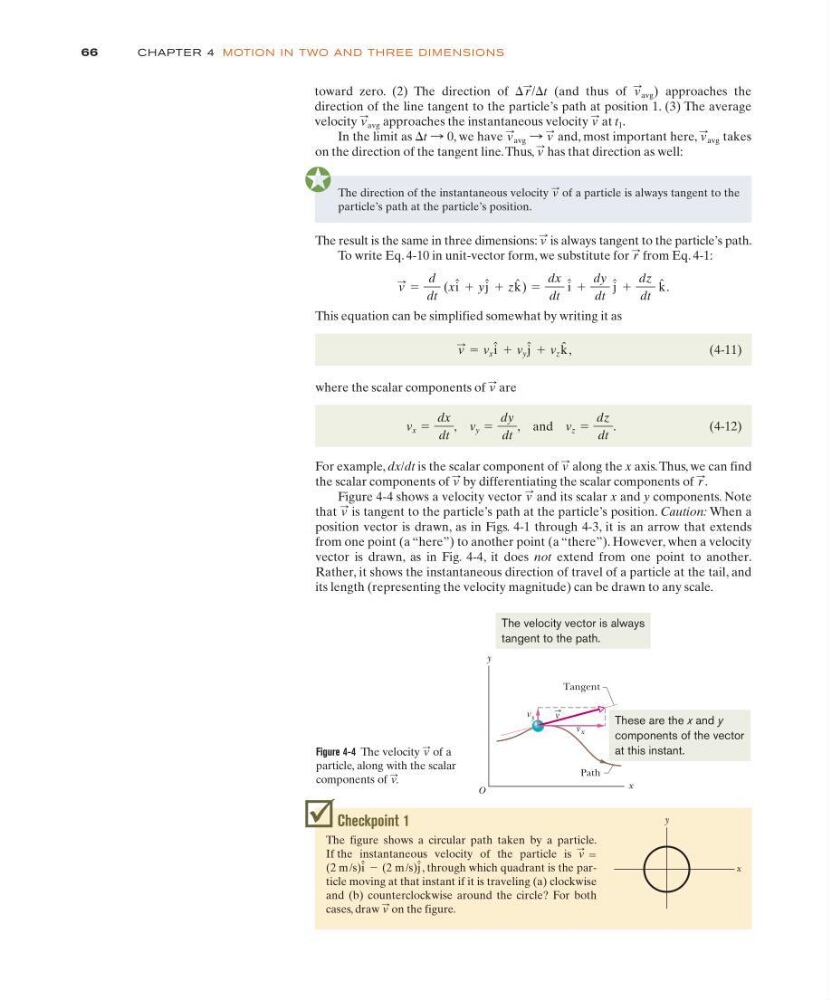
Figure 4-4 The velocity of a
particle, along with the scalar
components of .
v
:
v
:
Path
O
y
x
Tangent
v y
v x
v
The velocity vector is always
tangent to the path.
These are the x and y
components of the vector
at this instant.
Checkpoint 1
The figure shows a circular path taken by a particle.
If the instantaneous velocity of the particle is
, through which quadrant is the particle moving at that instant if it is traveling (a) clockwise
and (b) counterclockwise around the circle? For both
cases, draw on the figure.
v
:
(2 m /s)i ˆ Ϫ (2 m /s)j ˆ
v
: ϭ
y
x
66
CHAPTE R 4 MOTION IN TWO AND THREE DIM ENSIONS
The direction of the instantaneous velocity of a particle is always tangent to the
particle’s path at the particle’s position.
v
:
The result is the same in three dimensions: is always tangent to the particle’s path.
To write Eq. 4-10 in unit-vector form, we substitute for from Eq. 4-1:
This equation can be simplified somewhat by writing it as
(4-11)
where the scalar components of are
(4-12)
For example, dx/dt is the scalar component of along the x axis. Thus, we can find
the scalar components of by differentiating the scalar components of .
Figure 4-4 shows a velocity vector and its scalar x and y components. Note
that is tangent to the particle’s path at the particle’s position. Caution: When a
position vector is drawn, as in Figs. 4-1 through 4-3, it is an arrow that extends
from one point (a “here”) to another point (a “there”). However, when a velocity
vector is drawn, as in Fig. 4-4, it does not extend from one point to another.
Rather, it shows the instantaneous direction of travel of a particle at the tail, and
its length (representing the velocity magnitude) can be drawn to any scale.
v
:
v
:
r
:
v
:
v
:
v x ϭ
dx
dt
, v y ϭ
dy
dt
, and v z ϭ
dz
dt
.
v
:
v
: ϭ v x i ˆ ϩ v y j ˆ ϩ v z k ˆ ,
v
: ϭ
d
dt
(xi ˆ ϩ yj ˆ ϩ zk ˆ ) ϭ
dx
dt
i ˆ ϩ
dy
dt
j ˆ ϩ
dz
dt
k ˆ .
r
:
v
:
In the limit as
, we have
and, most important here,
takes
on the direction of the tangent line. Thus, has that direction as well:
v
:
v
:
avg
v
:
avg : v
:
⌬t : 0
(and thus of
) approaches the
direction of the line tangent to the particle’s path at position 1. (3) The average
velocity
approaches the instantaneous velocity at t 1 .
v
:
v
:
avg
v
:
avg
⌬ r
: /⌬t
Figure 4-4 The velocity of a
particle, along with the scalar
components of .
v
:
v
:
Path
O
y
x
Tangent
v y
v x
v
The velocity vector is always
tangent to the path.
These are the x and y
components of the vector
at this instant.
Checkpoint 1
The figure shows a circular path taken by a particle.
If the instantaneous velocity of the particle is
, through which quadrant is the particle moving at that instant if it is traveling (a) clockwise
and (b) counterclockwise around the circle? For both
cases, draw on the figure.
v
:
(2 m /s)i ˆ Ϫ (2 m /s)j ˆ
v
: ϭ
y
x
66
CHAPTE R 4 MOTION IN TWO AND THREE DIM ENSIONS
The direction of the instantaneous velocity of a particle is always tangent to the
particle’s path at the particle’s position.
v
:
The result is the same in three dimensions: is always tangent to the particle’s path.
To write Eq. 4-10 in unit-vector form, we substitute for from Eq. 4-1:
This equation can be simplified somewhat by writing it as
(4-11)
where the scalar components of are
(4-12)
For example, dx/dt is the scalar component of along the x axis. Thus, we can find
the scalar components of by differentiating the scalar components of .
Figure 4-4 shows a velocity vector and its scalar x and y components. Note
that is tangent to the particle’s path at the particle’s position. Caution: When a
position vector is drawn, as in Figs. 4-1 through 4-3, it is an arrow that extends
from one point (a “here”) to another point (a “there”). However, when a velocity
vector is drawn, as in Fig. 4-4, it does not extend from one point to another.
Rather, it shows the instantaneous direction of travel of a particle at the tail, and
its length (representing the velocity magnitude) can be drawn to any scale.
v
:
v
:
r
:
v
:
v
:
v x ϭ
dx
dt
, v y ϭ
dy
dt
, and v z ϭ
dz
dt
.
v
:
v
: ϭ v x i ˆ ϩ v y j ˆ ϩ v z k ˆ ,
v
: ϭ
d
dt
(xi ˆ ϩ yj ˆ ϩ zk ˆ ) ϭ
dx
dt
i ˆ ϩ
dy
dt
j ˆ ϩ
dz
dt
k ˆ .
r
:
v
:
In the limit as
, we have
and, most important here,
takes
on the direction of the tangent line. Thus, has that direction as well:
v
:
v
:
avg
v
:
avg : v
:
⌬t : 0