

4-2 AVERAGE VELOCITY AND INSTANTANEOUS VELOCITY
64
CHAPTE R 4 MOTION IN TWO AND THREE DIM ENSIONS
x (m)
0
20
40
–20
–40
–60
y (m)
20
40
60
80
(b)
25 s
20 s
15 s
10 s
5 s
t = 0 s
This is the path with
various times indicated.
x (m)
0
20
40
–20
–40
–60
y (m)
20
40
60
80
(a)
–41°
r
This is the y component.
To locate the
rabbit, this is the
x component.
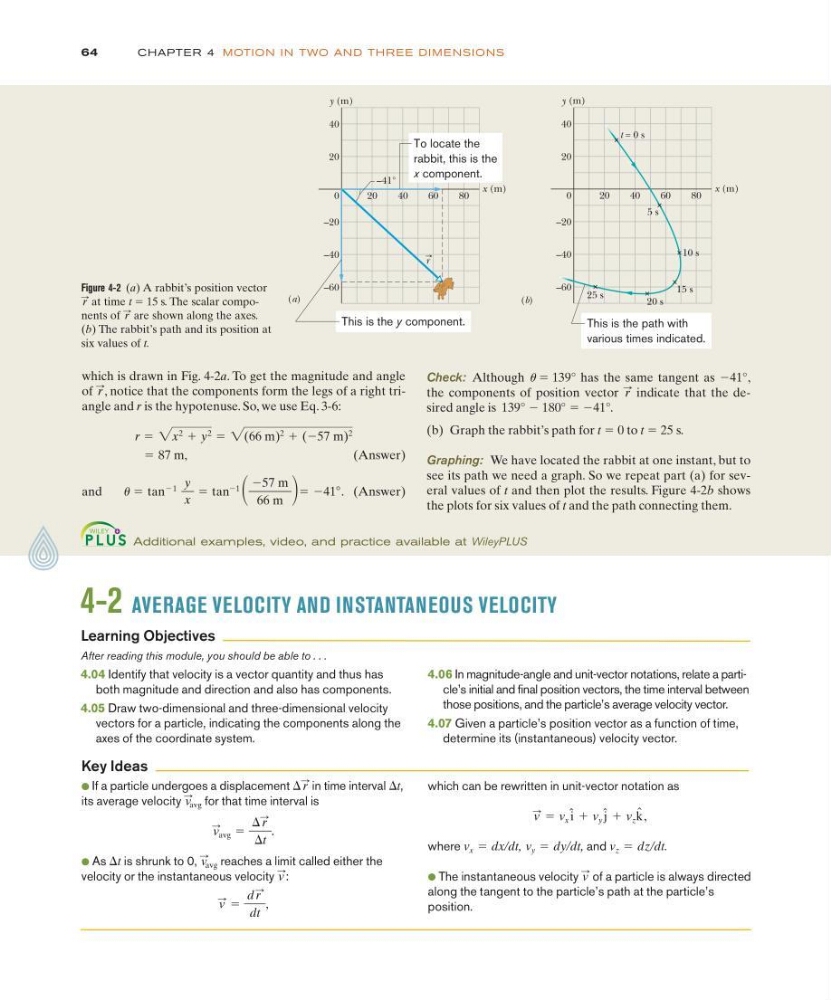
Figure 4-2 (a) A rabbit’s position vector
at time t ϭ 15 s. The scalar components of are shown along the axes.
(b) The rabbit’s path and its position at
six values of t.
r
:
r
:
Additional examples, video, and practice available at WileyPLUS
Check: Although u ϭ 139° has the same tangent as Ϫ41°,
the components of position vector indicate that the desired angle is 139° Ϫ 180° ϭ Ϫ41°.
(b) Graph the rabbit’s path for t ϭ 0 to t ϭ 25 s.
Graphing: We have located the rabbit at one instant, but to
see its path we need a graph. So we repeat part (a) for several values of t and then plot the results. Figure 4-2b shows
the plots for six values of t and the path connecting them.
r
:
which is drawn in Fig. 4-2a. To get the magnitude and angle
of , notice that the components form the legs of a right triangle and r is the hypotenuse. So, we use Eq. 3-6:
(Answer)
and
. (Answer)
ϭ tan
Ϫ1
y
x
ϭ tan
Ϫ1
Ϫ57 m
66 m ϭ Ϫ41Њ
ϭ 87 m,
r ϭ 2x
2 ϩ y
2 ϭ 2(66 m)
2 ϩ (Ϫ57 m)
2
r
:
4.06 In magnitude-angle and unit-vector notations, relate a particle’s initial and final position vectors, the time interval between
those positions, and the particle’s average velocity vector.
4.07 Given a particle’s position vector as a function of time,
determine its (instantaneous) velocity vector.
Learning Objectives
After reading this module, you should be able to . . .
4.04 Identify that velocity is a vector quantity and thus has
both magnitude and direction and also has components.
4.05 Draw two-dimensional and three-dimensional velocity
vectors for a particle, indicating the components along the
axes of the coordinate system.
which can be rewritten in unit-vector notation as
where
and
● The instantaneous velocity of a particle is always directed
along the tangent to the particle’s path at the particle’s
position.
v
:
v z ϭ dz/dt.
v x ϭ dx/dt, v y ϭ dy/dt,
v
: ϭ v x i
ˆ ϩ v y j
ˆ ϩ v z k ˆ ,
Key Ideas
● If a particle undergoes a displacement
in time interval t,
its average velocity
for that time interval is
● As t is shrunk to 0,
reaches a limit called either the
velocity or the instantaneous velocity :
v
: ϭ
d r
:
dt
,
v
:
v
:
avg
⌬
v
:
avg ϭ
⌬ r
:
⌬t
.
v
:
avg
⌬
⌬ r
:
64
CHAPTE R 4 MOTION IN TWO AND THREE DIM ENSIONS
x (m)
0
20
40
–20
–40
–60
y (m)
20
40
60
80
(b)
25 s
20 s
15 s
10 s
5 s
t = 0 s
This is the path with
various times indicated.
x (m)
0
20
40
–20
–40
–60
y (m)
20
40
60
80
(a)
–41°
r
This is the y component.
To locate the
rabbit, this is the
x component.
Figure 4-2 (a) A rabbit’s position vector
at time t ϭ 15 s. The scalar components of are shown along the axes.
(b) The rabbit’s path and its position at
six values of t.
r
:
r
:
Additional examples, video, and practice available at WileyPLUS
Check: Although u ϭ 139° has the same tangent as Ϫ41°,
the components of position vector indicate that the desired angle is 139° Ϫ 180° ϭ Ϫ41°.
(b) Graph the rabbit’s path for t ϭ 0 to t ϭ 25 s.
Graphing: We have located the rabbit at one instant, but to
see its path we need a graph. So we repeat part (a) for several values of t and then plot the results. Figure 4-2b shows
the plots for six values of t and the path connecting them.
r
:
which is drawn in Fig. 4-2a. To get the magnitude and angle
of , notice that the components form the legs of a right triangle and r is the hypotenuse. So, we use Eq. 3-6:
(Answer)
and
. (Answer)
ϭ tan
Ϫ1
y
x
ϭ tan
Ϫ1
Ϫ57 m
66 m ϭ Ϫ41Њ
ϭ 87 m,
r ϭ 2x
2 ϩ y
2 ϭ 2(66 m)
2 ϩ (Ϫ57 m)
2
r
:
4.06 In magnitude-angle and unit-vector notations, relate a particle’s initial and final position vectors, the time interval between
those positions, and the particle’s average velocity vector.
4.07 Given a particle’s position vector as a function of time,
determine its (instantaneous) velocity vector.
Learning Objectives
After reading this module, you should be able to . . .
4.04 Identify that velocity is a vector quantity and thus has
both magnitude and direction and also has components.
4.05 Draw two-dimensional and three-dimensional velocity
vectors for a particle, indicating the components along the
axes of the coordinate system.
which can be rewritten in unit-vector notation as
where
and
● The instantaneous velocity of a particle is always directed
along the tangent to the particle’s path at the particle’s
position.
v
:
v z ϭ dz/dt.
v x ϭ dx/dt, v y ϭ dy/dt,
v
: ϭ v x i
ˆ ϩ v y j
ˆ ϩ v z k ˆ ,
Key Ideas
● If a particle undergoes a displacement
in time interval t,
its average velocity
for that time interval is
● As t is shrunk to 0,
reaches a limit called either the
velocity or the instantaneous velocity :
v
: ϭ
d r
:
dt
,
v
:
v
:
avg
⌬
v
:
avg ϭ
⌬ r
:
⌬t
.
v
:
avg
⌬
⌬ r
: