

783
27-2 M ULTILOOP CIRCUITS
Resistances connected in parallel can be replaced with an equivalent resistance
R eq that has the same potential difference V and the same total current i as the
actual resistances.
You might remember that R eq and all the actual parallel resistances have the
same potential difference V with the nonsense word “par-V.”
To derive an expression for R eq in Fig. 27-10b, we first write the current in
each actual resistance in Fig. 27-10a as
where V is the potential difference between a and b. If we apply the junction rule
at point a in Fig. 27-10a and then substitute these values, we find
(27-21)
If we replaced the parallel combination with the equivalent resistance R eq
(Fig. 27-10b), we would have
(27-22)
Comparing Eqs. 27-21 and 27-22 leads to
(27-23)
Extending this result to the case of n resistances, we have
(n resistances in parallel).
(27-24)
For the case of two resistances, the equivalent resistance is their product divided
by their sum; that is,
(27-25)
Note that when two or more resistances are connected in parallel, the equivalent
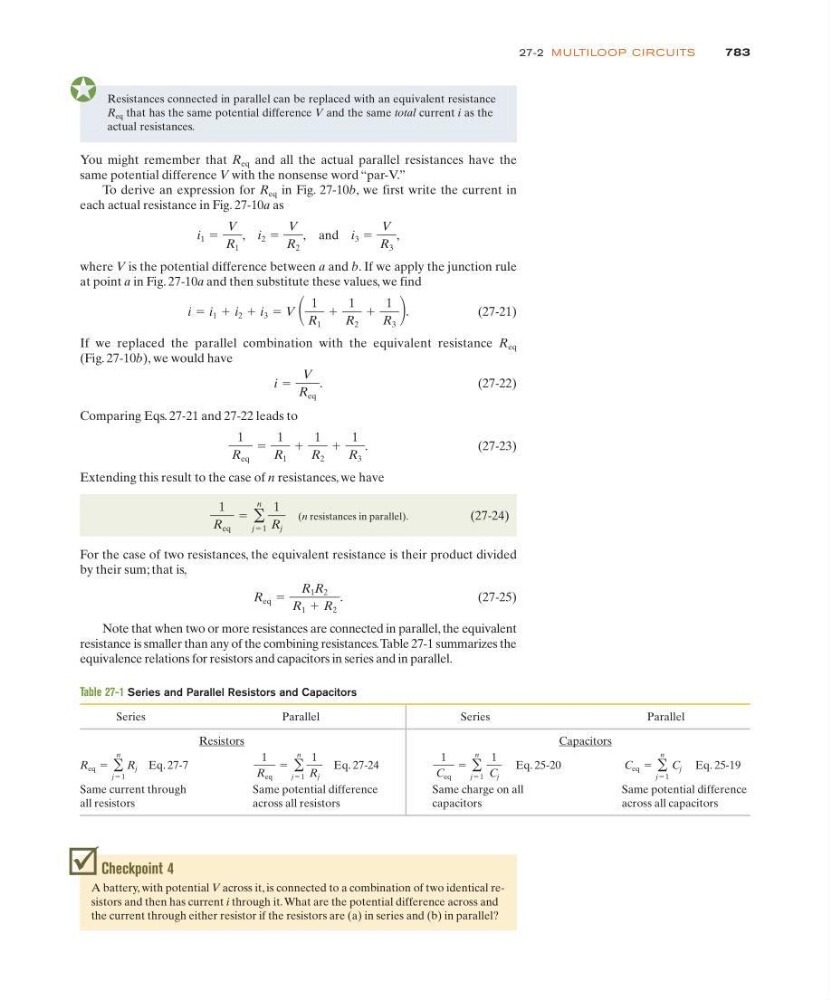
resistance is smaller than any of the combining resistances.Table 27-1 summarizes the
equivalence relations for resistors and capacitors in series and in parallel.
R eq ϭ
R 1 R 2
R 1 ϩ R 2
.
1
R eq
ϭ ͚
n
jϭ1
1
R j
1
R eq
ϭ
1
R 1
ϩ
1
R 2
ϩ
1
R 3
.
i ϭ
V
R eq
.
i ϭ i 1 ϩ i 2 ϩ i 3 ϭ V
1
R 1
ϩ
1
R 2
ϩ
1
R 3
.
i 1 ϭ
V
R 1
, i 2 ϭ
V
R 2
, and i 3 ϭ
V
R 3
,
Table 27-1 Series and Parallel Resistors and Capacitors
Series
Parallel
Series
Parallel
Resistors
Capacitors
Eq. 27-7
Eq. 27-24
Eq. 25-20
Eq. 25-19
Same current through
Same potential difference
Same charge on all
Same potential difference
all resistors
across all resistors
capacitors
across all capacitors
C eq ϭ ͚
n
jϭ1
C j
1
C eq
ϭ ͚
n
jϭ1
1
C j
1
R eq
ϭ ͚
n
jϭ1
1
R j
R eq ϭ ͚
n
jϭ1
R j
Checkpoint 4
A battery, with potential V across it, is connected to a combination of two identical resistors and then has current i through it. What are the potential difference across and
the current through either resistor if the resistors are (a) in series and (b) in parallel?